



Navigating the financial landscape of disability support systems in Canada can often feel like an exercise in bureaucratic patience. For families relying on programs like the Disability Tax Credit (DTC) and the Registered Disability Savings Plan (RDSP), the system does not always run smoothly. However, when the machinery does work as intended, the long-term impact on a beneficiary’s financial security can be profound. One Canadian parent recently shared a milestone moment after receiving their son’s 2026 Statement of Entitlement in the mail, highlighting a pivotal financial transition that occurs when a beneficiary turns 19.
The journey began two years prior, in 2024, when the family received welcome news regarding the DTC. The son’s DTC was successfully renewed for the rest of his life, providing an immense sense of relief. Maintaining a valid DTC is the foundational key that unlocks eligibility for the RDSP, federal grants, and government bonds. Without a valid DTC, the entire structure of long-term disability savings stalls. Fortunately, in this instance, the administrative process delivered a favorable outcome, laying the groundwork for future financial planning.
With the beneficiary now past the age of 19, a fundamental shift has taken place in how his RDSP grants and bonds are calculated. Up until this age milestone, contributions and subsequent government matching are typically tied to the primary caregiver’s or family’s household income. Once the beneficiary turns 19, the calculation method changes entirely. The government assesses grants and bonds based strictly on the individual’s personal income rather than parental earnings.
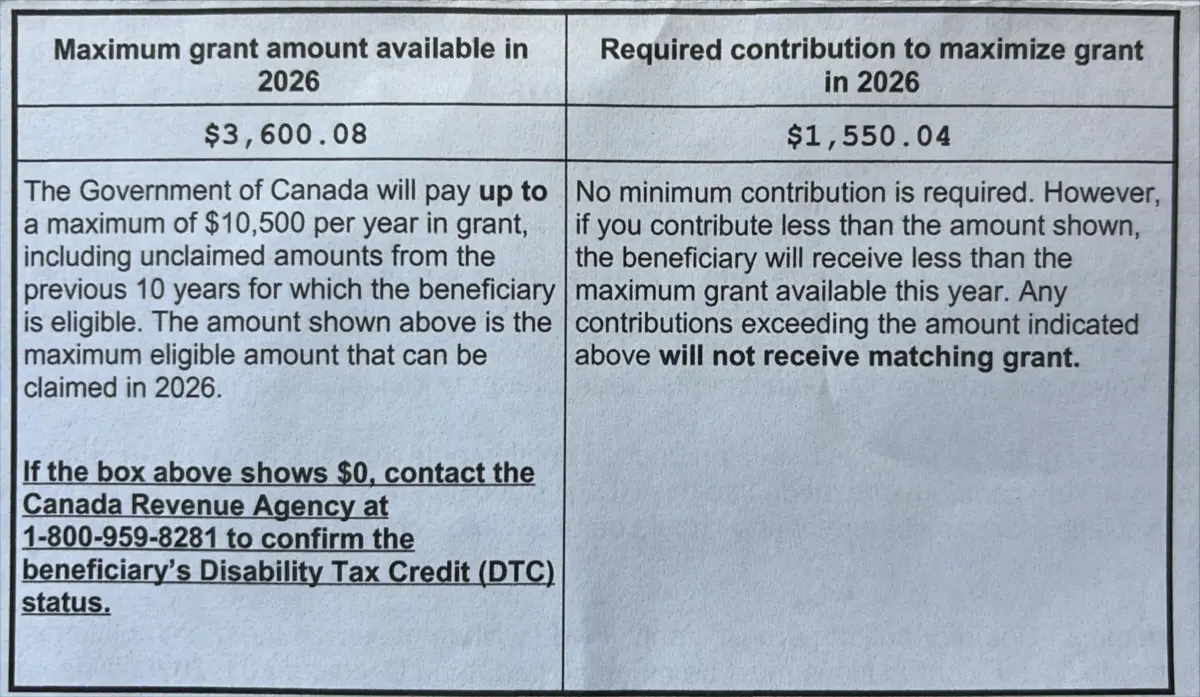
Because the beneficiary is currently a student—a path that was supported by setting up a Registered Education Savings Plan (RESP) years prior—his personal income is nearly zero. As reflected in his Grant Statement for the year, this drop in assessed income has dramatically altered the numbers in his favor. Due to this diminished personal income, he also qualified for an additional government bond this year, further boosting the potential growth of the account.
All of the funds deposited through government grants and bonds, along with the investment growth inside the RDSP, will eventually be taxed in the hands of the beneficiary when he starts drawing from the account in the future. Because his baseline personal income is expected to remain relatively modest, drawing from the account down the road is structured to be tax-efficient.
To maximize the benefits available for the current year, the account holder plans to set up an automatic monthly deposit. These contributions will add up to about $1,550 over the course of the year, which hits the maximum threshold that the federal government will match through its grant program. Under current rules, Canadians can contribute any amount of money to an RDSP at any time of the year, provided they do not exceed the lifetime maximum contribution limit of $200,000. For each eligible contribution made, the plan receives the corresponding matching government grant, scaling according to the beneficiary’s income tier.
Observers of the program emphasize that the RDSP is designed to function as a very long-term savings plan, requiring patience and steady contributions over decades to reach its full potential. While the family notes that the beneficiary will most likely not qualify for the Ontario Disability Support Program (ODSP) down the line, that factor does not diminish the immediate and long-term utility of the savings plan.

The income shift that occurs at age 19 is considered a major development for many Canadian families managing disability finances. Numerous households experience a dramatic increase in grant eligibility once the beneficiary’s income is assessed independently by the government. When that independent income is low—a common reality for students and individuals navigating significant disabilities—the government matching rate can scale up significantly, turning modest personal savings into a substantial long-term nest egg.
Financial planners often point out that the RDSP lacks the mainstream visibility of other registered accounts. It rarely trends on social media and does not receive the same widespread cultural attention as a Tax-Free Savings Account (TFSA) or a Registered Retirement Savings Plan (RRSP). Yet, experts widely regard it as one of the most generous government-supported savings vehicles available in Canada. The unique combination of matching grants and income-tested bonds can dramatically amplify modest, consistent contributions over a multi-decade timeframe.
DTC & RDSP FAQ
What happens to your RDSP if your DTC expires?
The account will no longer receive grants or bonds until the DTC is renewed. Maintaining active DTC status is a continuous requirement for ongoing government contributions.
When your DTC is renewed, how long will you receive a new statement of grant eligibility?
It can take anywhere from six to eight weeks to receive updated documentation, depending on the current workload at Employment and Social Development Canada and the Canada Revenue Agency. If no documentation arrives after eight weeks, beneficiaries or legal representatives are advised to follow up with a phone call.
My provider has locked my RDSP account so I cannot put any money in. What can the government do about that?
Federal departments cannot override financial institution restrictions in these cases. If a bank implements specific administrative policies regarding an RDSP that block deposits, account holders must work directly with their institution until the bank lifts the restriction and allows deposits to resume.
Can an RDSP be included in a bankruptcy proceeding?
No. Legislative changes implemented have specifically excluded RDSPs from all bankruptcy actions, protecting these long-term funds for the beneficiary’s future security.