




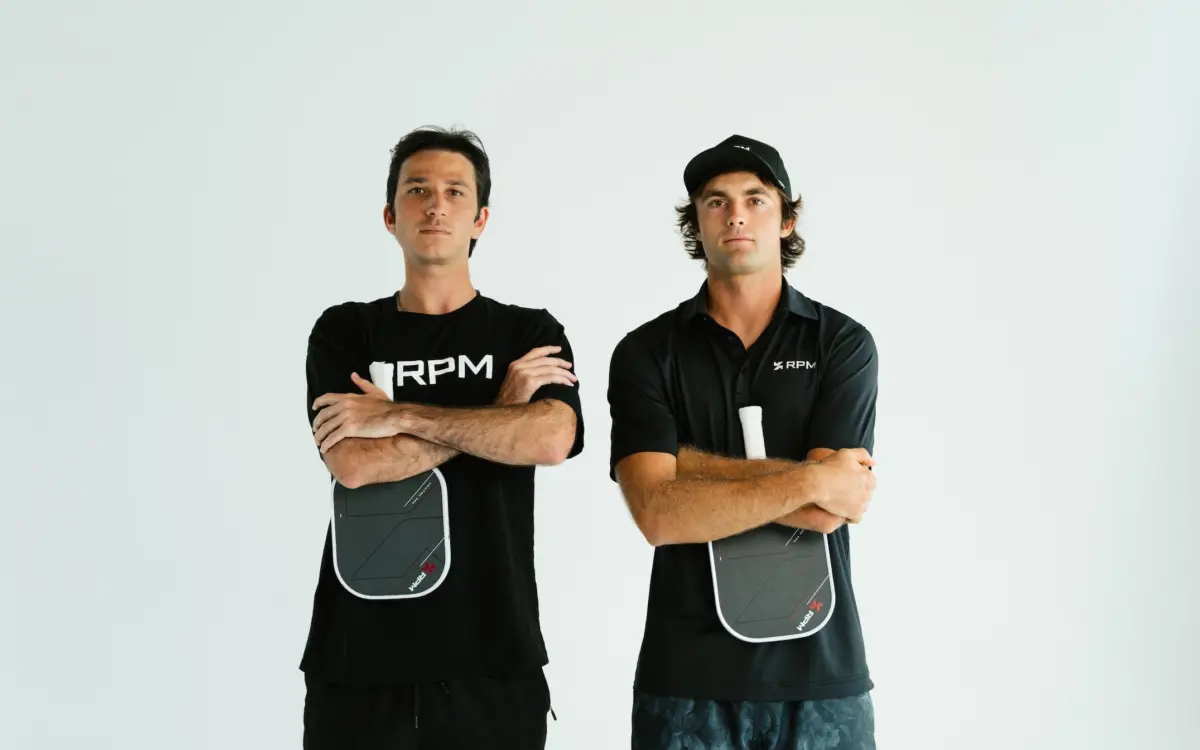
James Ignatowich was still winning plenty of matches, but he simply did not like his pickleball paddle. As a four-time Professional Pickleball Association (PPA) champion and former world No. 2 player, Ignatowich spent a significant amount of time competing at the highest levels of the sport, and his equipment was constantly on his mind. Frustrated by the performance limitations of the gear available to him, he kept calling his longtime friend Marwan Abaza to vent about his dissatisfaction.
The two men share a history that dates back more than a decade, having first crossed paths at a South Florida tennis tournament when they were approximately 12 years old. Their shared roots in competitive racquet sports forged a lasting bond. While Ignatowich ascended to the upper echelons of professional pickleball, Abaza pursued a Division 1 tennis career before turning his focus toward academics, eventually studying computational data science. Despite taking different paths through collegiate athletics and early adulthood, the childhood friends had frequently discussed the possibility of going into business together one day.
Eventually, Ignatowich’s persistent complaints about his equipment evolved into a concrete plan. He told Abaza that they needed to take matters into their own hands and fix the industry’s shortcomings themselves. Although this marked the first time either of them was launching a company, the timing and the market conditions aligned. Last September, the pair officially launched RPM Pickleball, taking a bootstrapped approach with no outside funding.
The growth that followed has been nothing short of explosive. Just one year after its inception, the pickleball paddle brand is on an annualized trajectory to reach $31 million in sales. The momentum has accelerated rapidly, with the company pulling in an impressive $4.5 million in revenue during the month prior alone. In total, RPM Pickleball has shipped more than 35,000 paddles to customers across 100 countries worldwide, transforming a casual conversation between old friends into a global sporting goods contender.
The secret to their rapid success lies in identifying a distinct market gap within one of the world’s fastest-growing sports. Prior to the emergence of performance-focused brands, the pickleball equipment landscape was largely homogenized. Beginners and seasoned professionals were frequently playing with the exact same paddles, and those products were fundamentally designed with the casual or novice player in mind.
Ignatowich and Abaza realized that traditional racquet sports operated under an entirely different economic and developmental philosophy. In tennis, major racquet manufacturers deliberately design their products for the world’s best professional players first. Everyday recreational players then purchase those exact same professional-grade racquets because they want to emulate the pros and play with the highest-tier equipment available. Applying this proven philosophy to pickleball changed the strategic equation. As Ignatowich points out, they simply decided to build a paddle that was engineered specifically for professionals from the ground up.
Translating that vision into reality required a hands-on approach to manufacturing and design. Rather than relying entirely on remote communication or standard white-label manufacturing processes, the founders spend half of every year directly on factory floors in China. There, they work meticulously to fine-tune foam densities, optimize heating times, and obsess over dozens of other small, performance-critical details that the average consumer might never notice. Along the way, their technical iterations and rigorous testing have led to the development of multiple patent-pending manufacturing technologies.
Abaza describes himself and his co-founder as "paddle connoisseurs," a designation backed by their deep backgrounds in competitive tennis and professional pickleball. Because of their firsthand expertise, the duo is able to provide factory partners with a level of detailed, granular feedback that a large, bureaucratic corporation simply cannot replicate.
However, this relentless pursuit of quality and rapid market adoption has not come without operational growing pains. The single biggest headache for the young company has been simply keeping up with consumer demand. Because the paddles resonated so strongly with players looking for professional-grade performance, RPM Pickleball was backordered for roughly half of its entire first year in business. Managing that scale with a lean, bootstrapped team meant navigating the daily challenge of communicating with an eager customer base. Ignatowich notes that they spent a significant amount of time dealing with frustrated customers who were anxiously waiting for their orders to ship.
As RPM Pickleball continues to cement its place in the booming racquet sports industry, the founders are already looking toward the horizon to identify the next big business opportunity within the sport. Ignatowich points to training tools as a wide-open sector with immense potential. While traditional sports like golf feature a massive, highly sophisticated market for training aids and developmental accessories, pickleball currently lacks high-quality options in that category. Drawing on his elite-level experience and entrepreneurial drive, Ignatowich is already exploring the possibility of launching a new venture in the training tools space to address that unmet need.