




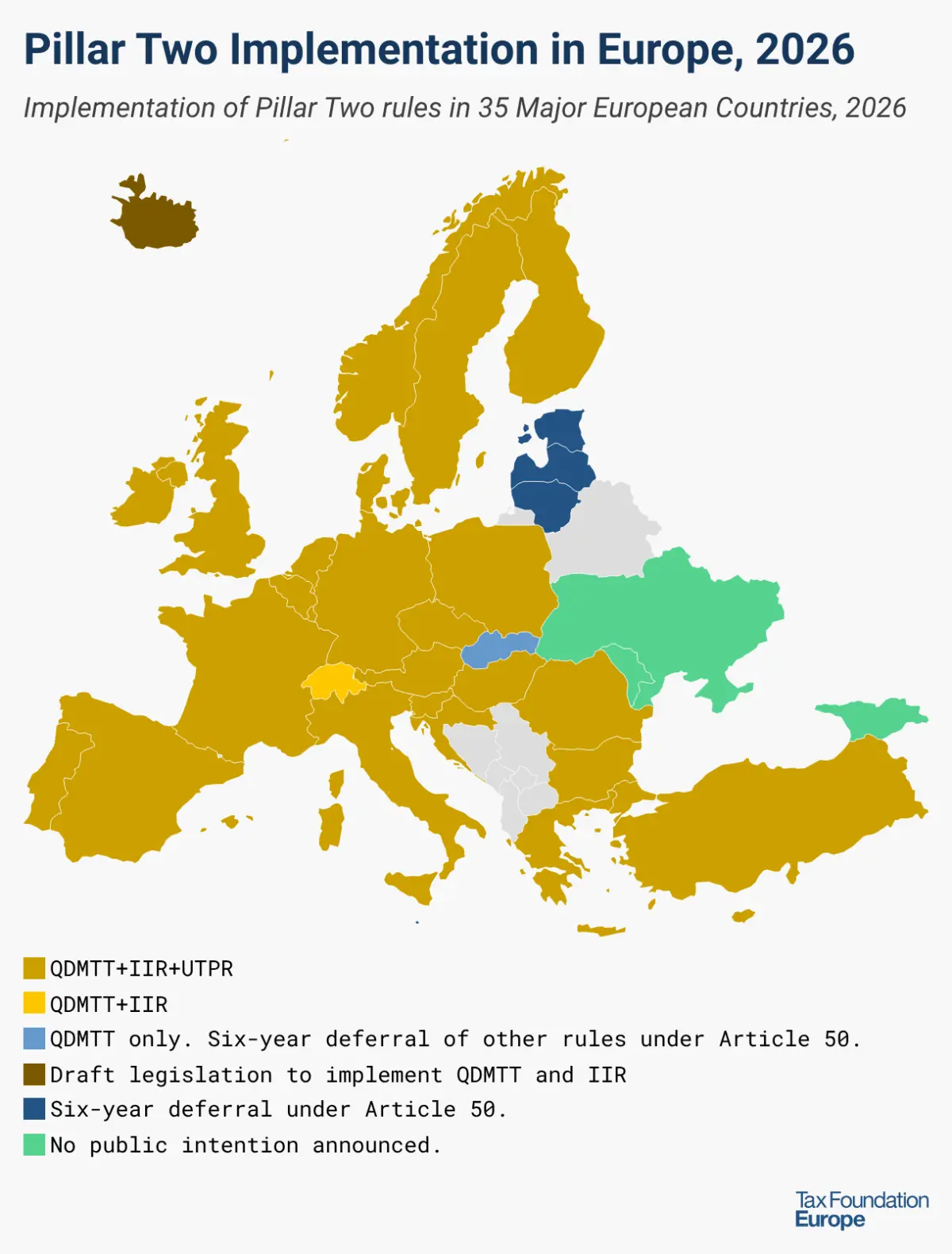
Years of intense international debate and complex negotiations over the architecture of the global tax system have culminated in a fragmented landscape of implementation, sharply dividing major economies and fundamentally altering how multinational corporations are taxed. Following landmark agreements brokered by the Organisation for Economic Co-operation and Development (OECD) in October 2021, more than 130 member jurisdictions signed on to an ambitious framework designed to rewrite international tax rules and curb base erosion and profit shifting. Central to this historic agreement is Pillar Two, which introduces a global minimum tax carrying an effective rate of 15 percent. According to estimates by the OECD, this sweeping reform is projected to generate between $91 billion and $155 billion in additional global tax revenues annually, representing roughly 6.5 to 8.1 percent of total global corporate income tax revenues.
The mechanics of Pillar Two rely on three primary rules designed to work in tandem to establish a minimum tax floor both on companies investing abroad and on foreign companies operating domestically. The first of these mechanisms is the qualified domestic minimum top-up tax, commonly known as the QDMTT. This rule grants countries the primary right to claim tax revenues on profits generated within their borders that would otherwise be taxed below the 15 percent minimum effective rate. The second mechanism is the income inclusion rule, or IIR, which dictates when the foreign income of a subsidiary must be incorporated into the taxable income of the ultimate parent company. Under the IIR, if a multinational corporation’s effective tax rate in a foreign jurisdiction falls below the 15 percent threshold, additional top-up taxes are assessed and owed directly in the home jurisdiction of the parent company.
The third and final pillar rule is the undertaxed profits rule, or UTPR, which functions as a backstop. The UTPR permits a country to apply additional taxes to a corporate entity if a related group company operating in another jurisdiction is being taxed below the 15 percent effective rate and has not been subjected to a top-up tax elsewhere. To prevent double taxation or overlapping claims when multiple nations apply similar top-up mechanisms, the taxable profit under the UTPR is divided among implementing jurisdictions based on a formula tied to the local presence of tangible assets and employees. Together, the domestic minimum tax, the income inclusion rule, and the undertaxed profits rule establish a comprehensive multilateral framework tied firmly to the minimum effective rate of at least 15 percent across every jurisdiction in which a multinational group operates.
Translating these complex international agreements into domestic law has proven to be a monumental challenge, particularly within the European Union. The European Union advanced the Pillar Two framework through a binding EU Directive that mandated member states with more than 12 in-scope multinational corporate groups to implement the income inclusion rule starting December 31, 2023, and the undertaxed profits rule starting December 31, 2024. However, the directive also included a special provision under Article 50, allowing smaller member states with no more than 12 in-scope multinational groups to elect a six-year deferral of both rules to ease administrative and economic burdens.
As the implementation timeline progresses toward the middle of the decade, the European bloc remains divided. Twenty-two of the 27 European Union member states successfully implemented a combination of the qualified domestic minimum top-up tax, the income inclusion rule, and the undertaxed profits rule, while five member states have chosen a different path. Capitalizing on the provisions of Article 50, all five eligible EU member states opted for the permitted six-year deferral. Estonia, Latvia, Lithuania, and Malta elected to defer the implementation of the core Pillar Two rules entirely until 2029, while Slovakia chose a selective approach, implementing only a domestic top-up tax in 2024 while holding off on the broader international rules.
The long-term implications of these rules for certain European economies are profound. By the year 2030, full implementation of the Pillar Two Directive threatens to compromise key structural design features inherent to the distribution-based corporate tax systems historically favored by Estonia and Latvia. Because these countries traditionally tax corporate profits only when earnings are distributed rather than when they are earned, the rigid mandates of Pillar Two will compel in-scope multinational companies to distribute sufficient earnings simply to satisfy the 15 percent minimum effective tax rate, effectively forcing a structural shift in how their corporate tax environments operate.
Furthermore, implementation timelines have sparked friction between Brussels and national capitals. Four EU member states—Cyprus, Poland, Portugal, and Spain—failed to meet the initial regulatory deadlines mandated by the EU Directive, prompting legal action from the European Commission. Despite being sued by the EU for failing to implement the corporate tax rules on time, these four countries have since moved forward, applying the Pillar Two provisions retroactively for the 2024 tax year to achieve compliance.
Outside the formal borders of the European Union, the adoption of Pillar Two among major European neighbors is similarly uneven. Among eight major European economies outside the EU, only Norway, Turkey, and the United Kingdom managed to implement a comprehensive suite comprising the QDMTT, the IIR, and the UTPR by 2025. Other nations have adopted a staggered or partial approach. Switzerland introduced a qualified domestic minimum top-up tax in 2024 followed by the income inclusion rule in 2025, but Bern has refrained from advancing any plans to implement the undertaxed profits rule. Iceland has similarly initiated public consultations with the goal of implementing a QDMTT and an IIR by 2026, though officials have made no official statements regarding the adoption of the UTPR. Meanwhile, Georgia, Moldova, and Ukraine—the latest official candidates for European Union accession—have not yet publicly announced any formal intentions to implement the Pillar Two framework.
In stark contrast to the widespread adoption seen across Europe, the United States has chosen a fundamentally different path, declining to implement changes that align directly with the international global tax deal. This divergence crystallized in June 2025, when the G7 announced a political agreement on a global minimum tax "side-by-side" solution. This arrangement effectively carves out and excludes United States-parented corporate groups from the reach of Pillar Two’s income inclusion rule and undertaxed profits rule, shielding American multinationals from direct foreign taxation under those specific mechanisms.
Instead of adopting the OECD framework, the United States has continued to independently refine and develop its own complex cross-border tax framework. Recent legislative adjustments to US international tax rules, enacted through the One Big Beautiful Bill Act, produce economic and tax outcomes remarkably similar to those of Pillar Two, even though the underlying legal structures remain entirely distinct. The newly introduced net CFC tested income functions as a minimum tax ranging between 12.6 and 14 percent on all foreign income generated by US companies, utilizing a blended global formula rather than the strict country-by-country calculations mandated by the OECD.
Policy analysts note that due to less generous foreign tax crediting rules, the removal of traditional substance-based income exclusions, the absence of comprehensive loss carryovers, and stricter interest deductibility limitations, the domestic United States tax system may ultimately prove to be significantly more stringent for American corporations than the international Pillar Two standard. As these divergent systems take root across the globe, multinational enterprises find themselves navigating an increasingly complex and multifaceted international tax environment where jurisdictional compliance requires balancing competing global mandates.