



Higher tax rates consistently incentivize tax avoidance, a foundational economic reality that continues to drive a lucrative criminal enterprise across the United States. As state and national lawmakers increase levies on tobacco products, consumers and suppliers actively search for ways around these added costs. In the nation’s cigarette markets, ordinary consumers frequently travel across state lines to shop where tax rates are lower, while illicit dealers develop sophisticated black and gray markets to sell illegal products directly to buyers, paying little or no tax at all. Growing cigarette tax levels and widening differentials between neighboring jurisdictions have transformed cigarette smuggling from a localized issue into a massive national problem and a highly lucrative criminal business.
Each year, in partnership with academic scholars at the Mackinac Center for Public Policy, researchers estimate cigarette smuggling rates for each of the continental United States. The most recent comprehensive report relies on baseline data gathered through 2024. Continuing a long-running trend documented in previous years, the new data reveals a strong, undeniable positive relationship between high cigarette smuggling rates and elevated tax rates across the country.
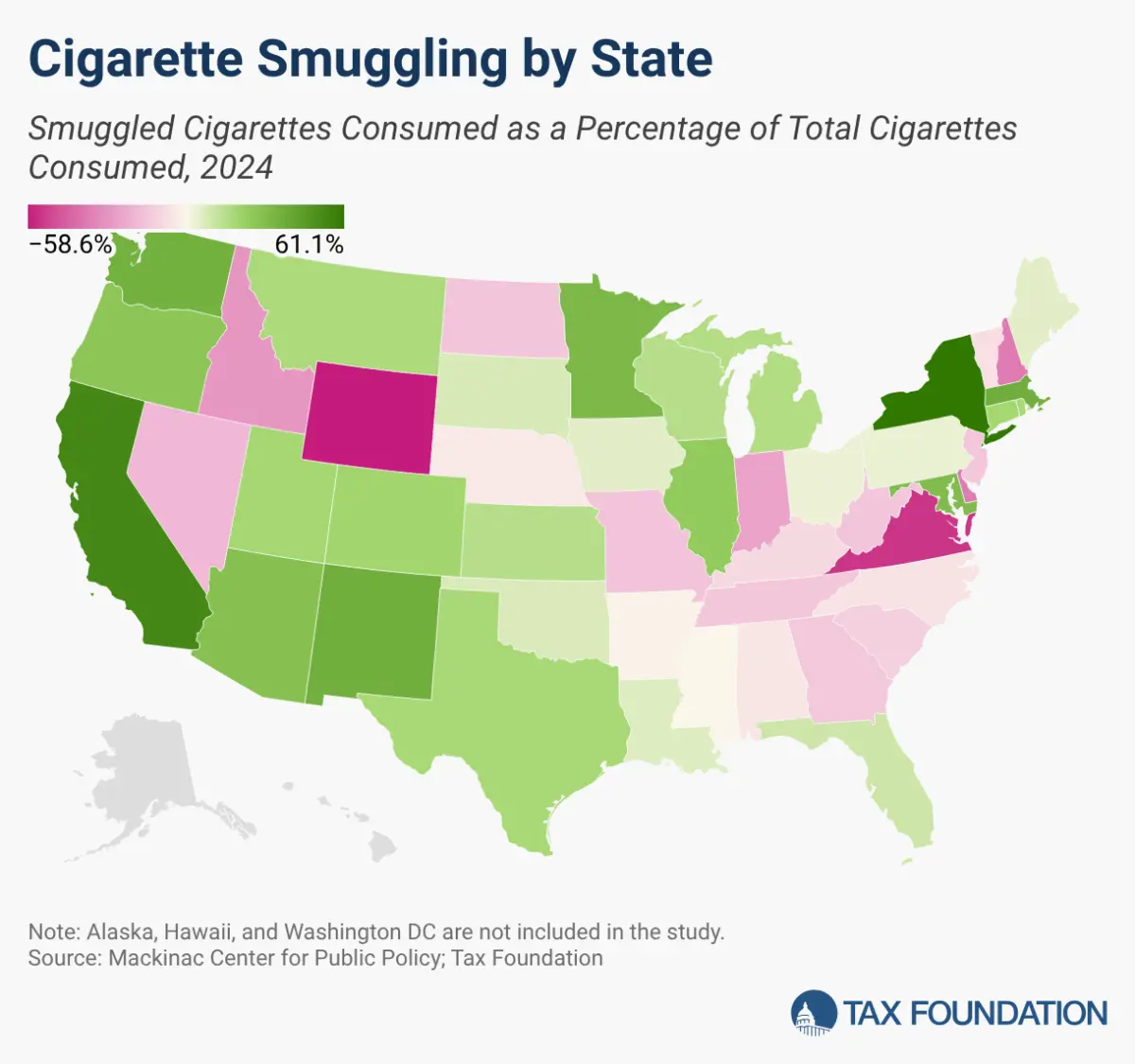
New York has retook its usual status as the nationwide leader in cigarette smuggling after being briefly surpassed by California in the previous year’s rankings. A staggering majority of all cigarettes consumed in New York—an estimated 61.1 percent—were not purchased legally within the state boundaries. California closely followed New York, registering an estimated smuggling rate of 54.4 percent of total consumption.
On the opposite end of the spectrum, net outbound smuggling rates, where cigarettes are legally purchased within a state and subsequently consumed elsewhere, were highest in Wyoming at 58.6 percent and Virginia at 54.4 percent. States like Wyoming and Virginia find themselves exceptionally well-positioned to accept cross-border shoppers looking to avoid higher taxes in neighboring states and high-tax municipal areas such as Colorado, Washington, and the District of Columbia.
Cigarette smuggling remains exceptionally costly for state budgets across the nation. Researchers estimate that the total foregone tax revenue resulting from smuggled cigarettes surpassed $4.6 billion in 2024 alone. California lost nearly $1.4 billion in cigarette excise tax collections, while New York missed out on more than $1.2 billion in vital state revenue.
Conversely, a handful of states benefit financially from regional purchasing dynamics. Virginia emerged as the largest beneficiary of smuggling-related cigarette tax revenue, netting the state more than $61 million. Indiana followed as the second largest beneficiary, with net smuggling generating nearly $57 million for the Hoosier State.
The underlying economics remain straightforward. There is a strong positive relationship between cigarette smuggling and cigarette tax rates nationwide. Furthermore, the empirical data demonstrates that whenever states increase their cigarette taxes, their smuggling rates inevitably increase as well—as evidenced by New York’s sharp rise this year. This evasion occurs both through routine cross-border purchasing trips to neighboring low-tax states and via illicit international trafficking channels.
Flavor Bans and Regulatory Overreach Compound the Illicit Market
While cigarette smuggling clearly correlates with high cigarette taxes, researchers point out that it also correlates heavily with excessive and restrictive regulations. Specifically, states that have implemented outright menthol and flavored tobacco bans, such as California and Massachusetts, also tend to record particularly high rates of smuggling as consumers aggressively shop across borders to bypass the bans.
Previous analyses detailed the direct impact that Massachusetts’s flavor ban had on the state’s tobacco tax revenue and local smuggling activity. Similarly, California’s flavor ban continues to cost the state hundreds of millions of dollars annually, exactly as policy experts previously predicted, while overall smoking behavior within the state has remained largely unchanged. Instead of reducing consumption, the sudden void in legal retail sales has simply been filled entirely by illicit products.
Evidence gathered from flavor bans in states like Massachusetts and California indicates a historical parallel to the alcohol prohibition era of the 1920s: consumers can and will acquire prohibited products if demand persists. While overall consumption levels remain steady, restrictive policies push everyday consumers directly into unregulated illicit markets. These shadow markets frequently feature dangerous, substandard products while simultaneously funding sophisticated, organized criminal enterprises that supply the demand. Flavor bans, nicotine restrictions, or effective de facto bans resulting from regulatory inaction by agencies like the Food and Drug Administration all place heavy burdens on ordinary consumers, domestic legal businesses, and state governments that lose critical tax revenue while facing ballooning enforcement costs.
International Counterfeiting Networks and Public Safety Risks
Although some individual states may benefit marginally from regional cross-border trade, no state benefits from the sprawling illicit market of smuggled and counterfeit cigarettes. A significant portion of these illicit cigarettes are smuggled directly from international manufacturing hubs, notably China, where an estimated 400 billion counterfeit cigarettes are produced annually.
Counterfeit cigarettes introduce severe public safety hazards because they are entirely unregulated, often containing toxic heavy metals and other dangerous chemical contaminants. Furthermore, law enforcement and intelligence agencies have linked the billions of dollars moving through the international cigarette smuggling underworld to broader criminal syndicates and terrorist financing networks.
State and federal enforcement agencies bear substantial burdens as they attempt—and largely fail—to combat these large-scale, transnational smuggling operations. Dedicated anti-smuggling task forces in various states routinely seize contraband cigarettes worth hundreds of thousands of dollars. However, these notable law enforcement seizures typically represent only a minuscule fraction of the overall shadow market. For example, a recent high-profile arrest and major seizure of approximately 43,700 packs of contraband cigarettes by a multi-agency police investigation in New York accounted for a mere 0.019 percent of the estimated annual smuggling activity within the state.
Similar illicit markets driven by tax avoidance and heavy regulatory restrictions are also becoming an increasingly prominent issue within the rapidly growing vaping market. Lawmakers have an opportunity to learn valuable historical lessons from decades of cigarette taxation and prohibition and apply them thoughtfully to vaping regulation. Unfortunately, state and federal policymakers frequently fall into the exact same policy pitfalls that ultimately harm public revenues, damage legitimate legal businesses, and fail consumers.
Legal markets inevitably suffer when untaxed, unregulated products receive massive competitive advantages driven by punitive tax rates and outright prohibitions. These thriving illicit markets create profound new dangers for consumer health, place undue burdens on public health infrastructure, and undermine both legitimate domestic enterprises and state revenue generation.
As lawmakers continue to debate legislative priorities, policymakers should carefully consider these unintended, yet entirely foreseeable, consequences when determining tax rates and regulatory frameworks for tobacco and nicotine products moving forward.