


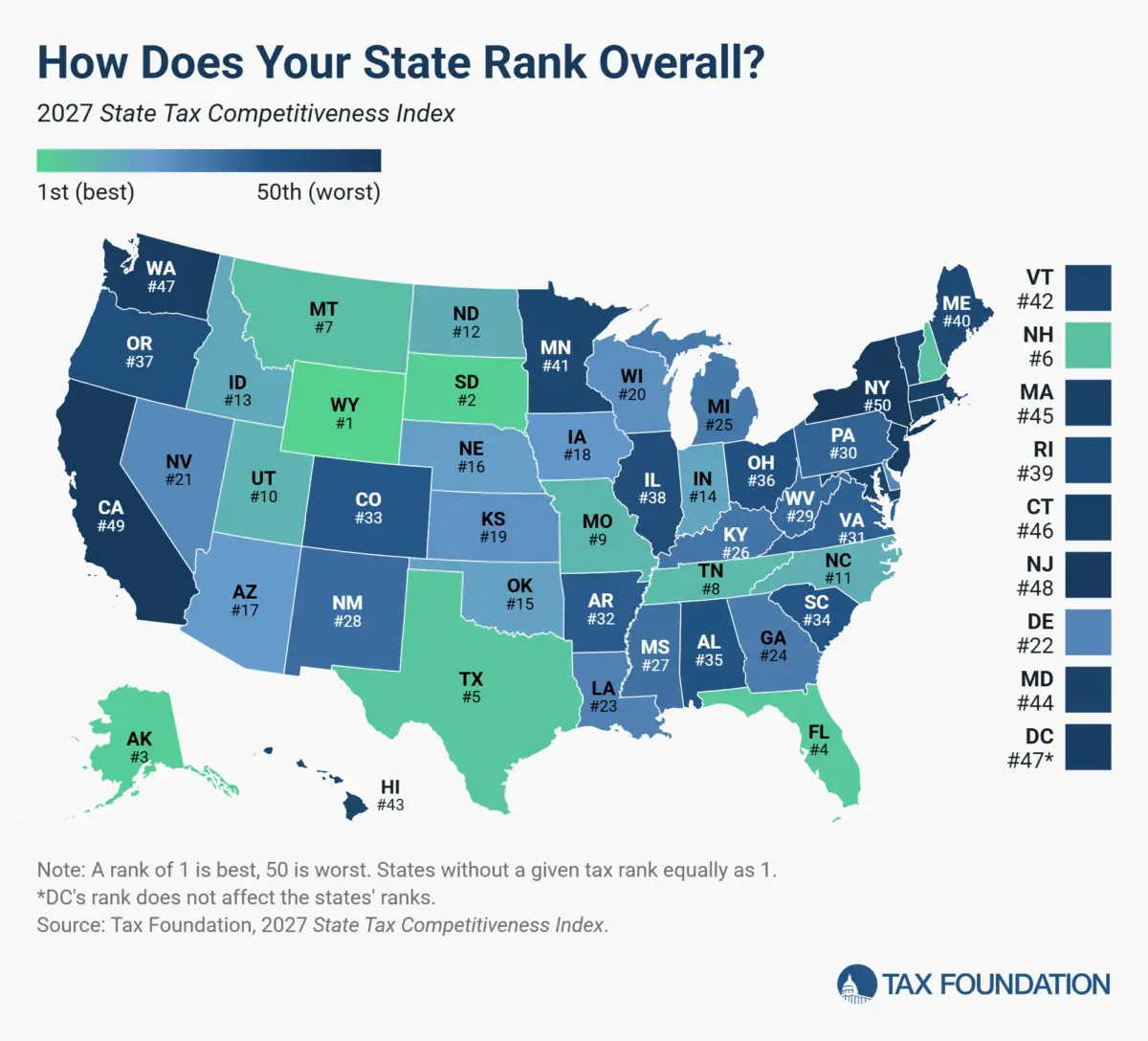
The Tax Foundation has officially released its newly rebranded and completely overhauled flagship evaluation of state tax systems, now titled the State Tax Competitiveness Index. Published annually since 2003 under its former name, the State Business Tax Climate Index, the newly renamed study reflects a comprehensive redesign that assesses states’ overall tax competitiveness rather than focusing strictly on the business tax climate.
According to Katherine Loughead, Vice President of State Policy at the Tax Foundation, the publication was rebuilt from the ground up to address the accelerating pace of change in state and federal tax policy over the last two decades. Major legislative shifts—including the federal Tax Cuts and Jobs Act, the Supreme Court’s landmark Wayfair decision, the post-pandemic rise of remote work, and the introduction of new or expanded taxes on wealth, digital products, and data—prompted the organization to refresh the study before its methodology became outdated.
The 2027 edition incorporates more than 150 variables evaluated across five major subindices: corporate income taxes, individual income taxes, sales and excise taxes, property and wealth taxes, and unemployment insurance taxes. To ensure rigorous and transparent year-over-year tracking under the expanded methodology, researchers have backcast state rankings for the seven years preceding the current edition, providing a reliable baseline for evaluating true policy movement over time.
Evaluating Tax Structure and Competitiveness
The primary purpose of the Index is to help policymakers, taxpayers, and business leaders evaluate how well states structure their tax codes. While standard revenue metrics show how much governments collect, the Index provides a strategic roadmap for creating a simple, neutral, transparent, and pro-growth tax environment.
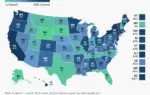
A recurring trend among the top-performing states in the Index is the absence of at least one major tax. South Dakota and Wyoming claim top positions, benefiting from the lack of both corporate and individual income taxes. Alaska and New Hampshire levy neither individual income taxes nor state-level sales taxes, while Florida, Tennessee, and Texas forgo individual income taxes altogether. Montana maintains its high standing by operating without a general sales tax.
However, the Foundation emphasizes that eliminating major taxes is not the only path to success. Several states that impose all major tax types—such as Missouri, Utah, North Carolina, North Dakota, Idaho, Indiana, Oklahoma, and Nebraska—rank comfortably within the upper tiers of the study by maintaining moderate rates and well-designed, broad-based structures.
Conversely, the lowest-ranked states in the analysis typically struggle with complex, nonneutral tax codes featuring comparatively high rates. New Jersey, for instance, faces steep property tax burdens alongside high corporate and individual income tax rates, an inheritance tax, and a poorly structured personal income tax system.
Economic Implications of Tax Structure
The conceptual framework of the Index draws heavily on public finance theory, comparing tax competition to the sabermetric concept of "Wins Above Replacement" in sports. While an optimal tax structure will not instantly transform a rural landscape into a metropolis, and a poor tax structure will not necessarily turn a major economic hub into a ghost town, tax policy undeniably influences business decisions and economic outcomes.
Decades of economic literature support the finding that taxes significantly affect business location decisions, entrepreneurial entry, capital investment, and labor supply. Studies dating back to Charles Tiebout’s foundational work on fiscal federalism have demonstrated that taxpayers and businesses sort themselves across jurisdictions based on public goods and the associated costs. More recent empirical research confirms that corporate income tax rates, property taxes, and progressive individual income taxes can act as a drag on employment growth and capital formation.
Despite these findings, lawmakers are frequently tempted to rely on targeted tax incentives and discretionary subsidies rather than broad-based systemic reform. Analysts caution that such incentive packages often serve as expensive patches for an uncompetitive underlying business tax climate, whereas long-term structural modernization yields more sustainable economic growth.
Notable Legislative Shifts Across States
The 2027 Index captures numerous legislative changes enacted by state lawmakers prior to the snapshot date of July 1, 2026.
Arizona fell three spots to 17th overall, influenced by timing issues regarding retroactive tax conformity and a temporary moratorium on data center tax incentives. Arkansas dropped three places to 32nd, pressured by nonconformity with federal full expensing provisions. Georgia slipped from 18th to 24th due to declining corporate tax scores after failing to conform to competitive business expensing provisions, combined with a narrowing of its individual income tax base via partial exemptions for tips and overtime pay.
Idaho and Indiana also saw lower rankings, driven in part by the adoption of temporary individual deductions for tips and overtime pay, which narrow tax bases and reduce revenues without generating equivalent economic growth. Iowa experienced a minor dip to 18th, though its corporate ranking improved following the adoption of full bonus depreciation.
Kansas improved four places to 19th, supported by rolling conformity to pro-growth business expensing provisions. Louisiana jumped from 32nd to 23rd overall, largely propelled by a 17-place improvement in its property tax rank following the final phase-in of capital stock tax elimination and reforms allowing S corporations to file through the individual income tax.
Meanwhile, Maine slid seven places to 40th after adopting a high-income surcharge that elevated its top individual income tax rate to 9.15 percent. Michigan dropped nine places to 25th due to a lack of conformity with federal expensing rules and the introduction of targeted tip and overtime exemptions.
Missouri broke into the top 10, rising from 12th to 9th place by adopting increased expensing provisions while resisting base-narrowing exemptions for tips and overtime. Nebraska climbed eight places to 16th as the state continued a systematic phase-down of its individual and corporate income tax rates. North Carolina rose to 11th, maintaining the nation’s lowest corporate income tax rate among states that levy one, which further declined to 2.0 percent.
Oklahoma advanced four spots to 15th following significant bracket consolidation and rate reductions enacted in 2025. Utah climbed into the top 10 at 10th overall, benefiting from pro-growth expensing conformity and modest, ongoing rate reductions. Conversely, West Virginia improved six places to 29th due to business expensing conformity, while Washington dropped to 47th after expanding its business-to-business digital taxation base.
Future Outlook and Policy Direction
As states continue to adjust their fiscal policies, several forthcoming changes are expected to influence future editions of the Index. Upcoming tax increases in states such as Hawaii, Illinois, and Rhode Island, alongside scheduled rate reductions in North Carolina and Arkansas, highlight the dynamic nature of state tax competition.
The Tax Foundation’s updated interactive tools and comprehensive datasets aim to provide policymakers with the granular detail needed to evaluate these trade-offs. By prioritizing simplicity, neutrality, and broad-based relief over targeted exemptions and complex surcharges, states can better position themselves to attract capital, foster entrepreneurship, and drive long-term economic vitality.