



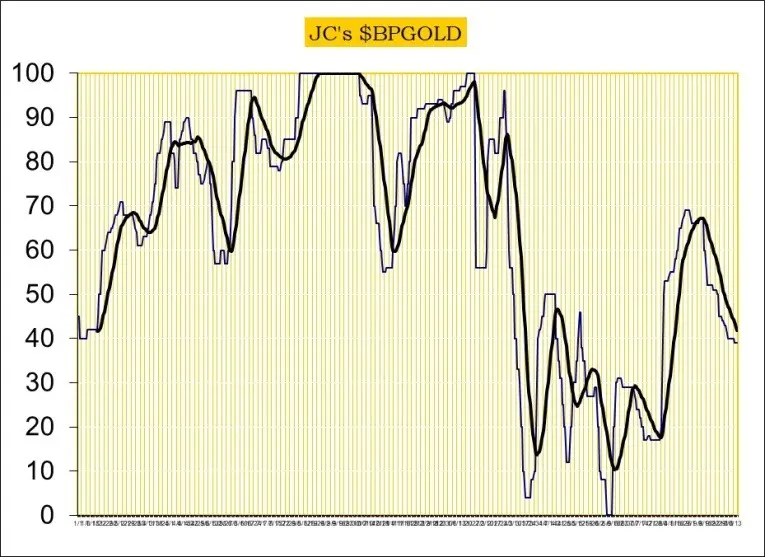
Precious metals markets are currently navigating a complex technical landscape, as a widely followed proprietary cycle indicator has flashed a decisive downward signal for the broader gold sector. According to technical analysts and market editors monitoring the space, the shift in the cycle indicator provides a clear framework for market participants, even as underlying long-term trends present a more nuanced picture of strength across gold, gold equities, and the U.S. dollar.

For investors and traders alike, the current market environment demands careful navigation. The proprietary cycle indicator, utilized by market observers as a primary timing tool, has historically offered a reliable mechanism for gauging market direction. While analysts readily acknowledge that the tool is not infallible—noting that periods of heightened market volatility can occasionally produce short-term whipsaws—it nonetheless serves as an essential compass for tactical positioning.

In light of the current downward cycle signal, strategists have outlined distinct approaches for different market participants. Investors are advised to remain in cash or maintain a heavily hedged posture until market conditions stabilize and the cycle resets. Conversely, active traders are encouraged to look for tactical opportunities by entering the market near cycle bottoms and exiting promptly at cycle tops to capture short-term profits, rather than attempting to hold positions through the broader corrective phase.

The technical weakness is currently reflected across a broad suite of market exchange-traded funds and indices. Recent chart data indicates that the SPDR Gold Shares (GLD), the VanEck Gold Miners ETF (GDX), the Toronto Stock Exchange Global Gold Index (XGD.to), and the VanEck Junior Gold Miners ETF (GDXJ) are all flashing short-term sell signals. These concurrent signals across both physical gold bullion vehicles and senior and junior mining equities underscore the pervasive nature of the current pullback.

A deeper technical analysis of the market structure reveals the mechanics behind the recent price action. Current speculation points toward an expectation of lower gold prices overall in the immediate term, following a failed recovery rally. Analysts note that recent upward momentum in gold stocks was decisively rejected at established resistance levels, prompting the ongoing correction.

Despite these near-term headwinds, the broader structural backdrop retains elements of resilience. Technical trend indicators continue to register an upward trajectory for physical gold itself, which is currently testing critical support levels. Similarly, the underlying trend for gold stocks remains technically up when viewed through a wider lens, even as they contend with the immediate resistance rejection and short-term sell signals. Compounding these dynamics, the U.S. Dollar (USD) is also exhibiting a strong upward trend, creating an environment where both gold and the greenback have experienced concurrent strength, though the resulting ratio has triggered a sell signal.

Adding to the longer-term technical outlook, chart watchers are monitoring a potential inverse head-and-shoulders pattern currently in progress. If confirmed over a broader time horizon, this classic bottoming formation could eventually provide a strong foundation for a future continuation of the bull market. However, for the immediate present, the combination of a downward cycle indicator, widespread short-term sell signals across key gold vehicles, and a rejected recovery rally confirms that a correction is firmly underway.

Market analysts and model operators emphasize that the framework provided does not constitute direct financial predictions or forecasts for future market outcomes. Instead, the insights stem from a systematic trading model designed to generate clear signals, establishing specific parameters for whether market participants should maintain long exposure, short exposure, or sit on the sidelines in cash at any given time. Real-time entry points and risk management stops are continuously managed and communicated to subscribers, meaning that retrospective market updates may not fully capture live positioning adjustments. Market participants are ultimately reminded to evaluate these technical developments and trade at their own discretion.