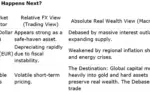





For years, market observers have noted that successive economic interventions and escalating debt levels have merely postponed systemic vulnerabilities rather than resolving them. However, financial analysts suggest that the monumental resource demands and capital allocation shifts driven by the artificial intelligence boom may represent the point where these postponed consequences finally catch up to the global economy. As traditional debt mechanisms face mounting friction, the broader implications are expected to ripple across all asset classes, with particular significance for traditional safe-haven assets such as gold and silver.
The current bond market turbulence has been a primary concern for institutional investors and monetary economists alike. Sovereign debt yields have experienced significant volatility amid shifting central bank policies, persistent inflationary pressures, and record-high government borrowing levels across Western economies. This persistent bond crisis reflects a deeper loss of confidence in long-term debt instruments, as investors demand higher compensation for holding sovereign risk in an era of heightened fiscal uncertainty. When financial systems are built primarily on an expanding foundation of debt, any disruption to the smooth functioning of the bond market threatens the stability of the entire monetary pyramid.
Simultaneously, the global economy is experiencing a massive technological transformation characterized by the explosive growth of artificial intelligence. This movement requires unprecedented levels of capital investment, energy consumption, and infrastructure development. Data centers, semiconductor manufacturing, and advanced computing power demand vast financial resources, drawing capital away from traditional sectors and competing directly with sovereign debt markets for liquidity. Rather than operating in a vacuum, the AI boom is intersecting with a financial system that is already heavily leveraged and structurally vulnerable.
Financial commentators point out that the Western debt-based financial system has long relied on the ability to continuously expand credit and defer fiscal reckoning. By repeatedly kicking the can down the road through monetary expansion and increased borrowing, policymakers have managed to avert acute systemic crises in the past. Yet, the sheer scale of the capital commitments required by the modern technology sector, combined with structural weaknesses in the bond market, suggests that the metaphorical road is running out of space. The systemic pressure is intensifying, forcing market participants to re-evaluate the long-term viability of debt-denominated assets.
These shifting economic dynamics have placed a renewed focus on precious metals, particularly gold and silver. Throughout history, precious metals have served as a traditional hedge against currency devaluation, sovereign default, and systemic financial instability. As the pressures within the bond market mount and the limitations of the debt-based financial model become increasingly apparent, investors frequently turn to tangible assets that carry no counterparty risk. Market analysts monitoring these developments emphasize that the ongoing structural changes in the global economy will almost certainly have a profound impact on the valuation and role of gold and silver in institutional and retail portfolios.
The commentary provided by Arcadia Economics highlights the urgency of these developments, underscoring that the current juncture is a critical period for understanding where the global economy is heading. As the capital-intensive AI movement accelerates against the backdrop of a breaking debt system, the traditional rules of financial navigation are being rewritten. Observers of the precious metals market are watching closely to see how the impending convergence of technological expansion and monetary strain will ultimately reprice hard assets in an environment where traditional financial buffers are rapidly diminishing.