



When taxpayers sell capital assets like real property or corporate stock, net earnings on those sales—commonly known as capital gains—are generally subject to taxation. Conversely, net losses on these transactions can typically be deducted when individuals calculate their annual income tax liability. However, beneath the surface of this standard financial mechanism lies a structural flaw that has long troubled economists, policymakers, and everyday savers alike: the failure of tax systems to account for inflation.
One of the major shortcomings of current capital gains taxation at both the federal and state levels is that the tax basis, or the original purchase price of an asset, is not indexed for inflation. As a result, capital gains are measured strictly in nominal dollars. When an asset is sold, the historical purchase price is subtracted from the sale price without any adjustment for the changing value of money over time. This means taxpayers are routinely taxed on a combination of real economic gains and fictitious income that does not reflect any actual increase in purchasing power.
While the tax code does provide some narrow accommodations—such as exclusions for qualifying sales of owner-occupied homes and certain properties transferred to heirs—the broader structural issue remains unaddressed. In many cases, this lack of inflation indexing can be significant enough that taxpayers end up owing taxes on what appears to be a capital gain on paper, but is, in real terms, a net loss when adjusted for the eroding power of the dollar.
The federal tax code partially addresses this inherent shortcoming through the preferential treatment of long-term capital gains. Under current federal rules, long-term capital gains—defined as net gains on assets held for more than one year—are taxed under a separate rate schedule featuring lower rates and different brackets. Depending on a taxpayer’s overall taxable income, these long-term gains are taxed at preferential rates of 0 percent, 15 percent, or 20 percent, providing some relief from the cumulative impact of inflation and nominal taxation.
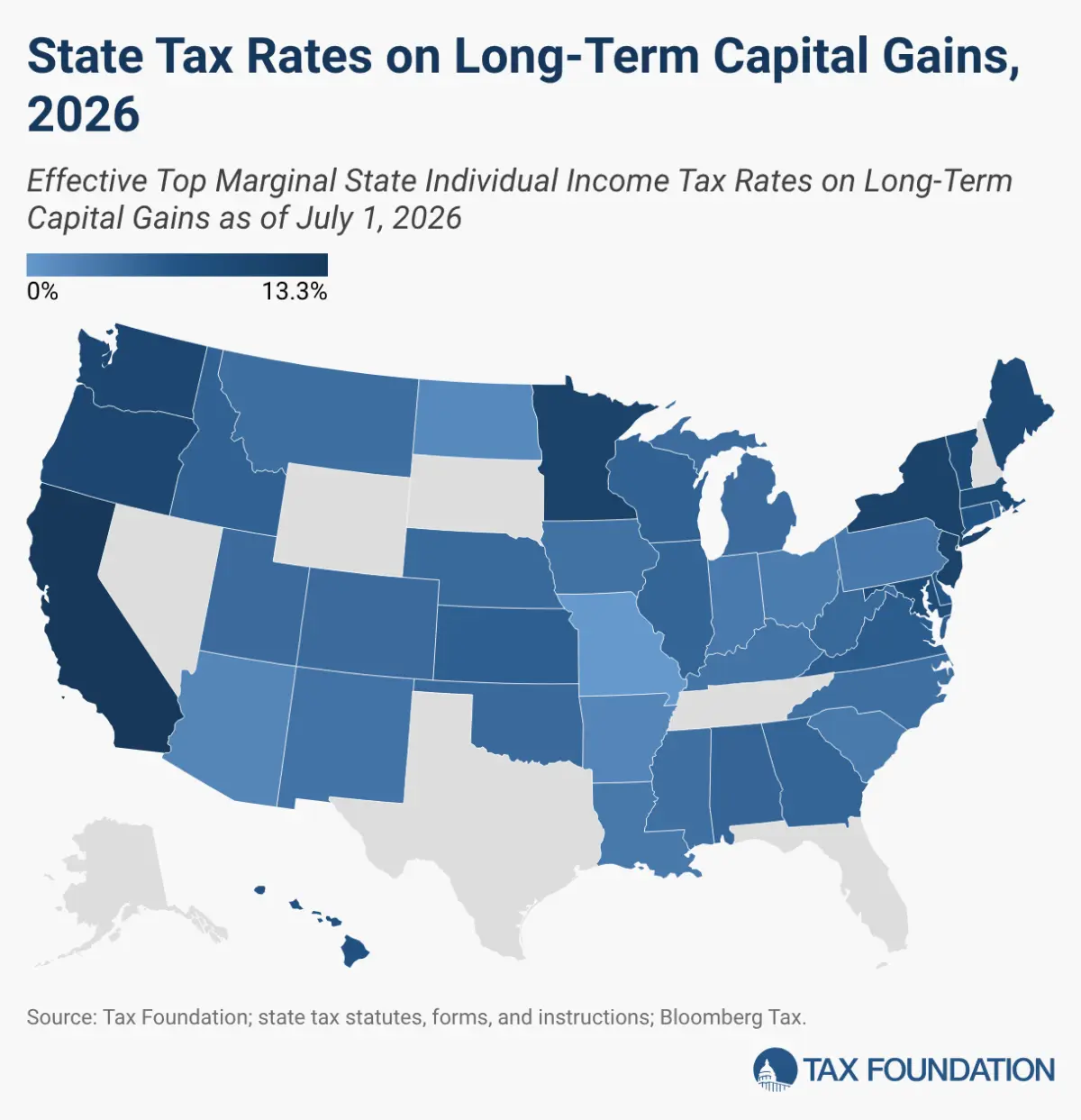
At the state level, however, accommodating the effects of inflation is far less common. Thirty states and the District of Columbia overtax capital gains income simply by subjecting those earnings to the exact same rate schedule that applies to ordinary wage and salary income. By ignoring the distinction between investment returns and labor income, these jurisdictions exacerbate the inflationary penalty borne by long-term investors.
The divergence in state policies becomes even more pronounced at the extremes. Three states—Maryland, Minnesota, and Washington—actively expose certain capital gains to higher tax rates than those that apply to ordinary income. Maryland levies an additional 2 percent capital gains surtax on the state income tax due on income exceeding $350,000. Minnesota taxes most capital gains at ordinary rates but imposes an additional 1 percentage point tax on net investment income exceeding $1 million. Meanwhile, Washington takes a different approach entirely, imposing a 7 percent rate on capital gains income up to $1 million and an additional 2.9 percent excise tax on capital gains income over that threshold.
On the other end of the spectrum, eight states follow the federal lead by applying lower effective individual income tax rates to long-term gains than to ordinary income. They achieve this either by applying lower statutory tax rates or by offering an exclusion for a portion of otherwise taxable capital gains. Meanwhile, Missouri exempts capital gains entirely from its state income tax, and eight other states avoid the issue altogether by forgoing an individual income tax entirely.
Beyond these broad approaches, several states provide targeted preferential tax treatment for certain narrow categories of capital gains, often granting exemptions for qualifying capital gains derived from investments in specific industries. For example, Colorado offers a subtraction of up to $100,000 to farmers for capital gains realized from the sales of qualifying agricultural real property. Similarly, Maine offers a subtraction to certain housing organizations for a portion of capital gains generated from the transfer of properties designated for affordable housing use.
While these types of provisions vary considerably from state to state, their very existence indicates that lawmakers recognize a fundamental economic truth: taxing capital gains at the exact same rate as ordinary income can heavily disincentivize investment and create severe economic distortions. Yet, because these provisions are often extremely narrowly targeted, they offer meaningful tax advantages to only a tiny subset of taxpayers while leaving the broader structural problem untouched.
Tax experts argue that at the state level, taxing long-term capital gains at lower rates or excluding a set percentage of capital gains income for all taxpayers and all types of capital gains helps offset the reality that capital gains taxes apply to nominal, rather than real, capital gains. Consequently, fiscal analysts suggest that more states should reconsider their treatment of long-term capital gains, either by applying a lower statutory rate to capital gains income or by excluding a certain percentage of otherwise taxable capital gains. Additionally, states must ensure they provide robust and timely deductions for capital losses to maintain fairness in the tax code.
Even when lower rate schedules or targeted exclusions are granted, capital gains taxes represent a persistent form of double taxation on investment income. To illustrate this dynamic, consider an individual who decides to save for the future by purchasing shares of stock in a company. Unless those shares are purchased through tax-advantaged investment accounts—such as a 401(k) or an Individual Retirement Account, where invested income is taxed only once, either on the way in through Roth accounts or on the way out through traditional accounts—the investment is made using ordinary wage or salary income that has already been taxed under standard federal and state individual income tax rate schedules.
Under favorable circumstances, the value of that investment will grow over time. That growth reflects underlying corporate earnings that have already been subject to corporate income taxes, which inherently reduces the amount of income ultimately available to be distributed to investors. Years or decades later, when the investor finally sells their shares and realizes a capital gain, that exact same underlying income will be taxed yet again under the individual income tax.
While preferential rates applied to long-term capital gains reduce this heavy tax burden, they do not eliminate it. Moreover, the burden is frequently compounded by the fact that capital gains are measured by nominal rather than inflation-adjusted dollars. As a result, taxpayers may find themselves owing tax not only on previously taxed earnings but also on inflationary gains that do not represent a genuine increase in purchasing power.
When evaluating the overall tax treatment of investment income, state policymakers are increasingly urged to consider all layers of taxes levied on those earnings, including corporate income taxes. They must also understand how the ongoing failure to inflation-index the tax basis, combined with most states’ failure to adjust their tax rates accordingly, results in the widespread overtaxation of capital gains income across the United States.
Because savings and private investment remain essential foundations for individuals’ and families’ long-term financial security, as well as for broader economic growth, financial analysts emphasize that policymakers should actively pursue reforms that help mitigate rather than add to existing tax code biases against saving and investing.