



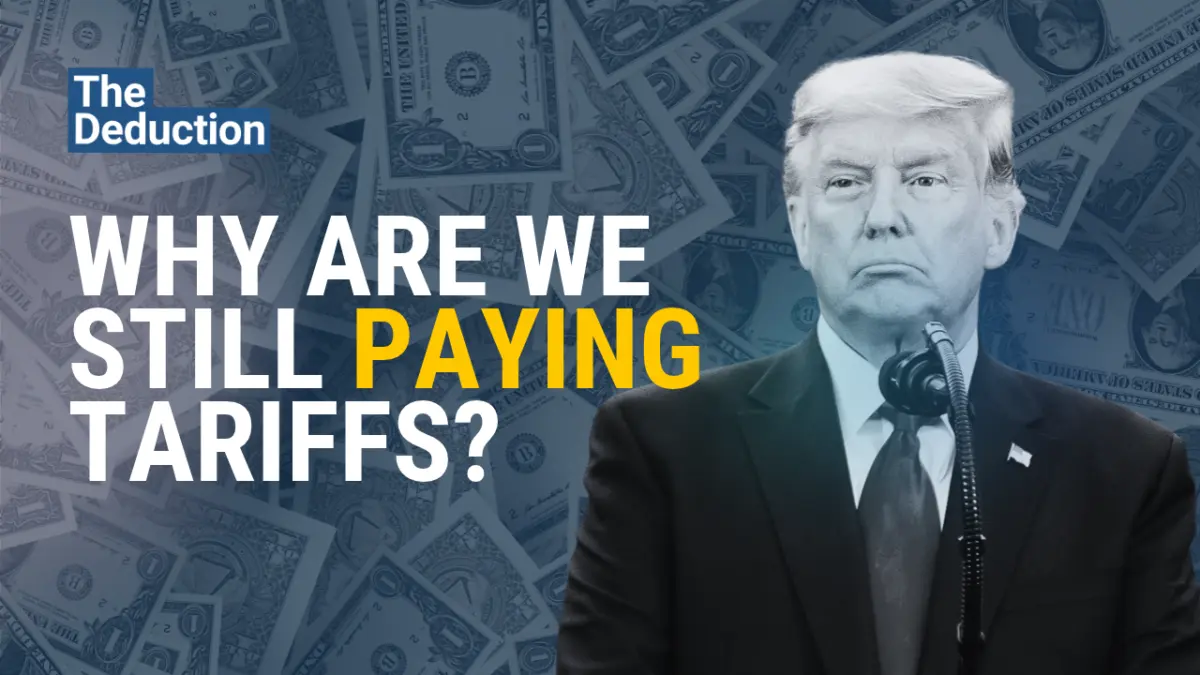
Months after the Supreme Court struck down sweeping tariffs enacted under the International Emergency Economic Powers Act (IEEPA) in February, American businesses and consumers continue to face heavy import levies. The persistence of these trade barriers has left many wondering why the legal defeat has not translated to financial relief at ports and retail counters. The explanation lies in a rapid pivot by the administration, which quickly replaced the invalidated measures with alternative mechanisms, keeping the financial burden on international trade largely intact.
In a recent episode of The Deduction, host Kyle sat down with cohost Erica York to break down the current state of tariff policy and examine how these ongoing trade measures intersect with broader domestic economic goals. During their discussion, the policy experts explored the administration’s strategic shifts following the Supreme Court decision, moving first to temporary Section 122 tariffs and subsequently establishing persistent 10 to 12.5 percent Section 301 tariffs on nearly every United States trading partner.
To understand the scope of the issue, the hosts revisited the fundamental mechanics of tariffs. Tariffs are taxes imposed by one government on goods imported from another country. Functioning as artificial trade barriers, they raise prices for consumers, reduce the available quantities of goods and services for United States businesses, and create a significant economic burden on foreign exporters, who often pass those costs down the supply chain. Despite legal challenges that successfully dismantled the original IEEPA framework, the rapid deployment of alternative authorities has ensured that tariff-related costs remain a fixture of the American import landscape.
A central theme of the conversation between Kyle and York was the counterproductive nature of these ongoing duties, particularly regarding domestic investment. The discussion highlighted how widespread tariffs may effectively cancel out the investment boost intended by pro-growth provisions in the tax code, such as full expensing. Full expensing allows businesses to immediately deduct the full cost of certain investments in new or improved technology, equipment, or buildings. By alleviating a long-standing bias in the tax code, full expensing is designed to incentivize companies to invest more aggressively. Over the long run, this increased capital expenditure is meant to raise worker productivity, boost wages, and create more jobs across the economy.
However, the hosts pointed out that the imposition of broad-based tariffs on nearly all trading partners creates severe cost pressures that can blunt these positive incentives. When businesses face heightened expenses on imported capital goods, raw materials, and intermediate inputs due to Section 301 tariffs, the capital available for domestic investment and expansion can be severely constrained. Consequently, the beneficial impacts of policies aimed at encouraging modernization and business growth risk being undermined by the very trade policies running parallel to them.
Beyond the immediate economic friction, the podcast episode delved into the ongoing legal battles that could still shape the future of American trade policy. While the Supreme Court’s February ruling invalidated the IEEPA tariffs, litigation continues over the legality of the administration’s replacement strategies. Legal scholars and industry stakeholders are closely watching pending court cases that challenge whether the administration overstepped its statutory authority by transitioning so swiftly to Section 122 and Section 301 tariffs to achieve similar protectionist aims. If these ongoing legal challenges succeed, they could fundamentally alter or invalidate the current tariff regime, forcing a new phase in federal trade and economic strategy.
As the legal and economic debates unfold, businesses and consumers continue to navigate an environment defined by high import taxes and regulatory uncertainty. Listeners interested in a deeper dive into the intersection of tax policy, tariffs, and economic growth can find the full conversation on Apple Podcasts, Google Podcasts, Spotify, Castbox, Stitcher, Amazon Music, and through the official RSS feed, alongside video coverage available on YouTube.