




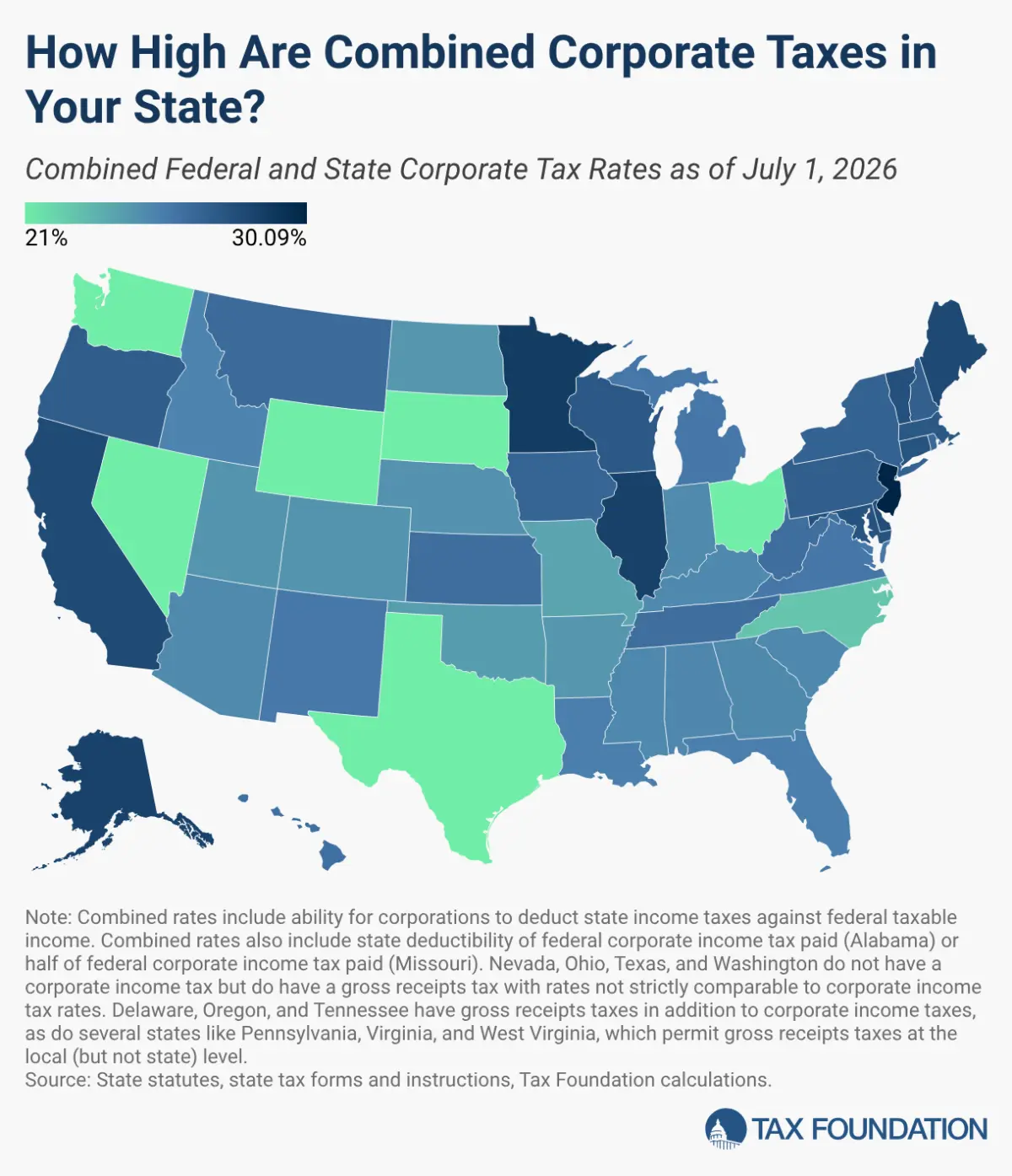
When businesses evaluate the total tax burden of operating within the United States, looking solely at federal requirements provides only half the picture. Corporations nationwide are subject to a federal corporate income tax levied at a flat rate of 21 percent. However, the true fiscal reality for any enterprise is heavily shaped by geography, as nearly all states overlay their own distinct tax structures onto this federal baseline.
A comprehensive analysis of the nation’s tax architecture reveals that forty-four states, alongside the District of Columbia, levy taxes on corporate income. Within this group, top marginal rates span a wide spectrum, dipping as low as 2.0 percent in North Carolina while climbing as high as 11.5 percent in New Jersey. The structural design of these state-level taxes also varies significantly across jurisdictions. Thirteen states employ graduated corporate income tax rates that increase alongside a company’s profits, while thirty-one states and the District of Columbia opt for a flat rate system.
Adding further complexity to the corporate tax landscape are alternative revenue mechanisms employed by a handful of states. In Nevada, Ohio, Texas, and Washington, corporations do not pay traditional corporate income taxes at all. Instead, these jurisdictions subject businesses to gross receipts taxes. Meanwhile, Delaware, Oregon, and Tennessee take a hybrid approach, imposing both a traditional tax on corporate income and a separate levy based on gross receipts.
The web of taxation extends even further at the sub-state level in certain regions. Pennsylvania, Virginia, and West Virginia authorize gross receipts taxes to be levied by local governments, even though they do not impose them statewide. On the opposite end of the spectrum, only two states in the entire country—South Dakota and Wyoming—completely forgo both corporate income taxes and gross receipts taxes, leaving businesses in those states to face only the federal corporate tax rate.
Because state and federal taxes do not exist in a vacuum, the interaction between the two creates unique combined tax burdens for corporations depending on where they choose to establish their operations. When calculating the aggregate tax pressure, the combined rates can climb substantially higher than the individual state or federal figures suggest.
The state with the highest combined corporate income tax rate in the nation is New Jersey, where the total burden reaches 30.1 percent when factoring in federal obligations. Several other states also place heavy tax pressures on corporate earnings. In Alaska, Illinois, Maine, and Minnesota, corporations face combined corporate income tax rates at or at the threshold of 28 percent or higher. Conversely, the six states that levy no state corporate income tax—Ohio, Nevada, South Dakota, Texas, Washington, and Wyoming—expose businesses only to the federal rate of 21 percent, though it is worth noting that four of these states compensate by levying statewide gross receipts taxes instead.
To accurately gauge corporate liabilities, tax professionals must account for how federal and state systems interact through deductions. Crucially, corporations are generally permitted to deduct state corporate income tax payments against their federal taxable income. This mechanism effectively lowers the corporation’s overall effective federal tax rate.
As a practical example, a corporation operating in Rhode Island and subject to the state’s 7 percent flat corporate income tax can deduct those state tax payments against the 21 percent federal corporate income tax. This deduction reduces the effective federal rate to 19.53 percent, which, when combined with the state levy, results in an overall tax rate of 26.53 percent.
In a rare exception to the standard flow of tax deductions, a couple of states allow corporations to deduct federal corporate income tax liabilities against a portion of their state-level corporate income tax. Alabama permits the full deductibility of federal corporate income tax liability against its state liability, while Missouri allows corporations to deduct 50 percent of their federal corporate income tax liability. These provisions provide meaningful relief, lowering the effective corporate income tax rate faced by businesses operating within those borders.
When averaging the entire country—including the jurisdictions that impose no traditional corporate income taxes whatsoever—the average combined state and federal corporate tax rate in the United States sits at 25.5 percent.
Policy experts emphasize that analyzing these combined tax burdens is essential for understanding broader economic competitiveness. Economists frequently point out that corporate income taxes rank among the most economically damaging ways for governments to raise revenue. Because capital is highly mobile, high corporate tax burdens can discourage investment, hamper business expansion, and ultimately slow wage growth for workers. Consequently, tax policy analysts view corporate tax reform as a vital pathway for states seeking to boost their economic competitiveness and foster an environment conducive to long-term growth and job creation.