




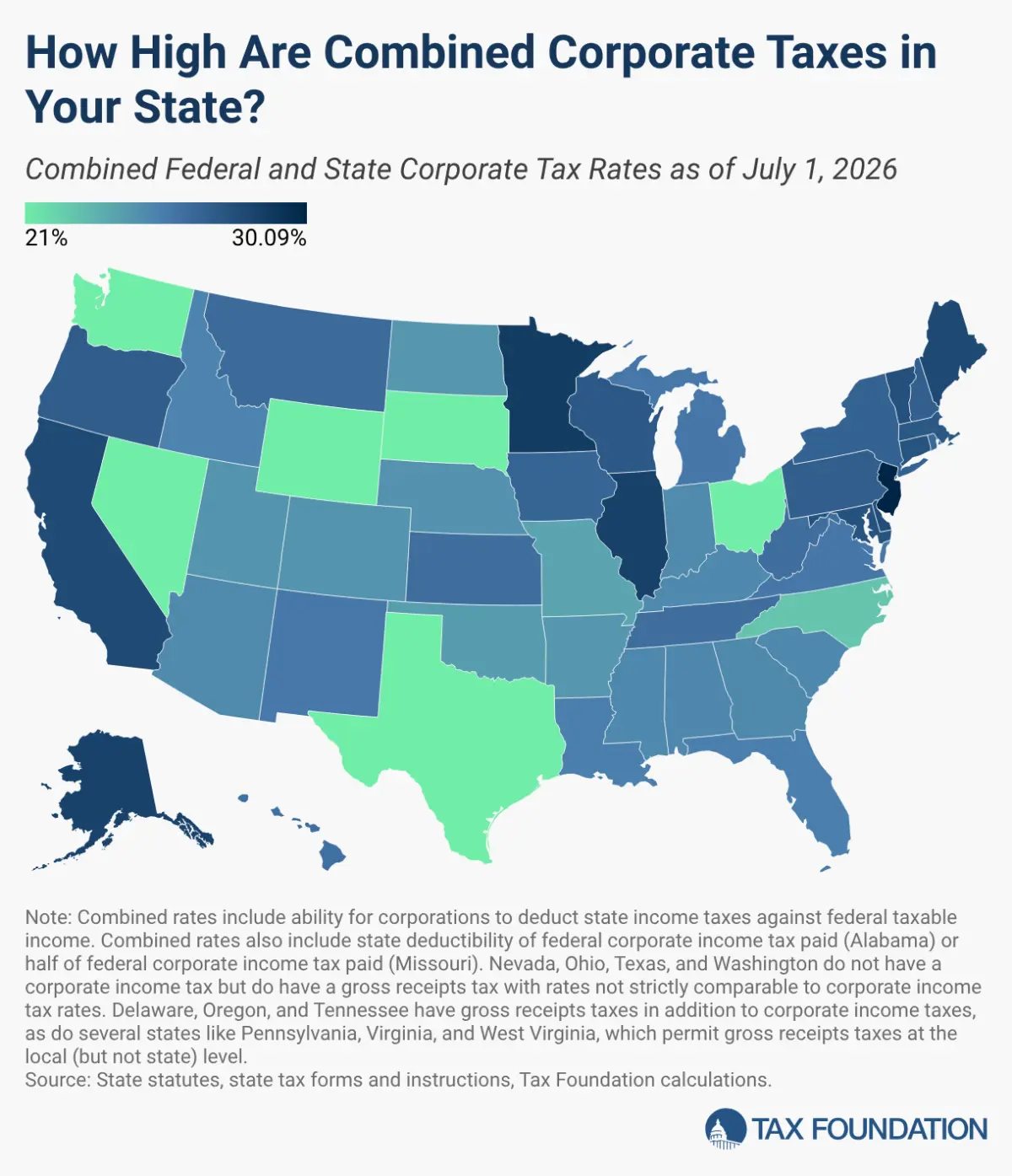
When corporations in the United States evaluate their annual tax liabilities, they face a complex, multi-layered system that combines federal obligations with a diverse mosaic of state-level policies. At the federal level, corporate income is taxed at a flat 21 percent rate, a benchmark established following major federal tax overhauls. However, looking at the federal rate alone provides only a fraction of the picture. Forty-four states and the District of Columbia also levy taxes on corporate income, creating a patchwork of marginal rates, brackets, and alternative tax structures that vary dramatically from one jurisdiction to the next.
The variation in state-level corporate income taxation is vast. Among the 44 states and Washington, D.C., that impose a corporate income tax, top marginal rates span from a modest 2.0 percent in North Carolina to a hefty 11.5 percent in New Jersey. Structurally, states divide themselves into two main camps regarding how they apply these rates: thirteen states utilize graduated corporate income tax structures with multiple brackets, while 31 states and the District of Columbia enforce a flat rate across corporate earnings.
Adding to this complexity is the fact that corporate income is distinct from pass-through business income. Many smaller companies and partnerships are not subject to the traditional corporate income tax (CIT) because they operate as pass-through entities, meaning their business profits are reported under individual income tax codes instead. For traditional C corporations, however, navigating state boundaries requires careful calculation of both direct income levies and alternative business taxes.
Beyond traditional corporate income taxes, several states rely on alternative mechanisms to raise revenue from commercial activity. In Nevada, Ohio, Texas, and Washington, corporations are subject to gross receipts taxes rather than corporate income taxes. Gross receipts taxes are levied directly on a company’s total gross sales without permitting deductions for ordinary and necessary business expenses, such as employee compensation, the cost of goods sold, and overhead costs. Unlike a standard retail sales tax, a gross receipts tax is assessed on businesses and applies to transactions at every distinct stage of the production process, a cascading phenomenon known in economic terms as tax pyramiding.
Other states take a hybrid approach. Delaware, Oregon, and Tennessee impose both a tax on corporate income and a separate levy on gross receipts. Meanwhile, Pennsylvania, Virginia, and West Virginia do not impose statewide gross receipts taxes, but they do authorize such levies at the local municipal level. At the opposite end of the spectrum, two states—South Dakota and Wyoming—stand out for levying neither a corporate income tax nor a gross receipts tax, leaving corporations in those jurisdictions free from direct state-level taxes on business profits or revenues.
When calculating the total tax burden, businesses must look at how federal and state taxes interact. The state with the highest combined corporate income tax rate in the country is New Jersey, where the top state marginal rate combines with federal obligations to reach 30.1 percent. Several other states push corporations toward similarly high combined burdens. In Alaska, Illinois, Maine, and Minnesota, corporations face combined corporate income tax rates at or above 28 percent. Conversely, the six states that levy no state corporate income tax—Ohio, Nevada, South Dakota, Texas, Washington, and Wyoming—expose businesses only to the federal tax rate of 21 percent, though four of those states offset the lack of an income tax by implementing statewide gross receipts taxes.
Fortunately for corporate taxpayers, the tax code provides mechanisms for partial relief through deductibility rules. Corporations are generally permitted to deduct state corporate income tax payments against their federal taxable income, which effectively lowers their overall federal corporate income tax rate. For example, a corporation operating in Rhode Island is subject to the state’s 7 percent flat corporate income tax. Because that state tax payment can be deducted from federal taxable income, the company’s effective federal rate drops from 21 percent to roughly 19.53 percent. When combined with the state levy, the total effective rate comes out to 26.53 percent rather than a simple addition of the two rates.
In rare instances, the flow of deductibility moves in the opposite direction or offers unique reciprocal relief. Two states allow corporations to deduct federal corporate income tax liability against a portion of their state corporate income tax obligations. Alabama provides full deductibility of federal corporate income tax liability against state tax liability, while Missouri permits a 50 percent deduction of federal corporate income tax liability. These provisions further reduce the effective corporate income tax rate faced by businesses operating within those state borders.
When taking all fifty states into account—including those that impose no corporate income taxes whatsoever—the average combined state and federal corporate tax rate across the United States sits at 25.5 percent. This national average reflects a delicate balance between federal fiscal policy and the ongoing efforts of state legislatures to remain attractive destinations for commercial investment.
When economists and policy analysts examine the overall tax burdens carried by businesses, they emphasize the importance of viewing federal and state corporate taxes through a unified lens. Corporate income and gross receipts taxes are widely recognized by economic researchers as some of the most economically damaging ways for governments to raise revenue. Because these taxes can discourage capital investment, depress productivity growth, and ultimately reduce wages for workers, policymakers frequently point to corporate tax reform as a prime opportunity for states to increase their economic competitiveness. By modernizing their tax codes, states aim to foster a more dynamic environment that promotes sustainable economic growth and benefits both corporate employers and the local workforce.