



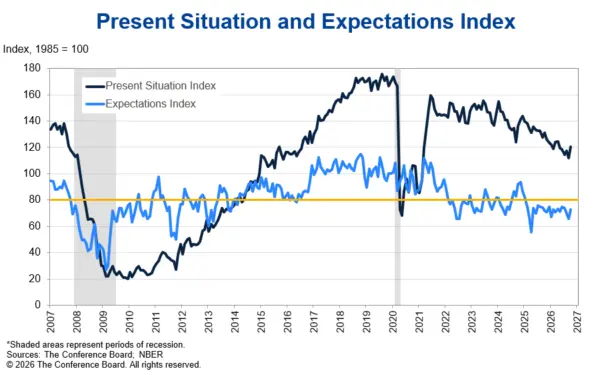
American consumer confidence staged a notable rebound in October, rebounding sharply from the summer slump and significantly outperforming market expectations. According to the latest data released by the Conference Board, the headline Consumer Confidence Index climbed from 84.2 in September to 91.7 in October. This substantial 7.5-point increase completely reversed three consecutive months of declines and brought the index back to the levels last seen in June.
The surge comfortably beat the consensus forecast of economists, who had predicted a much more modest reading of 81.2. The resulting 10.5-point upside surprise caught many financial analysts off guard, sparking discussions about the underlying resilience of the United States consumer base even as broader economic headwinds persist.

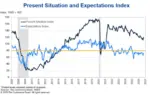
The October improvement was driven by gains across both core components of the monthly survey. The Present Situation Index, which measures consumers’ assessment of current business and labor market conditions, climbed from 111.8 to 120.4. Concurrently, the Expectations Index—reflecting consumer outlook for the coming six months—recovered from 65.7 to 72.6. Despite this positive momentum, the Conference Board noted that expectations remained relatively subdued when viewed in a historical context. The data suggests that households are becoming incrementally less pessimistic rather than decisively more optimistic about the medium-term economic trajectory.
Underpinning the headline recovery was a subtle improvement in how consumers perceive immediate business and labor market conditions. Net assessments of current business environments rose by 4.8 percentage points to reach positive territory at +3.6%. Similarly, the labor market differential, which tracks the percentage of respondents who view jobs as plentiful against those who find them difficult to secure, improved from +2.9% to +5.3%.
Expectations regarding future business conditions, employment opportunities, and household incomes also ticked upward during the month. However, forward-looking metrics for both business conditions and employment remained negative on a net basis, underscoring lingering caution. Analysts pointed out that the timing of the confidence rebound coincided with a noticeable easing of retail gasoline prices between September and October, which likely provided temporary relief to household balance sheets. Even with this short-term reprieve, the longer-term downward trend in overall consumer confidence remains intact, constrained by persistent inflation and stubbornly elevated living costs that continue to weigh heavily on consumer sentiment.
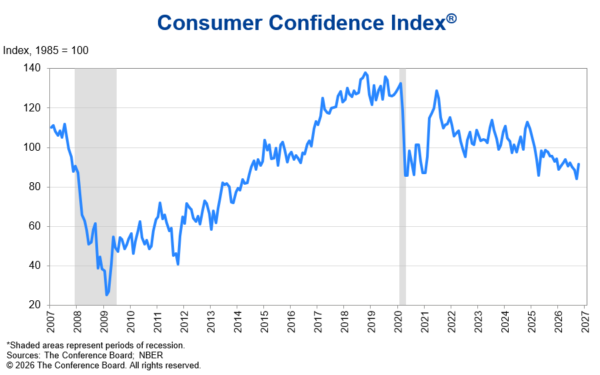
The most striking revelation within the October report is the stark divergence between improving economic sentiment and actual consumer behavior. Despite the sharp jump in the confidence index, consumers exhibited a heightened sense of caution regarding their future spending habits. Purchase intentions for durable goods declined across virtually all major categories, signaling that big-ticket discretionary purchases remain on the back burner for many households.
Planned services spending also softened across the board, affecting sectors such as hospitality, air travel, and general vacations. Specifically, the share of respondents planning a vacation over the next six-month window edged down from 44.2% in September to 43.3% in October.
At the same time, inflationary pressures remain a dominant source of consumer anxiety. Average 12-month inflation expectations eased slightly during the month but remained stubbornly elevated at 5.8%. Survey respondents continued to express deep-seated frustration over the cost of everyday necessities, including food, energy, and overall living expenses.
This widening gap between improving macroeconomic perceptions and weaker spending intentions highlights a complex reality for the broader economy. While households feel marginally better about current conditions and their immediate job security, this renewed perception has not translated into a greater willingness to open their wallets. Consequently, the outlook for discretionary consumption and retail performance heading into the final stretch of the year remains uncertain.