



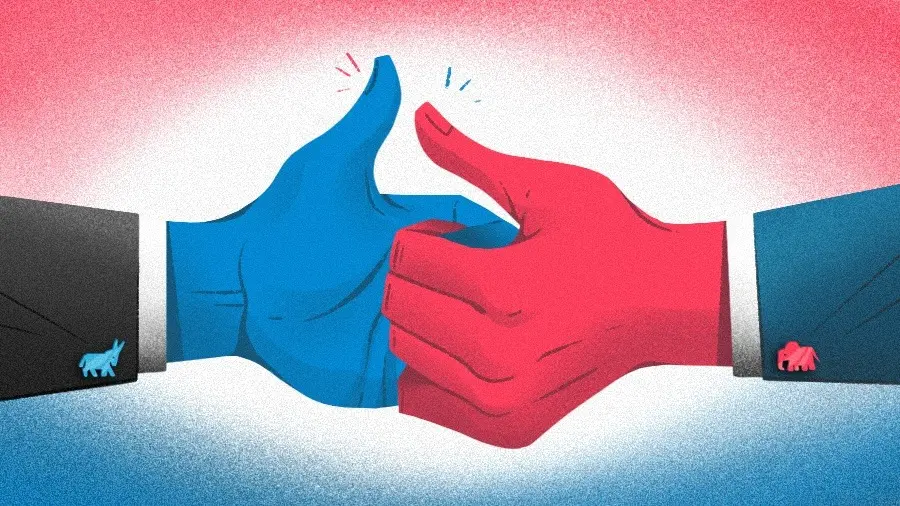
For the past few decades, the vast majority of U.S. startup funding has consistently flowed into companies located in blue states or purple states—jurisdictions where Democrats control all or some statewide elected offices. However, following the latest election cycle, the investment divide separating blue, purple, and red states has grown even more pronounced, reshaping the geographical landscape of American venture capital.
According to comprehensive data compiled by Crunchbase, less than 2% of all startup investment secured so far this year has gone to companies headquartered in post-election red states. For the purposes of this analysis, red states are defined as those that will be governed by both a Republican governor and two Republican U.S. senators following the election results.
This meager share for red states is significantly smaller than in years past, a shift largely driven by five states transitioning into the purple category. Among those shifting states, the largest and most influential venture capital hub is Texas, which moved into purple territory following the election of Democratic Senator James Talarico and Governor Gina Hinojosa. Ohio followed close behind as another major transitioning market.
As of Election Day this year, startups operating in the remaining 17 red states—which together are home to nearly a quarter of the U.S. population—had collectively pulled in a mere $8.6 billion in venture funding. Major contributors within this shrinking red-state cohort included Florida, Tennessee, and Utah. To put that figure into perspective, the total amount raised across nearly a third of the country’s states is less than what the entire United States typically attracts nationwide in a single week.
Purple States Rising
The landscape looks somewhat different, though still heavily skewed, when examining the 10 purple U.S. states. These jurisdictions are home to just over a quarter of the American population and pulled in about $28.6 billion this year as of Election Day. While that tally is vastly higher than the total accumulated by red states, it still accounts for less than 6% of all startup funding nationwide.
Beyond the aforementioned newcomers Texas and Ohio, several other purple states regularly pull in sizable venture funding rounds. These include Pennsylvania, North Carolina, and, to some extent, Wisconsin.
It is also worth noting that the structural divide between red, purple, and blue states becomes somewhat less stark when examining individual round counts rather than total dollar amounts. Approximately 12% of startup financings valued at $1 million or more went to purple-state companies this year, while about 9% went to red-state companies.
Broadly speaking, these figures suggest that investors are still finding plenty of investment-worthy talent outside of traditional blue-state strongholds when it comes to smaller, early-stage deals. However, when writing massive checks, institutional backers are concentrating the vast majority of their capital into massive artificial intelligence funding rounds for companies based primarily in California and New York.
Blue States Secure Over 90% of Startup Funding
This massive concentration of capital brings the broader market trend into sharp focus: blue states receive the overwhelming majority of all startup funding, with the lion’s share of that capital flowing directly into California.
A Crunchbase analysis released last week revealed that California-based companies alone had pulled in more than three-fourths of all U.S. startup funding throughout the year. The vast majority of that capital stems from mega-financings secured by San Francisco-based artificial intelligence giants OpenAI and Anthropic.
While no other state comes close to challenging California for total investment volume, the nearest runners-up are also predominantly blue states, led by New York and Massachusetts. In total, blue states have pulled in a staggering $481 billion in startup investment this year as of Election Day, marking an entirely new all-time record for regional capital concentration.
Politics and What Makes for a Venture Hub
This extreme disparity raises a fundamental question for economists and industry observers: Is this deep investment divide driven by politics, or is it simply a coincidence of geography and economic history?
Broadly speaking, the essential qualities that geographic startup hubs share—such as a deep pool of technical talent, dense urban environments, leading technology companies, and top-tier research universities—are not exclusively the domain of blue states. That said, predominantly rural states, which lean heavily red in political alignment, are statistically less likely to possess the dense urban ecosystems required to naturally foster these specific ingredients.
Even so, there is no inherent rule preventing red-state startup prowess. Austin, Texas, for example, successfully managed to cement its status as a major national technology hub even while the state of Texas remained solidly under uninterrupted Republican control. Similarly, Utah boasts a sophisticated, highly active startup scene that consistently punches above its weight.
Yet, following a series of significant Democratic electoral shifts and the transition of key economic powerhouses into the purple column, it is hardly a surprise that an even greater share of the nation’s premier startup hubs now find themselves firmly located within blue or purple states. As institutional investors continue to prioritize massive artificial intelligence bets in established coastal enclaves, the geographical divide in American venture capital appears deeper than ever.