



For individuals pursuing Financial Independence (FI), travel rewards and credit card points have long offered a way to offset living expenses and stretch retirement savings further. While traditional retirement portfolios typically consist of stocks, bonds, and real estate, tracking the monetary value of accumulated travel points reveals a supplementary asset class that functions similarly to an alternative portfolio. Over the course of several years, tracking the real-world value derived from miles and points demonstrates a significant yearly financial impact that directly reduces the necessary size of a core retirement portfolio.
Historical data tracking the yearly financial value extracted from miles and points highlights this ongoing trend. In 2019, the total value reached $2,614, followed by $4,401 in 2020, and $6,080 in 2021. The upward trajectory continued with $6,192 in 2022, a brief dip to $648 in 2023, a substantial rebound to $10,593 in 2024, $4,253 in 2025, and $5,917 projected or recorded for 2026. This consistent accumulation averages well over $5,000 per year in direct value. Applying standard financial independence mathematics, specifically a 4% safe withdrawal rate, generating $5,000 annually through travel rewards equates to removing the need for approximately $127,175 within a traditional FI portfolio.
Building Up the "Other Portfolio" Through Strategic Wallet Management
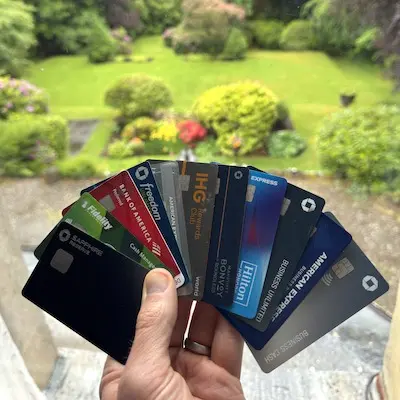
While managing a core FI portfolio remains a foundational element of long-term wealth building, the day-to-day mechanics of personal finance often come down to the contents of one’s physical wallet. Over the years, maintaining a streamlined and consistent wallet strategy has taken precedence over chasing constant optimizations. Focusing on simplicity rather than complexity ensures that financial habits remain sustainable and stress-free, eliminating the need to constantly hunt for new financial products when existing tools already deliver exceptional value.
At the center of this wallet strategy is the Chase Sapphire Reserve, a premier travel card that handles the vast majority of daily transactions. Acquired when it was first introduced to the market in 2016, this card quickly became the primary payment method for more than 95% of all purchases. Industry valuations from expert sources like The Points Guy often value these specific travel points at over two cents per point. Consequently, earning elevated multipliers on categories such as flights, hotels, and dining translates to significant cash-equivalent returns on major household and travel expenses.
Beyond point multipliers, the card delivers tangible convenience and savings during transit. Airport lounge access consistently saves money on terminal food and beverages during travel days while transforming stressful layovers into relaxed experiences. Furthermore, recent adjustments to the card’s annual fee structure introduced a fresh wave of perks and statement credits that have generated substantial financial value, encouraging a deliberate approach to luxury spending that aligns with the broader journey of learning how to enjoy accumulated wealth.
Essential Banking and Everyday Spending Cards
Complementing the primary travel card requires a reliable vehicle for everyday cash access and niche spending categories. The Fidelity Cash Management Debit Card, while not earning reward points or travel miles, serves as an essential tool for liquidity both domestically and abroad. One of its primary advantages is the absence of foreign transaction fees, making it an ideal companion for international travel. Instead of visiting currency exchange bureaus or relying on outdated financial instruments, travelers can withdraw local currency directly from foreign automated teller machines upon arrival, securing competitive exchange rates effortlessly.
Domestically, the card offers unmatched flexibility by providing unlimited reimbursements for all ATM fees incurred nationwide. This removes the administrative burden of hunting down a specific banking network’s physical terminals, allowing users to withdraw cash from any convenient machine with the absolute certainty that all fees will be fully refunded by the institution. Alongside this debit card, traditional bank debit cards are occasionally utilized for localized cash withdrawals near specific brick-and-mortar branches.
For non-travel and non-dining purchases within the United States, the Chase Freedom Unlimited card serves as a dependable workhorse. Earning a solid return on all general purchases, and paired with high point valuations, it functions effectively as a high-yield cash-back instrument on everyday spending. Because the card carries no annual fee, it remains a permanent fixture in the long-term wallet lineup. Similarly, specialized cards are deployed for specific merchant categories, such as utilizing the Amex Everyday for supermarket and grocery shopping in the United States.
Managing Legacy Hotel and Business Accounts
Hotel-branded credit cards occupy a specific niche in a well-managed wallet, often maintained for their long-term structural benefits rather than everyday spending. For instance, legacy products like the IHG Select card—which is no longer open to new applicants—allow long-term cardholders to retain their accounts without forced upgrades. Despite minimal everyday use, keeping the card active makes financial sense due to the annual complimentary night awarded upon renewal, which far outweighs the modest annual fee.
A similar strategy applies to co-branded hotel cards like the Chase Marriott Bonvoy Boundless, which is reserved exclusively for Marriott properties. The recurring annual fee is easily offset by the receipt of a guaranteed free night award redeemable at participating properties, providing substantial value during vacations. Likewise, the Amex Hilton Honors card is maintained exclusively for Hilton-related travel expenses, offering the benefit of a zero-dollar annual fee that allows cardholders to preserve their account history and point-earning capabilities indefinitely without incurring ongoing maintenance costs.
In the realm of business finances, dedicated corporate cards streamline accounting and maximize point accumulation without adding unnecessary expenses. The Chase Ink Business Unlimited functions as a primary business card by offering strong flat-rate returns on all business expenditures with no annual fee. Alternative business cards, such as the Amex Business Blue, are selectively utilized to diversify point balances across different reward ecosystems, capturing elevated returns on business spending up to annual caps. Other legacy business cards, such as the Chase Ink Business Cash, are retained despite reduced active usage simply because their zero-annual-fee structure permits long-term account retention with zero downside.
Maximizing Modern Credit Card Perks and Credits
Recent structural shifts in premium travel cards have introduced a robust suite of statement credits, lifestyle perks, and milestone rewards that reward high spending volumes. For individuals actively transitioning from strict wealth accumulation to intentional spending in retirement, these credits provide a helpful framework for enjoying lifestyle upgrades that might otherwise be overlooked. Recent utilization of these benefits includes multi-night stays at boutique downtown hotels, where substantial statement credits combine with daily dining vouchers to cover upscale meals and property amenities.
Additional statement credits easily absorb the cost of entertainment, ranging from ticketing platforms used for professional hockey games to major live music concerts. Furthermore, crossing high annual spending thresholds unlocks substantial airline-specific credits and elevated loyalty statuses that translate into immediate savings on ancillary travel costs like baggage fees. While some cardholders may find that promotional credits encourage discretionary spending, for disciplined individuals, these programs effectively subsidize luxury experiences and travel adventures that enrich everyday life.
As consumers evaluate their own financial strategies, questions remain regarding the optimal composition of a modern wallet, the varying utility of different reward ecosystems, and the balance between cash-back simplicity and travel point maximization.