


Long before the era of sleek, frictionless financial apps and ubiquitous social media stock gurus, the internet operated at a distinctly different cadence. Back in the late 2000s, RSS feeds were frequently breaking, Blogger reigned supreme as the publishing platform of choice, and optimistic digital creators still harbored secret hopes of accidentally stumbling into wealth through a combination of cleverness and digital persistence. Fast-forward to the present day, and the landscape has transformed entirely. Traditional RSS feeds have largely faded into digital fossils, while online government services—once a punchline for inefficiency—now shockingly function with seamless reliability.
Amidst these sweeping technological shifts, a few fundamental personal lessons have crystallized over the years. Chief among them is the realization that the vast majority of mainstream "investing advice" is little more than ordinary confidence packaged neatly inside an appealing font.
The Myth of Financial Expertise
As new readers continue to discover recent online spaces and financial commentary platforms, inevitable questions surface regarding where one should allocate capital. The answer to those inquiries remains remarkably blunt and transparent: there is no definitive inside track, and looking to long-time commentators for personalized portfolio guidance is a distinctly flawed strategy. While it is standard practice to maintain links to exceptionally bright minds whose deep research informs broader financial perspectives, comparing one’s own forecasting record to the lowest batting average in a major league season is an apt analogy.
Occasional opinions on the broader market are bound to be shared, but readers should never commit their hard-earned money based solely on the passing remarks of a writer who is the first to admit their own limitations. True financial wisdom usually begins with acknowledging one’s profound lack of omniscience.
Modernized Online Government Services
A stark contrast to the unpredictable world of financial markets can be found in the surprising efficiency of modern civic infrastructure. During the recent holiday season, a routine household conversation highlighted a welcome convenience: the ability to seamlessly renew vehicle registrations online through provincial government portals.
Testing the Ontario Government’s digital service yielded an unexpectedly positive experience. The entire renewal process operated smoothly, functioning without friction or anxiety, culminating in the physical sticker arriving directly in the mail. The lone minor critique of an otherwise streamlined procedure involved a logistical quirk of the digital storefront. Because the household maintains two vehicles, the renewals had to be processed as two separate, individual transactions. Incorporating a shopping cart functionality to allow multiple vehicle renewals in a single checkout session would undeniably elevate an already commendable user experience.
Steady Growth Through Registered Education Savings Plans
When it comes to long-term household savings vehicles, maintaining a disciplined, low-risk approach continues to yield reliable results. Registered Education Savings Plans, or RESPs, have steadily appreciated over time largely due to a conservative strategy anchored in the consistent purchase of exchange-traded funds (ETFs) and a deliberate avoidance of speculative risk. For families navigating post-secondary education savings, utilizing these accounts effectively represents a straightforward opportunity to benefit from government incentives and structured compounding growth.
Navigating Personal Finance and Platform Migrations
Daily financial habits remain remarkably uneventful, marked by consecutive days of recording zero spending at the workplace. Maintaining strict fiscal discipline during the working week requires conscious restraint, serving as a quiet counterweight to the louder, more erratic movements of the broader economy.
At the same time, transitioning digital platforms has presented its own set of administrative hurdles. Migrating away from legacy hosting environments while trying to properly configure modern RSS delivery systems proved surprisingly complex. A misconfiguration temporarily disrupted how updates reached subscribers, resulting in an overly comprehensive feed for a brief period. Such technical mishaps serve as a humbling reminder that mastering the back-end mechanics of contemporary content management systems requires as much patience as managing a diversified portfolio.
The Honest Truth About Investing Skills
To reiterate for absolute clarity—because repetition is vital whenever capital is involved—there is no hidden mantle of investing expertise here. If true market clairvoyance were possessed, sharing it broadly would run entirely counter to human nature.
At best, decades of observation qualify one as a grizzled veteran of bad assumptions and mediocre timing. Countless hours of reading, various trial-and-error experiments, and a sufficient collection of past errors grant the designation of being "experienced," but experience is rarely synonymous with true intelligence. True insight belongs to those brilliant analysts whose company is cultivated for as long as their patience holds out. Those searching for guaranteed multi-bagger stock picks, secret market timing formulas, or revolutionary wealth-generation blueprints will inevitably find themselves in the wrong place. Those who appreciate homespun rhetoric, candid admissions of limitation, and grounded perspectives will find familiar company.
Overconfidence: The Real Financial Killer
The most enduring perspective on market risk often comes from unexpected sources, such as a sharp observation printed on a cynical daily calendar: "Before you attempt to beat the odds, be sure you could survive the odds beating you."
Decades ago, public discourse surrounding the stock market frequently acknowledged those stark realities, maintaining a healthy respect for volatility. Today, that kind of stoic perspective has largely evaporated from popular culture. Most individuals who suffer catastrophic financial losses do not fail simply because they are plagued by bad luck; they stumble because they harbor an unshakeable belief that they are fundamentally smarter than the market collective.
Final Thoughts on Modern Market Access
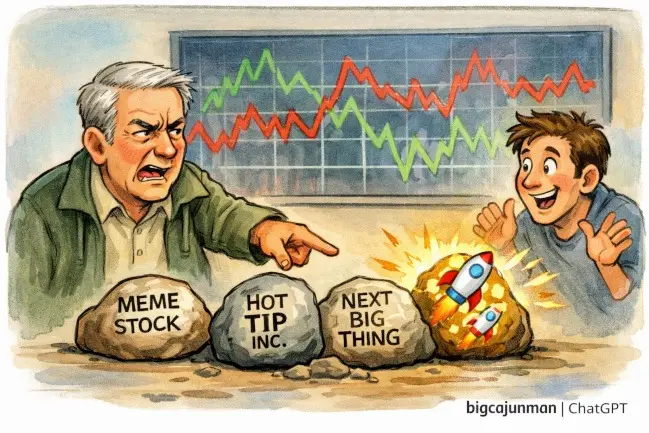
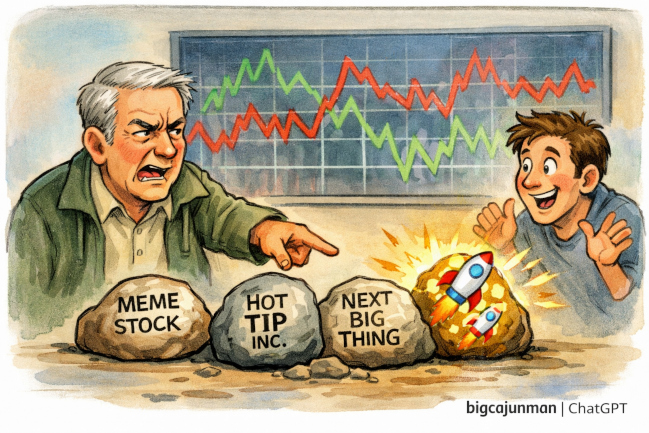
If any single dynamic has shifted dramatically over the past two decades, it is that investing has become far too accessible. Mobile trading applications, zero-commission platforms, and aggressive social media promotions have completely removed the traditional friction that once forced investors to slow down and deliberate. Today, it is easier than ever to act on a fleeting impulse and regret it immediately.
While the fundamental principles of prudent saving and risk management remain entirely unchanged, the sheer velocity at which one can execute a poor financial decision has accelerated exponentially. The modern digital ecosystem makes high-speed destruction of personal wealth remarkably convenient—a reality further compounded by the relentless expansion of the commercial betting industry into everyday financial life.