



The foundational rule of retirement planning—the widely cited 4% rule—may be fundamentally miscalculated for individuals who choose to exit the workforce decades ahead of schedule. That is the conclusion of a collaborative data simulation project between personal finance researcher Nick Maggiulli, author of Just Keep Buying, and the financial blogger known as the Mad Fientist.
The joint project addresses a long-standing criticism within the financial independence community: while the 4% rule provides a reliable guideline for traditional retirees in their seventies or eighties, it fails to account for the unique economic flexibility available to individuals who retire in their thirties or forty-somethings.
The Flaw in Applying Standard Retirement Rules to Early Retirees
The 4% rule dictates that a retiree can safely withdraw 4% of their portfolio’s initial value during their first year of retirement, subsequently adjusting that dollar amount upward for inflation each year over a standard 30-year horizon. However, financial analysts note that traditional retirees nearing the end of their working lives typically possess far less lifestyle and spending flexibility than younger retirees.
By their seventies, standard retirees usually have fixed housing situations, established family structures, and limited opportunities to re-enter the workforce or drastically alter their living arrangements if market conditions sour. In contrast, early retirees in their thirties and forties often maintain immense lifestyle flexibility. They frequently possess marketable professional skills that allow them to earn supplemental income, the ability to relocate to lower-cost regions or countries, and ample time to let investments recover from economic downturns.
Despite these distinct advantages, the standard 4% rule assumes a rigid spending trajectory, locking retirees into an annual withdrawal that scales strictly with inflation regardless of whether every expense category is actually rising.
Accounting for Fixed Costs and Conservative Inflation Assumptions
Recent discussions involving William Bengen, the creator of the 4% rule, have highlighted that the traditional formula is inherently conservative because of how it treats inflation. The standard calculation assumes that a retiree will apply inflation adjustments across 100% of their annual expenditures every single year.
In reality, many households carry large fixed expenses that remain entirely insulated from inflationary pressures. For instance, a homeowner locked into a 30-year fixed-rate mortgage will see their single largest monthly expenditure remain completely flat for decades. When factoring in fixed-cost stability alongside other conservative metrics often highlighted in modern financial research, the underlying data suggests the baseline withdrawal rate could theoretically be higher than 4% even for traditional timelines.
Yet, a longer timeline—such as an early retirement spanning 40, 50, or 60 years—requires careful adjustment. Historical analyses, including previous interviews conducted with financial planner Michael Kitces, indicate that adding ten years to a standard retirement horizon necessitates lowering the initial withdrawal rate by roughly 0.6%. Interestingly, historical market simulations show that a portfolio designed to survive for 40 years generally possesses a high probability of surviving indefinitely due to sequence-of-returns dynamics.
When combining a baseline rate that could theoretically start higher with the necessary reduction for an extended timeline, planners often find themselves mathematically right back near the traditional 4% threshold. However, this equilibrium previously ignored the dynamic spending adjustments unique to early retirees.
Incorporating Discretionary Spending Into Withdrawal Strategies
To resolve this oversight, Maggiulli and his collaborator developed an alternative withdrawal framework that explicitly accounts for discretionary spending flexibility. Rather than treating all expenses as rigid, this method requires retirees to categorize their budget into essential costs—such as housing, basic utilities, and food—and discretionary expenses that can be reduced or eliminated during adverse market conditions.
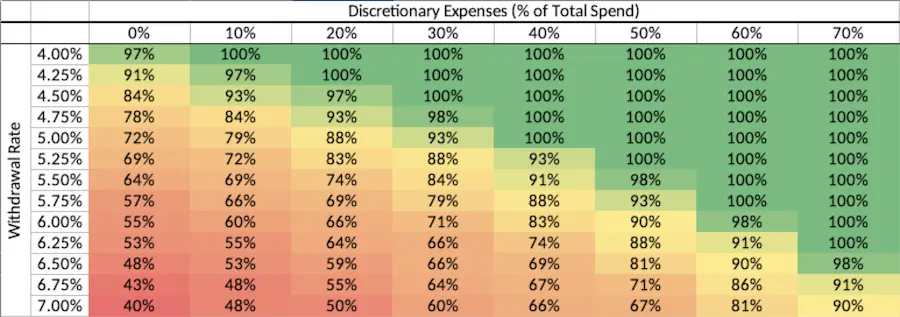
Under this new simulation model, the retiree determines the exact percentage of their budget allocated to discretionary items. By factoring this flexibility into historical market data spanning nearly a century from 1926 through 2022, the simulations demonstrate that early retirees can safely sustain a higher initial withdrawal rate without sacrificing their overall portfolio success probability.
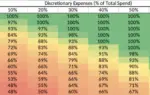
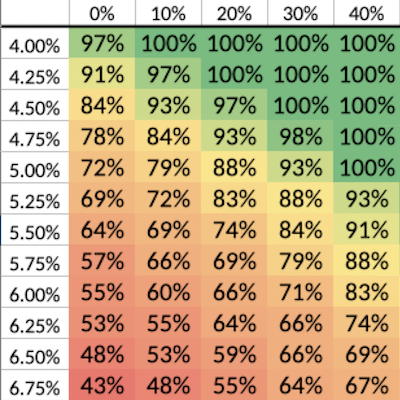
For example, a retiree managing a $1 million portfolio divided into an 80/20 stock and bond allocation using the traditional 4% rule would withdraw $40,000 in the first year, yielding a high historical success rate across 40-year periods. However, if that same retiree classifies 50% of their spending as discretionary, the new simulation indicates they can safely increase their initial withdrawal rate to 5.5% while maintaining a comparable probability of portfolio survival.
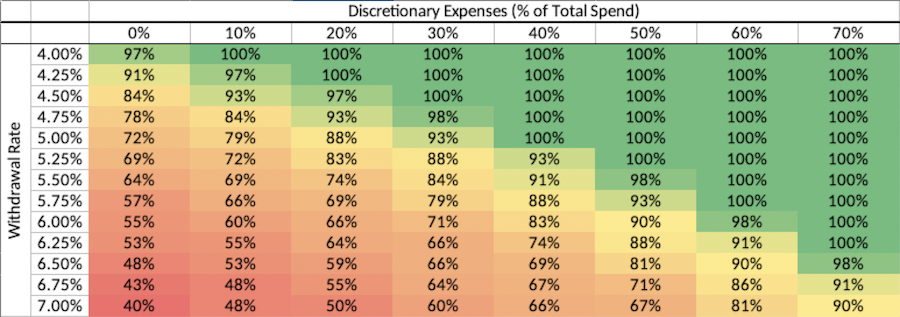
Under this flexible structure, essential expenses continue to adjust upward with inflation annually, while discretionary withdrawals fluctuate based on the previous year’s stock market performance. In years following significant market downturns, retirees trim or completely eliminate their discretionary spending, thereby protecting the core portfolio from premature depletion during vulnerable periods. Conversely, in strong market years, they can enjoy their full discretionary budget.
Practical Implications for Early Retirement Timelines
Adopting a flexible withdrawal strategy impacts both spending power and the timeline required to achieve financial independence. Because a higher withdrawal rate requires a smaller total nest egg to cover identical annual expenses, individuals can theoretically retire years earlier than strict adherence to the 4% rule would allow.
Using the previous scenario, a person needing $40,000 annually would require a $1 million portfolio under a 4% withdrawal rate. By shifting to a 5.5% flexible withdrawal rate, the required savings target drops significantly, though it comes with the explicit trade-off of tightening budgets when the broader economy and stock markets struggle.
Furthermore, financial analysts note that this approach addresses a psychological hurdle frequently encountered by early retirees. Many individuals race toward financial independence only to experience disorientation once money is no longer a driving daily motivator. Establishing a dynamic spending framework introduces healthy engagement with portfolio management and economic realities, preventing the stagnation that sometimes accompanies full retirement.
While critics might question whether market-wide indicators should dictate individual budgets—since an individual portfolio’s performance rarely mirrors the broader stock market index precisely—proponents emphasize the value of simplicity and macroeconomic awareness. Aligning personal discretionary cuts with widespread bear markets coincides with periods when the broader economy is typically under strain, making supplemental employment harder to secure and reinforcing the prudence of conservative spending.
Ultimately, the collaborative research offers early retirees a customizable framework, allowing individuals to fine-tune their essential-versus-discretionary thresholds to match their personal comfort levels regarding risk, lifestyle sacrifice, and retirement timing.