



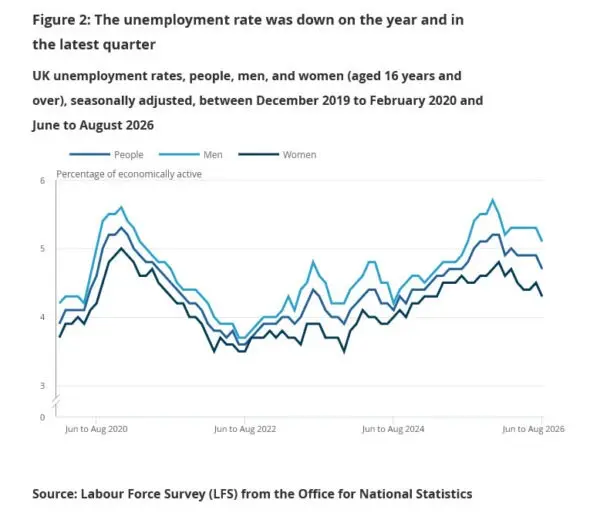
The United Kingdom labor market has delivered a surprising performance in its latest official figures, with the headline unemployment rate falling unexpectedly to 4.7% in the three months leading up to August. This marks a notable decline from the previous reading of 4.9% and comfortably beats market expectations, which had projected that joblessness would edge up to 5.0%. At the same time, the broader employment rate increased from 75.1% to 75.3% when compared with the preceding quarter, offering an initial impression of renewed resilience across the British economy.
Data compiled through the Office for National Statistics (ONS) Labour Force Survey further illustrated this quarterly upward momentum, showing that overall employment expanded by 102,000, while the total number of unemployed individuals declined by 47,000. Regular wage growth also managed to outpace forecasts, ticking up from 3.6% to 3.7% on a year-on-year basis. However, total earnings growth presented a contrasting narrative, slowing from 3.9% to 3.7% to touch its weakest pace since 2020. While these headline employment and wage figures provided some immediate encouragement for policymakers, a deeper dive into alternative labor market indicators revealed a considerably less convincing picture of underlying demand.
Payroll Employment Shows Tentative Stabilization Amid Longer-Term Weakness
Beneath the headline statistics, payroll employment displayed tentative signs of stabilization, though the longer-term trajectory remained subdued. According to provisional real-time information data released by Her Majesty’s Revenue and Customs (HMRC), payrolled employment increased by an estimated 13,000 in September, bringing the total count of payrolled employees to approximately 30.3 million.
More significantly, the previously reported decline of 26,000 for August was revised upward by 27,000, shifting the month-on-month figure to a marginal increase of 1,000. This substantial statistical adjustment notably improved the recent retrospective picture of the employment landscape. Nevertheless, despite these short-term upward revisions, total payroll numbers remained 66,000—or 0.2%—below where they stood in September of the previous year.
Market analysts point out that the ongoing divergence between rising Labour Force Survey employment figures and weaker payroll data partly reflects fundamental differences in methodology and coverage, including the inclusion of self-employment dynamics. Furthermore, because September’s preliminary payroll estimate remains subject to routine future revisions, economists remain cautious about declaring that a sustained recovery in formal hiring has officially taken hold.
Persistent Weakness in Hiring Demand and Rising Benefit Claims

While headline figures offered a degree of reassurance, hiring demand across the broader economy continued to exhibit persistent signs of weakness. Job vacancies fell by 21,000 during the three months leading to September, dropping to 691,000. This represents the lowest non-pandemic level recorded since 2014 and places vacancies 37,000 lower than the same period a year earlier.
The ONS noted that smaller businesses continue to cite escalating labor costs as a major constraint holding back recruitment efforts. Compounding this cautious recruitment outlook, the number of people claiming unemployment-related benefits climbed further. September’s Claimant Count rose by 30,300, overshooting consensus expectations of a 19,400 increase and pushing the total number of claimants to 1.701 million.
Wage pressures across the economy also proved to be unevenly distributed. Private-sector regular pay growth edged up modestly from 2.9% to 3.0%, reflecting relatively contained underlying momentum. In contrast, public-sector wage growth remained significantly elevated at 6.3%. Economists noted that this higher public-sector figure was largely driven by the specific timing of public-sector pay awards rather than a broad, economy-wide acceleration in underlying wages.
A Balanced Assessment of the British Economy
When evaluated as a whole, the UK labor market appears demonstrably more stable than the bleak payroll estimates from earlier periods had suggested, yet concrete evidence pointing toward a meaningful recovery in hiring remains remarkably limited. The combination of lower unemployment, improving Labour Force Survey employment levels, and upward payroll revisions provides a welcome cushion of reassurance for economic observers.
At the same time, falling vacancies, rising benefit claims, and negative annual payroll growth serve as persistent reminders of the continued caution being exercised by employers navigating an uncertain economic climate. Regular wage growth has largely steadied rather than accelerated in a decisive manner, with private-sector pay pressures remaining relatively well-contained.
Ultimately, this mixed labor market report offers little conclusive evidence of either a dramatic renewed surge in labor market strength or an abrupt, disorderly deterioration. With the domestic employment picture presenting such crosscurrents, financial markets and policymakers alike are turning their attention toward upcoming economic releases, making the impending inflation data particularly critical for assessing the future persistence of domestic price pressures across the United Kingdom.