


Three major global markets are converging on decisive technical levels simultaneously, creating a high-stakes backdrop for investors as a heavy week of macroeconomic data, central bank decisions, and Big Tech earnings approaches. Brent crude oil is actively testing the $120 resistance threshold amid mounting Middle East supply risks, the US 10-year Treasury yield is holding firm near the psychological 5% mark as inflation and growth fears compete for dominance, and the Nasdaq Composite is barely clinging to its 25,803 support level due to intensifying concerns over artificial intelligence financing.
With the Federal Reserve, US Gross Domestic Product, Personal Consumption Expenditures inflation data, and major technology earnings all landing in quick succession next week, the intricate interaction between these three asset classes could ultimately matter more than any single directional move. Global markets ended a potentially pivotal week with these major assets approaching crucial technical thresholds, reflecting a complex web of competing economic and geopolitical pressures that continue to shape the broader financial landscape.
Why This Matters
Global markets wrapped up a week defined by assets pressing against major technical barriers. Brent crude extended its powerful rally to reach its highest futures settlement since late April, firmly bringing the $120 region into sharp focus. Simultaneously, the US 10-year Treasury yield ended the week hovering around 5% after retreating sharply from its early-October peak. Meanwhile, the Nasdaq Composite closed near 25,955, lingering just above a critical support floor at 25,803, as persistent anxieties over AI investment returns and capital financing continued to weigh heavily on technology shares.
These three diverse markets vividly reflect competing inflation and growth risks in the global economy. Rising oil prices threaten to prolong inflationary pressures and further complicate the interest-rate outlook for central bankers. At the same time, uncertainty surrounding the long-term profitability of AI investments is undermining equity confidence and encouraging defensive demand for safe-haven Treasuries.
Whether bond yields respond more aggressively to lingering inflation concerns or weaker risk appetite could dictate the next direction for both equities and borrowing costs. With a Federal Reserve policy decision, US GDP data, PCE inflation figures, and major technology earnings all scheduled for the upcoming week, this convergence of macroeconomic and geopolitical pressures is approaching a severe test.
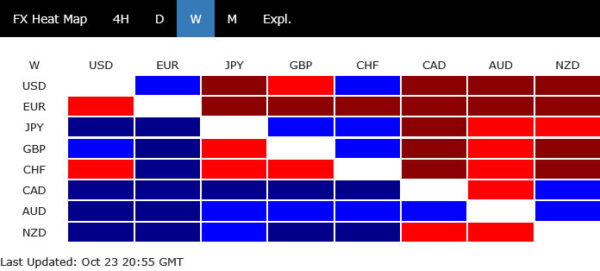
Currency markets similarly highlighted the uneven nature of the week’s market adjustments. The Australian dollar led the major currencies, followed by the Canadian dollar and the New Zealand dollar, while the euro finished at the bottom of the rankings. The US dollar and the Swiss franc also underperformed, suggesting that the technology-led equity retreat did not translate into a uniform, broad-based shift toward traditional defensive currencies. This divergence reinforces the view that markets were primarily responding to competing domestic economic and geopolitical pressures rather than a single, unified global risk-off theme.
Brent Approaches $120 as Middle East Risk Premium Builds
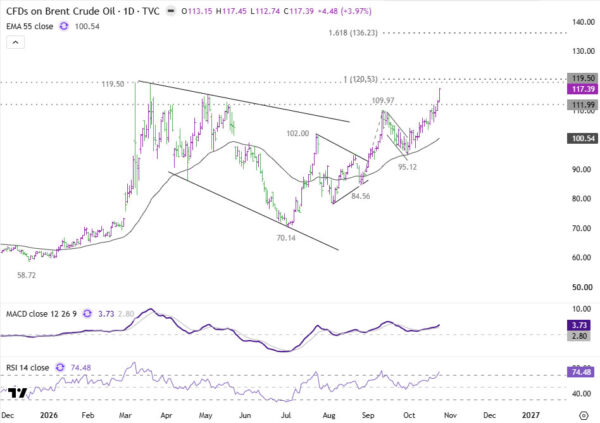
Brent crude extended its advance for a third consecutive week, with futures settling Friday at $116.72, marking a 3.1% gain on the day and approximately a 6% increase over the week. This settlement represented the highest level recorded since April 29, while the Brent CFD closed at 117.39. Measured from its October 2 settlement at $102.77, Brent has gained approximately 13.6%, reflecting a sustained repricing of geopolitical supply risks rather than an isolated, knee-jerk response to the latest headline news.
The aggressive rally has been driven in part by an escalating security situation in Saudi Arabia and the wider Middle East. Houthi attacks and claims involving Saudi energy installations, airports, and shipping infrastructure have heightened anxieties regarding further physical disruptions to energy supplies. Saudi Aramco’s precautionary evacuation of personnel from its Dhahran headquarters added significantly to the prevailing uncertainty, while repeated threats to regional shipping lanes have reinforced the market’s acute sensitivity to the security of critical energy trade routes.

A separate concern centers on the reported preparation of US-Israeli military options for renewed strikes against Iran following the November 3 US midterm elections. These reported plans have drawn intense market attention to the possibility that current political restraint regarding further US military action could lift after the election cycle concludes. However, no new military operation has been formally approved, and public comments from political figures have offered mixed signals concerning the prospects for further escalation or an eventual diplomatic resolution. Consequently, the post-election period represents a potential risk window rather than a confirmed deadline for military action.
The oil market’s inherent sensitivity is magnified by limited global supply buffers. Observed inventories have remained substantially below pre-war levels despite various production recoveries, leaving relatively little room to absorb another significant supply disruption. Meanwhile, expected demand contraction indicates that elevated prices are already beginning to weigh on actual consumption.
The current rally therefore reflects a geopolitical risk premium layered onto a market with thin supply protection, rather than concrete evidence of another major, confirmed production loss. Recovering exports and weakening demand provide partial counterweights, but the complete absence of a durable diplomatic resolution leaves prices highly vulnerable to further security developments.
Technically, Brent is approaching a particularly consequential resistance region. The March high at 119.50 is followed closely by the 100% projection of the rise from 84.56 to 109.97, measured from 95.12, located at 120.53. A sustained break above this region would carry Brent beyond its earlier wartime price spike and strengthen the technical case for an extension toward the 161.8% projection at 136.23.
However, the daily Relative Strength Index has risen to approximately 74, indicating increasingly stretched upward momentum. An initial rejection around the $120 mark would therefore not come as a surprise. The vital distinction for traders will be whether Brent can establish itself firmly above this resistance region on a closing basis, rather than merely recording another temporary intraday spike.
US 10-Year Yield Tests 5% as Inflation and Growth Risks Compete
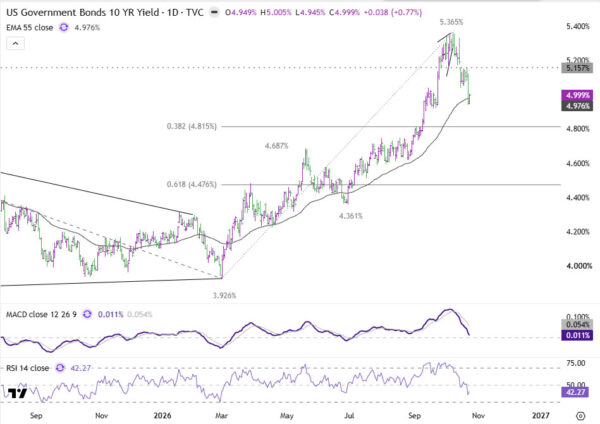
The US 10-year Treasury yield finished the week hovering around 5%, following a volatile reversal from its early-October peak of 5.365%. The benchmark yield has declined for three consecutive weeks, reflecting a significant shift in market momentum after the earlier aggressive surge in borrowing costs.
Thursday provided the clearest example of the competing forces currently influencing the bond market. As technology shares retreated sharply, investors sought traditional protection in government bonds, pushing the 10-year yield down by approximately 16 basis points. Inflation-adjusted real yields also declined, suggesting that the move was closely associated with defensive capital flows and growing anxieties regarding the broader growth and financing outlook.
Friday brought a partial reversal, however. Treasury yields rebounded toward the 5% threshold as crude oil extended its rally, even as US equities remained under intense downward pressure. These contrasting sessions vividly illustrate how the bond market is being pulled in opposing directions by weaker risk appetite on one side and renewed inflation concerns on the other. Nevertheless, individual yield movements cannot be attributed exclusively to either factor alone, as monetary policy expectations, heavy Treasury supply dynamics, and term premiums continue to heavily influence overall borrowing costs.
Federal Reserve fed funds futures continue to strongly favor an unchanged policy rate at the central bank’s upcoming Wednesday meeting. The distribution of expectations suggests that investors have become increasingly less convinced of an immediate rate move, though they have not completely abandoned expectations for further monetary tightening later in the year.
From a technical perspective, the psychological 5% threshold and the daily 55 Exponential Moving Average situated around 4.976% form the immediate market decision zone. A sustained break below this area would reinforce the recent downward trend and bring the 38.2% retracement of the advance from 3.926% to 5.365%, located at 4.815%, directly into focus. Further weakness would subsequently expose the 61.8% retracement level at 4.476%.
Conversely, a sustained recovery and stabilization above the 5% level would suggest that the recent Treasury bond rally is rapidly losing steam. If accompanied by continued strength in oil prices and weaker equity markets, such a move would spark fresh concerns that renewed inflation or persistent borrowing-cost pressures were becoming the dominant drivers of the economy. The direction of bond yields next week will therefore prove critical not only for the Treasury market itself, but also for determining whether overall financial conditions provide much-needed relief or additional pressure for technology shares.
Nasdaq Nears Critical Support Amid AI Investment Concerns
The Nasdaq Composite ended Friday trading at 25,955, following Thursday’s steep 2.6% decline, which marked its largest single-day loss since June. The index has now retreated approximately 6% from its early-October record high near 27,723, as investors increasingly question the massive financing requirements and the timing of eventual financial returns associated with large-scale artificial intelligence investments.
Market concern has clearly shifted from whether AI investment is actively supporting corporate growth to whether the sheer scale and capital cost of that investment can realistically be justified over the medium term. Recent corporate earnings have demonstrated continued robust demand for AI-related products and services, but substantial capital expenditure commitments have aggressively renewed investor attention on profitability, cash generation, and the availability and cost of external financing. This pressure has been particularly evident among semiconductor companies and various businesses closely tied to AI infrastructure development.
The financing dimension makes broader Treasury yields especially relevant to the tech sector. Higher borrowing costs increase the financial burden of funding heavy AI infrastructure, particularly for companies heavily dependent on external capital markets. Conversely, lower yields could theoretically ease overall financial conditions, although a bond yield decline driven primarily by deteriorating macroeconomic growth expectations would not necessarily provide lasting support for equity valuations.
Technically, the Nasdaq’s recent retreat has pushed the index below its daily 55 EMA near 26,528, while the daily RSI has fallen to around 38 and the MACD indicator has noticeably weakened. The immediate market focus is fixed squarely on the 25,802.96 support level, which sits a mere 0.6% below Friday’s closing price.
A firm break below 25,803 would signal an extension of the current equity correction, but the more significant technical level lies around 25,036, representing the 38.2% retracement of the massive advance from 20,690 to 27,723. This crucial level also coincides neatly with the lower boundary of the rising price channel originating from the April low. A sustained break through that support region would carry far greater negative implications for the broader bullish market structure, suggesting that the current retreat is evolving well beyond a relatively contained correction. Further downside technical references would then include 24,425 and the 61.8% retracement level near 23,377.
On the other hand, successful stabilization above the 25,803 mark, followed by a recovery back through the daily moving average, would suggest that selling pressure is finally easing. Next week’s major technology earnings reports could provide the necessary catalyst for either outcome, particularly through corporate guidance concerning capital expenditure, profit margins, and expected returns on AI infrastructure.
Oil, Treasury Yields, and Nasdaq: Three Markets, One Competing Set of Risks
The complex interaction between these three major markets could ultimately prove far more important than their individual price movements. Higher oil prices represent a direct inflation and operating-cost risk for the broader economy. A sustained advance beyond the $120 level could reinforce widespread concerns regarding consumer price inflation, business input costs, and the growing prospect of interest rates remaining elevated for an extended period. Higher borrowing costs would, in turn, present an additional, compounding challenge for technology companies already facing intense market scrutiny over AI investment financing.
By contrast, a deeper correction in the Nasdaq could encourage heavy defensive Treasury buying, driving bond yields lower even if underlying inflation concerns remain elevated. Such a decline in yields would not necessarily signal improving overall financial conditions if it merely reflected deteriorating investor confidence or heightened anxieties about future economic growth.
The relationship between Nasdaq and Treasury yields will help market participants distinguish whether the next phase of financial market volatility is predominantly driven by lingering inflation pressures or broader concerns surrounding economic growth and capital financing.
Week Ahead: Fed, GDP, PCE, and Big-Tech Earnings
The coming week brings an unusually concentrated sequence of monetary policy decisions, crucial economic releases, and major corporate earnings reports that are poised to thoroughly test all three key markets.
The Federal Reserve announces its latest monetary policy decision on Wednesday, October 28. With an unchanged interest rate widely anticipated by market participants, primary attention will focus closely on how Chair Kevin Warsh assesses the conflicting economic signals emanating from resilient economic activity, persistent inflation, and renewed financial market volatility. The absence of updated economic projections makes the accompanying policy statement and press conference particularly vital for interpreting the central bank’s near-term outlook.
Thursday’s releases of US third-quarter Gross Domestic Product and September Personal Consumption Expenditures inflation data will provide definitive evidence regarding the underlying strength of economic growth and the persistence of price pressures. Strong economic growth combined with elevated inflation readings could readily support bond yields, whereas weaker economic activity would dramatically increase market attention on the growth risks underlying the ongoing technology sector correction.
Corporate earnings will prove equally influential. Alphabet and Microsoft are scheduled to report on Wednesday, followed closely by Amazon and Intel on Thursday. Investors will look far beyond headline earnings figures to scrutinize AI capital expenditure, funding requirements, free cash generation, and expected financial returns on infrastructure investments. Strong results may help stabilize the Nasdaq, but substantial additional spending commitments could easily invite further aggressive scrutiny from wary shareholders.
Treasury auctions spanning the two-, five-, and seven-year maturities will offer additional, real-time indications of institutional investor demand for government debt. Across the globe, Australian inflation data, upcoming monetary policy decisions from the Bank of Canada and the European Central Bank, and the Bank of Japan’s meeting will all contribute to the broader, interconnected global interest-rate backdrop.
Beyond the immediate week, the November 3 US midterm elections remain an important potential geopolitical turning point for the global oil market, particularly given ongoing reports of military contingency planning involving Iran.
Market Outlook: Three Levels to Watch
Financial markets enter the new week anchored by three closely connected technical thresholds: Brent crude around $120, the US 10-year Treasury yield near 5%, and Nasdaq support at 25,803, followed closely by the highly consequential 25,036 region. None of these individual levels guarantees an immediate breakout or breakdown. Brent’s price rally is technically extended, Treasury yields are carefully balancing competing macroeconomic forces, and the Nasdaq’s correction has not yet breached the vital support region that would place its broader rising market structure under severe pressure.
Nevertheless, this convergence is profoundly significant. The oil market is currently testing just how much geopolitical inflation risk global markets can absorb, technology shares are testing investor confidence in the underlying economics of artificial intelligence investment, and Treasury yields are reflecting the acute tension between those opposing forces. With the Federal Reserve, major GDP and PCE data releases, and heavy technology earnings arriving in quick succession, the coming week is set to provide a much clearer indication of whether global markets are finally approaching stabilization or bracing for another intense phase of financial adjustment.