




Marking a major personal and professional milestone, the creator behind the popular personal finance platform the Financial Independence Podcast recently celebrated ten years of post-financial independence (FI) life. Stepping away from the traditional workforce a decade ago unlocked a transformative chapter, bringing deep personal fulfillment alongside unexpected shifts in perspective. As the milestone arrived, reflections on the past ten years revealed a profound sense of gratitude, evolving attitudes toward spending and lifestyle creep, a reevaluation of modern career risks like artificial intelligence, and the unfamiliar territory of living without a driving long-term financial goal.
The journey began with the decision to leave a traditional career, a leap that ultimately afforded the luxury of spending entire days with young children and witnessing vital developmental milestones firsthand. Beyond the priceless family time, the financial side of the equation has taken on an unexpected sheen, particularly in light of rapid technological shifts. As a former software developer, the host once viewed the profession as a foolproof, reliable fallback career if economic tides turned or lifestyle costs unexpectedly inflated. However, recent hands-on exploration of advanced artificial intelligence tools, such as Claude Code, has fundamentally altered that outlook.
While experimenting with AI to build projects has been an incredible creative outlet for someone with a natural inclination toward programming, the realization is stark: artificial intelligence is poised to have a dramatic impact on the broader software developer market. The certainty of simply returning to code a backup salary to support living and investing expenses no longer exists. For anyone currently relying on a traditional developer’s salary, the climate warrants caution. Surviving outside that ecosystem has eliminated the need to worry about AI’s looming disruption, offering immense relief and validating the security built over the years.
Reflecting further on the financial trajectory, the strategy evolved organically from modest origins into something far more robust. Initial plans centered firmly around lean FIRE—retiring on a bare-bones budget with the safety net of future coding work if necessary. Looking back, the transition from lean FIRE to an accidental fat FIRE lifestyle proved to be a welcome evolution. For anyone currently evaluating their financial independence strategy—particularly software developers locked into high-paying roles that are not entirely miserable—the advice is to reconsider rushing toward the exit via a bare-bones lifestyle. Staying in the workforce just a bit longer to accumulate a larger buffer offers a crucial shield against unforeseen labor market shifts while enabling a much more enjoyable post-work reality.
That enjoyment stems directly from a major psychological shift regarding spending. While the day-to-day lifestyle looks fairly normal from the outside, the internal relationship with money has completely transformed. Knowing that a robust portfolio safely covers an upper-middle-class standard of living has completely eradicated financial anxiety. Daily choices are no longer filtered through the lens of price tags or cost constraints. Whether indulging in the highest-quality morning coffee or treating the family to appetizers, cocktails, and desserts at dinner, the expenditures do not move the needle.
This realization mirrors lessons learned from past conversations with financial expert Ramit Sethi, author of I Will Teach You to Be Rich. Ideas that once seemed counterintuitive now resonate deeply. One such piece of advice—asking why one should spend less when they can spend more—initially made no sense. Today, it serves as a guiding philosophy. Because imagination and genuine desire for material goods are inherently limited, the few things actually purchased ought to be the highest quality available in their category. Investing in superior, well-designed items that last longer and bring genuine daily utility adds immense value, making the act of consumption deeply satisfying rather than a source of clutter.
Another paradigm shift involved learning to embrace waste, manage sunk costs, and let go of an obsession with strict efficiency. Efficiency has historically driven every facet of lifestyle design and software programming. Yet, letting go of that absolute optimization has yielded significant dividends. Concrete examples include recent travel decisions during major trips to Canada and Italy. When a family trip to Canmore, Canada, reached an incredible emotional peak after a weekend visit from relatives, the decision was made to cut the remaining nine days of the itinerary short and book separate one-way tickets home. Rather than dragging out the vacation for the sake of utilizing pre-booked accommodations, ending on a high note preserved the fondest memories, avoided exhaustion, and ultimately saved money on prolonged daily expenses.
These mental adjustments naturally increased annual expenditures, reframing lifestyle creep entirely. While lifestyle creep is traditionally viewed as a dangerous trap where individuals inflate spending after a raise without boosting savings, asset-based lifestyle creep tells a different story. When portfolio growth drives sustainable spending increases—such as an extra eight thousand dollars a year generated by a growing nest egg—the gradual expansion feels just as rewarding as blowing a corporate bonus, but with the vital distinction that the purchasing power is permanent and inflation-adjusted year after year.
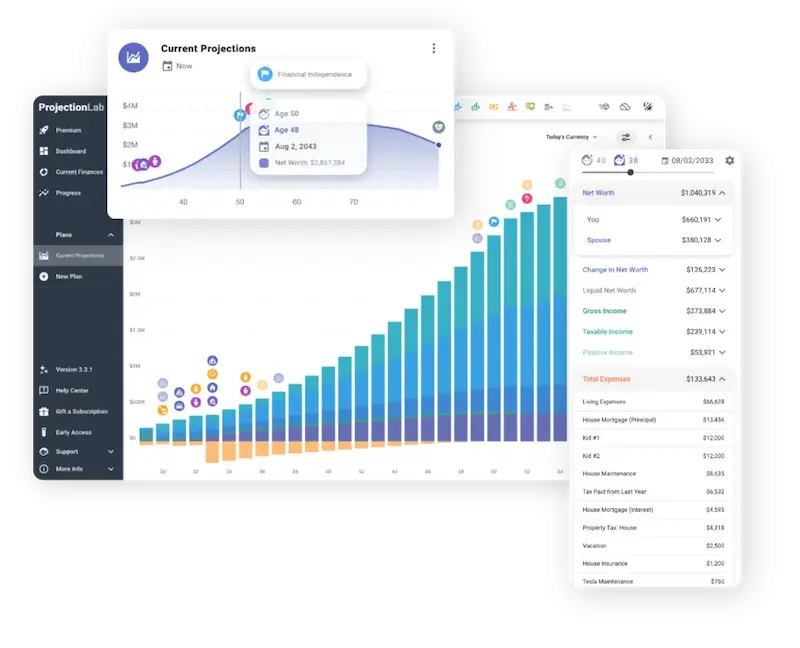
This philosophy directly inspired the development of Wealth Machines, a software tool designed to help individuals recognize and safely utilize surplus assets to enrich their present lives. Building a massive nest egg for a distant future should not come at the absolute expense of enjoying the present. Extracting value from accumulated wealth along the path to financial independence makes the journey significantly more rewarding than starving present consumption solely to cross the finish line as quickly as possible.
Along with embracing spending, simplicity has decisively triumphed over hyper-optimization in portfolio management. The early days of the path to financial independence were defined by complex tax strategies, backdoor Roth contributions, and maintaining a tiny percentage of individual speculative stocks for fun. Over time, the mental baggage associated with tracking and rebalancing these intricate pieces became an unnecessary burden. Eliminating backdoor Roth contributions to avoid the ticking task list and liquidating individual stock holdings in favor of a streamlined collection of permanent core funds has drastically reduced administrative stress.
To further insulate the financial foundation, a strategic adjustment was recently made to take risk off the table. A portion of the stock portfolio was reallocated into thirty-year Treasury Inflation-Protected Securities (TIPS) currently yielding a historically high real rate near three percent. These bonds are structured to mature precisely when standard retirement age arrives and required minimum distributions (RMDs) from retirement accounts begin to kick in. Securing this predictable, inflation-adjusted income floor guarantees essential long-term financial stability without requiring ongoing micro-management.
Despite a comfortable, sustainable routine that accommodates spontaneous travel, dining out, and daily comforts, portfolio growth continues to outpace current spending. This pleasant dilemma has sparked new conversations regarding long-term housing and lifestyle maximization. As family life enters a peak fifteen-year window—with healthy parents, a grandmother, and young children growing rapidly—the primary focus is optimizing the present era. The most compelling use of surplus capital moving forward involves establishing a permanent home base in an ideal location.
The vision centers on creating a gravitational pull for the family, securing a property in a walkable, beautiful community with great weather and enough space to comfortably host visiting family and friends for extended stays. By planting deep community roots while the children are young, the objective is to build a cherished environment that naturally draws them back as they grow older and forge their own paths. Experimenting with long-term rentals in various regions will guide the search over the next few years, turning the exploration into an exciting new adventure.
Perhaps the most profound realization after a decade of freedom is entering entirely uncharted territory: the absence of long-term financial and career goals. Having successfully achieved the milestones that financial independence was designed to unlock, the underlying motivation has shifted away from planning exclusively for tomorrow. Rather than forcing compliance with dreaded cardio routines like rowing machines or running, physical health is now maintained through joyful activities like playing tennis. The guiding principle is simply to make the present day as rich and memorable as possible, investing fully in family, presence, and daily contentment without compromising the future.