



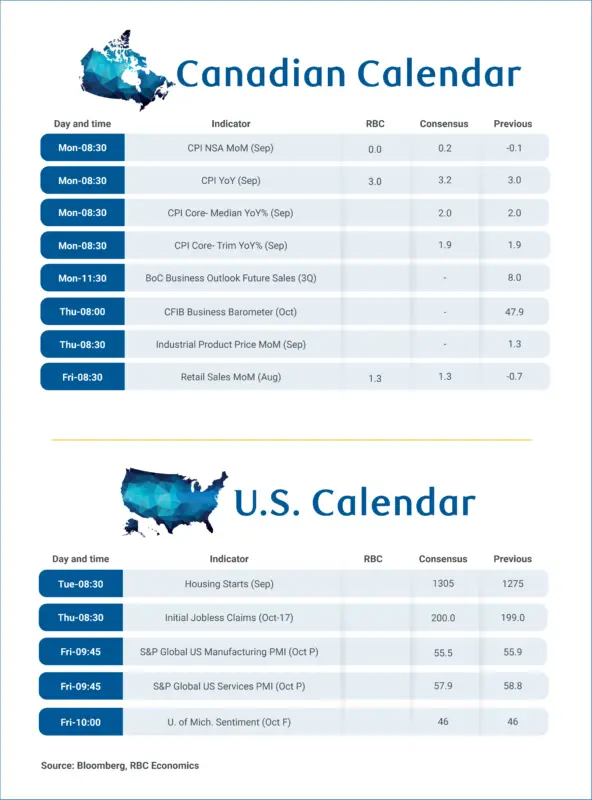
As the calendar turns toward the end of October, financial markets and policymakers in Ottawa are bracing for a pivotal cluster of economic data. Canadian inflation figures and the Bank of Canada’s Q3 Business Outlook Survey, both scheduled for release on Monday, will be scrutinized by analysts and central bankers alike for definitive signs of whether persistent energy price pressures are beginning to broaden and permeate deeper into the broader economy.
These upcoming economic releases are set to serve as foundational inputs for the Bank of Canada’s crucial interest rate decision on October 28. Governing Council members have grown increasingly wary that stubbornly high global oil prices could spill over past the pumps, driving up non-energy components and stoking rising inflation expectations among both businesses and consumers.
However, these mounting inflation risks do not exist in a vacuum and must be carefully balanced against a gradually improving domestic economy that nevertheless remains fundamentally soft. Economic progress has been decidedly choppy throughout the year. Real gross domestic product growth is projected to slow noticeably in the second half of 2026, cooling down from the relatively stronger pace recorded in the second quarter. Furthermore, the labor market has shown clear signs of fatigue, with net employment declining consecutively through August and September. After falling steadily over the prior year, the national unemployment rate has plateaued stubbornly around 6.5% over the past three months.
Given this delicate macroeconomic balancing act, market watchers continue to expect a somewhat contentious trade-off between lingering inflation risks and underlying economic softness. This tug-of-war is widely anticipated to keep the Bank of Canada uncomfortably on hold through the remainder of 2026, leaving monetary policymakers with very little room for error as they navigate a complex landscape of competing pressures.
Inflation Held Up by Persistently Elevated Energy Prices

Looking ahead to the incoming consumer price figures, headline inflation in Canada is expected to hold steady at 3.0% year-over-year in September, marking the third consecutive month the headline metric has remained at that exact level. Underlying this reading, energy inflation likely accelerated over the month as gasoline and furnace oil prices registered significant increases compared to August. Conversely, food inflation is anticipated to continue its gradual moderation, offering a measure of relief to household grocery budgets.
When stripping out the more volatile categories of food and energy, core inflation is expected to edge down slightly to 1.8% in September, dipping from the 2.1% reading recorded in August. Economists continue to anticipate a very limited pass-through of broader energy inflation into core components outside of airfares, though transportation categories will be watched closely as they remain among the most vulnerable to fuel cost shocks.
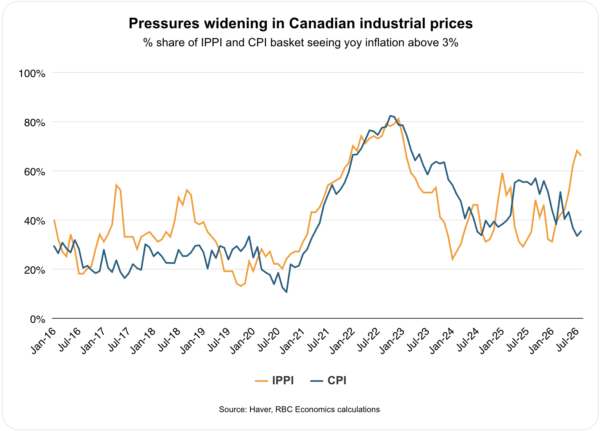
The consumer price index diffusion index, which serves as a vital gauge for measuring the breadth of underlying price pressures across the economy, has so far failed to point to a problematic broadening in the scope of inflation. The share of the consumer basket that has experienced annual price growth exceeding 3% remained exceptionally narrow in August at just 35%, down sharply from 54% recorded a year prior.
At the same time, however, the equivalent diffusion index tracking industrial production prices has already flashed warning signs of a concerning upward spread. Despite this factory-gate pressure, there remains a long way to go before those upstream price increases are ultimately passed down through various production layers to reach final consumer prices on retail store shelves. For that transition to occur, global energy prices would need to remain elevated for a sustained period between the industrial and retail stages.
Business Survey to Unveil Shifting Inflation Expectations
Complementing the incoming consumer price data, the central bank’s third-quarter Business Outlook Survey will offer crucial qualitative signals regarding the real-world impact of elevated energy inflation, including a detailed look at how those cost pressures have shaped corporate expectations moving forward.
Overall business sentiment weakened noticeably during the second quarter, weighed down heavily by higher fuel costs and lingering geopolitical and trade uncertainties. Unfortunately, rather than receding, those external risks escalated significantly during the third-quarter survey period, which ran from early to mid-August. This window coincided with a renewed surge in global oil prices alongside a fresh flare-up in international trade tensions, marked by the imposition of new U.S. Section 338 measures on August 22. Economists expect these compounding uncertainties to have weighed heavily on corporate sentiment and overall business outlooks.
Analysts will be scouring the survey results for granular details on changes in firms’ future sales outlooks, capital investment plans, and hiring intentions. Furthermore, executive reports regarding input and selling price increases, alongside any shifts in corporate inflation expectations, will be evaluated for signs of persistence. While short-term inflation expectations among businesses are expected to show another notable uptick, medium- to longer-term expectations are anticipated to remain relatively well-anchored near the central bank’s foundational 2% target.
Beyond the federal economic data releases, regional political developments are also commanding attention. In Alberta, voters are participating in a high-stakes process starting Monday, October 19, on whether to initiate formal steps toward a future binding referendum on provincial separation, with advance polling having already opened on Tuesday.
Looking further ahead on the economic calendar, next Friday’s retail sales report is widely expected to align closely with Statistics Canada’s advance estimate, which pointed to a solid 1.3% increase in economic activity for August. Given that retail gasoline prices remained largely flat on a month-over-month basis, the expansion in August was likely driven by genuine increases in sales volumes. This resilience is consistent with proprietary RBC card transaction data, which has demonstrated solid consumer spending trends throughout the summer months and continued, albeit slower, growth heading through September.