



Brent crude prices rallied sharply on Thursday, jumping over 4% to hit a two-week high as a compounding wave of geopolitical tensions in the Middle East and severe weather disruptions along the United States coastline renewed acute anxieties regarding global energy supplies. The convergence of escalating conflicts in vital shipping lanes, potential military escalations involving major regional powers, and weather-enforced shutdowns of domestic US oil and gas infrastructure combined to propel energy markets upward, shifting the near-term technical and fundamental outlook firmly in favor of bullish traders.
The immediate catalyst for Thursday’s aggressive price action stemmed from growing supply apprehensions in critical international maritime chokepoints. Reports surfaced detailing intensifying attacks on commercial vessels navigating the Gulf and the Strait of Hormuz. These incidents introduced fresh volatility, counteracting earlier optimism from reports indicating that oil flows through the Strait of Hormuz had managed to recover approximately 81% of their pre-war volumes. Compounding these maritime risks, a significant number of US offshore and onshore oil installations were forced to shut down operations in response to severe weather and an approaching hurricane, cutting domestic production and tightening an already delicate supply balance.
Beyond immediate logistics and weather disruptions, the broader geopolitical landscape deteriorated significantly, providing a powerful psychological and fundamental tailwind for higher oil prices. The conflict in Yemen saw a pronounced escalation, while regional actors, including Syria, signaled potential intentions to provide active assistance to their regional allies, notably Saudi Arabia, which remains deeply entangled in ongoing hostilities. Furthermore, market sentiment was rattled by the latest indications that the United States and Israel are preparing for potential military actions against Iran, with observers noting that operational readiness is reportedly awaiting final approval from President Trump. This compounding matrix of geopolitical flashpoints injected substantial risk premiums back into energy markets.
Reflecting this explosive mix of supply threats and geopolitical risk, oil prices surged past the $105-per-barrel threshold for the first time since September 25. This decisive move allowed Brent to retrace more than 61.8% of its preceding downward correction from the $109.77 high down to the $95.11 swing low. More importantly, the commodity successfully broke above the former recovery peak recorded on October 1 at $103.95. This technical breakout generated a strong bullish continuation signal, validating the broader recovery leg that originated from the $95.11 support level.
Market analysts closely monitoring the technical landscape noted that the daily chart underwent significant improvements. The latest upward push followed repeated rejections at key bull-trendline support zones, a clear indication that larger-scale buyers continue to maintain control over the market dynamics. Furthermore, the daily moving averages shifted into a fully bullish configuration, while the 14-period momentum indicator successfully pushed back into positive territory. These improving technical metrics have dovetailed seamlessly with favorable underlying fundamentals, leaving the near-term market focus firmly anchored on further upside potential.
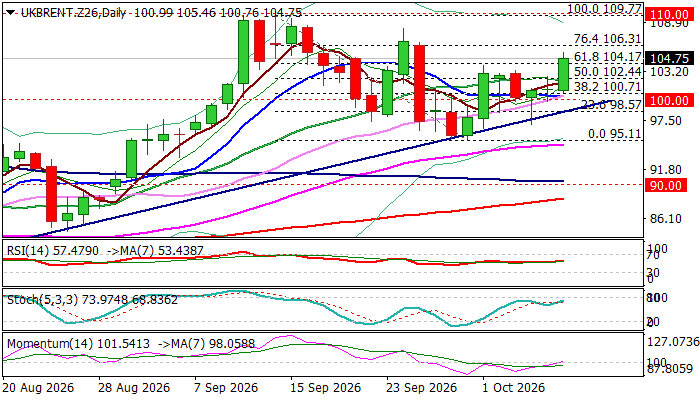
For the bullish trajectory to be fully cemented, market participants are watching for a sustained, confirmed break above the critical $103.95 technical barrier. Achieving this would keep the price firmly on an upward trajectory, clearing a path toward the initial upside target situated at $106.31, which corresponds to the 76.4% Fibonacci retracement level. Beyond that milestone, stronger resistance guards the $108.22 area—marking the lower top from September 24—and ultimately the key $110 resistance zone, a formidable ceiling where multiple upward probes repeatedly stalled throughout September.
On the downside, traders are keeping a close watch on immediate support levels to gauge market resilience should a corrective pullback occur. Near-term support is currently identified at 103.37, followed by deeper safety floors at 102.44, 101.98, and the psychological and technical cushion at 100.76. As the market digests the dual pressures of Middle Eastern geopolitical friction and US production losses, traders and analysts alike remain focused on whether upcoming developments will provide the necessary momentum to test the upper resistance boundaries in the sessions ahead.