


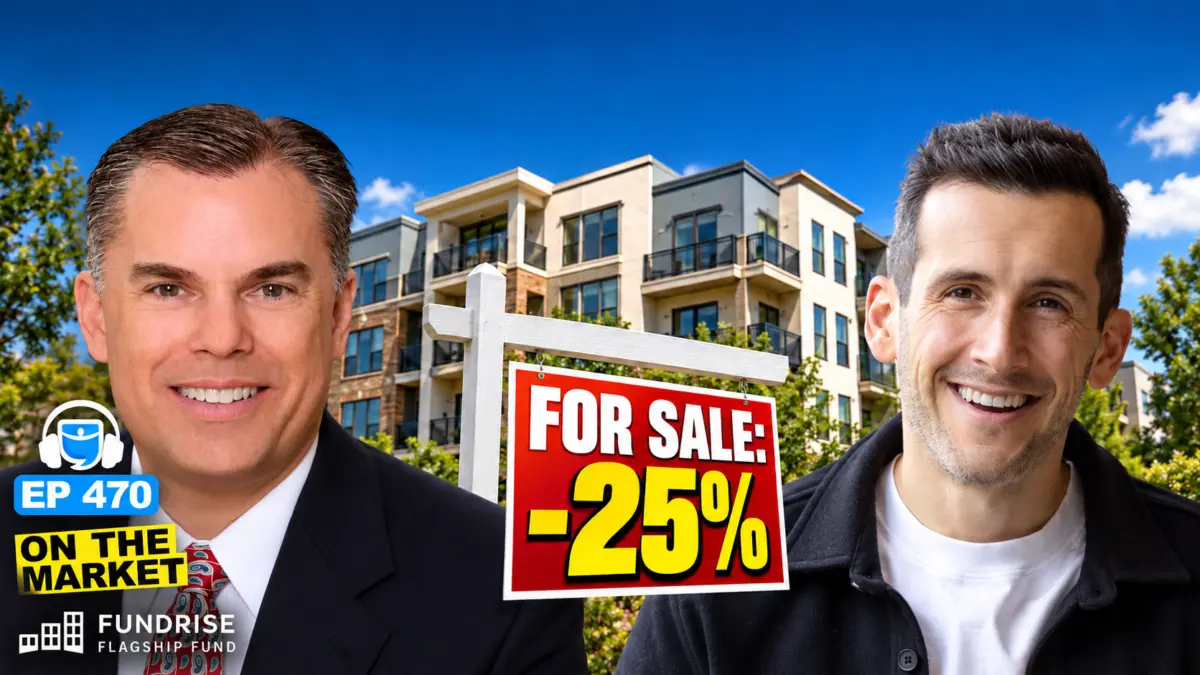
As investors evaluate opportunities across the economic landscape—from residential real estate and gold to cryptocurrency and equities—commercial real estate is increasingly emerging as a standout asset class for the coming decade. While prices remain stubbornly high in residential housing, the stock market, and commodities, the commercial sector has already experienced significant downward corrections. With values falling at least 20% broadly and dropping by as much as 50% in sectors like office space, market analysts suggest that these declines could deepen further, potentially opening up a once-in-a-generation buying opportunity for prepared investors.
To examine this market hypothesis, real estate investor and podcast host Dave Meyer recently invited multifamily expert Brian Burke onto the "On the Market" program to discuss the unfolding situation in the commercial real estate sector. Reflecting on broader economic parallels, Meyer noted that the years 2027 and 2028 could ultimately mirror the profound corrections that 2007 and 2008 brought to residential real estate. Just as many investors later kicked themselves for failing to enter the residential market in 2010 and 2011, a strikingly similar dynamic may soon take shape within commercial real estate.
Assessing the current condition of the multifamily market, Burke didn’t mince words, describing the environment as a complete disaster that has been brewing for years. Rather than a sudden shock, Burke compared the situation to the proverbial frog boiling slowly in a pot, where conditions deteriorated gradually until the water finally boiled over, forcing industry participants to confront an undeniable reality.
For months, market observers have debated why severe distress has taken longer to materialize than initially anticipated. Many market participants mistakenly assumed that the Federal Reserve would swiftly intervene and cut interest rates to rescue over-leveraged properties. However, Burke emphasized that such expectations stem from a fundamental misunderstanding of monetary systems. The Federal Reserve directly controls only overnight interbank borrowing and short-term rates, whereas long-term debt rates for multifamily assets are heavily influenced by the 10-year Treasury bond, which operates independently of central bank mandates.
The initial wave of pressure began when the Fed raised overnight borrowing rates, which drove up the secured overnight financing rate (SOFR) and severely penalized properties carrying floating-rate debt. Subsequently, rising 10-year Treasury yields eliminated the safety valve of refinancing into long-term debt, as long-term borrowing costs surged past acceptable thresholds. This dynamic has triggered widespread cap rate decompression. Properties simply cannot transact at four or five percent cap rates in an economic environment where Treasury yields hover significantly higher, resulting in fundamentally broken investment math.
Brokers attempting to market properties are caught in a classic real estate conundrum. While sellers continue to demand pricing based on historical peaks, buyers refuse to step into negative leverage—a scenario where a property’s cap rate falls below its borrowing cost, guaranteeing an operational loss. During the pandemic boom, excessive investor capital flowed freely into real estate driven by the belief that hard assets outperformed equities, regardless of underlying fundamentals. Now that sentiment has shifted, investors have pulled back, leaving overpriced assets stranded.
The current downturn is not merely a byproduct of higher interest rates, but rather the result of a convergence of economic factors. Burke described the situation as a four-way traffic collision where multiple green lights—encompassing cap rates, interest rates, rent growth, and occupancy—suddenly collided in the middle of an intersection. Concurrently, demographic shifts have exerted downward pressure on rental demand. Birth rates have declined for nearly 18 years, shrinking the primary 18-to-30 age demographic that constitutes the core apartment-renting population. Furthermore, historic lows in population growth and a sharp decline in international immigration have coincided with an unprecedented wave of apartment construction in markets such as Austin, Texas, and Denver, creating a severe supply and demand dislocation.
Navigating the recovery will require patience, as market corrections of this magnitude typically unfold over several years. Historical precedent indicates that double-digit declines in commercial real estate—such as those seen following 1980s tax law changes and the 2008 global financial crisis—are rare, occurring only twice in the past fifty years. Following both historical drops, the market experienced a multi-year bull run lasting over a decade. Consequently, investors do not need to time the absolute bottom of the market; waiting for clear evidence of stabilization still allows participants to capture long-term upside while significantly reducing risk.
For investors monitoring the sector, recovery indicators will include declining rental concessions, positive lease trade-outs where incoming tenants pay higher rent than departing ones, decreasing vacancy rates, and renewed market rent growth. While long-term retail investors targeting multi-decade retirement holds can absorb near-term volatility more easily, those deploying institutional or raised capital must time their market entry carefully.
Executing successful acquisitions during this period relies heavily on established industry relationships. Because distressed assets rarely appear on public listing platforms or standard multiple listing services, active investors must forge strong ties with property management companies hired by lenders and asset managers to oversee troubled properties in receivership. Maintaining close communication with commercial brokers who track owner constraints and local market distress is another proven path to off-market deal flow.
Prospective buyers must also position themselves as reliable solutions for lenders seeking certainty under strict regulatory or reporting timelines. Demonstrating immediate access to capital or maintaining soft commitments from a robust investor network ensures that sellers and lenders view potential buyers as capable of executing transactions without delay. While traditional fixed-rate long-term debt remains the gold standard for stabilized assets, interim financing tools like bridge debt may occasionally serve a tactical purpose when acquiring deeply discounted, under-occupied properties at the bottom of a cycle.
Ultimately, market participants are advised to use the current period for rigorous preparation—building investor networks, refining strategic criteria, and establishing clear operational plans. As the commercial real estate sector continues to absorb ongoing economic pressures, disciplined investors who remain patient and prepared will find substantial opportunities amid the market chaos.