



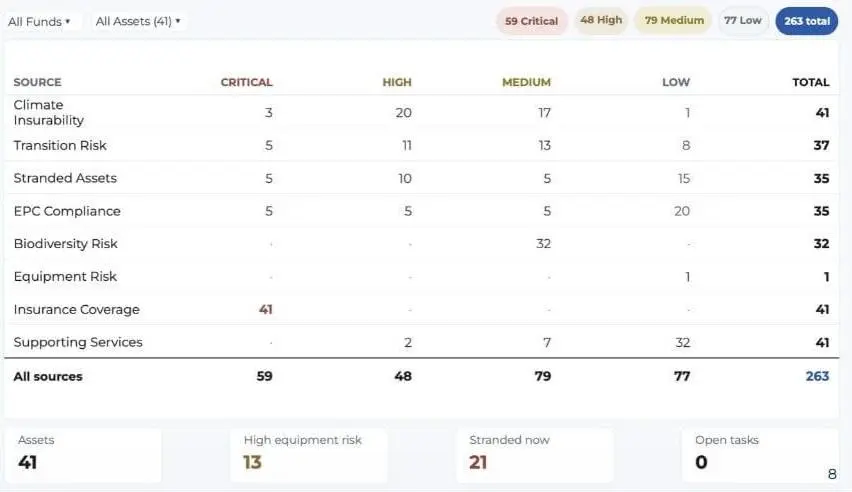
Sustainability and business risk software provider ESG Playbook has announced the official launch of its new real estate dashboard, a specialized technological solution designed to enable real estate asset managers, institutional investors, and lenders to thoroughly quantify climate, energy, and retrofit risks across building portfolios.
Announced by the company, the newly developed dashboard is engineered to provide market participants with deep visibility into the "true cost" of owning and operating a commercial or residential building. In an era where regulatory pressures, decarbonization mandates, and physical climate hazards increasingly threaten property values, the tool aims to empower deal teams to rapidly screen large pipelines of potential acquisitions. By peering past initial asking prices, users can instantly evaluate what specific capital expenditures a building will require to remain competitive and compliant, while seamlessly matching identified retrofit plans against an extensive database of over 1,400 financial incentive programs spanning 52 countries.
The commercial real estate sector faces a rapidly evolving landscape shaped by stringent climate regulations, rising energy costs, and shifting tenant expectations. According to ESG Playbook, the introduction of this solution will help investors, asset managers, and lenders identify potential structural, financial, and environmental concerns much earlier in the investment lifecycle. By streamlining the initial screening process, organizations can prioritize which properties warrant deeper, more resource-intensive due diligence before committing capital.
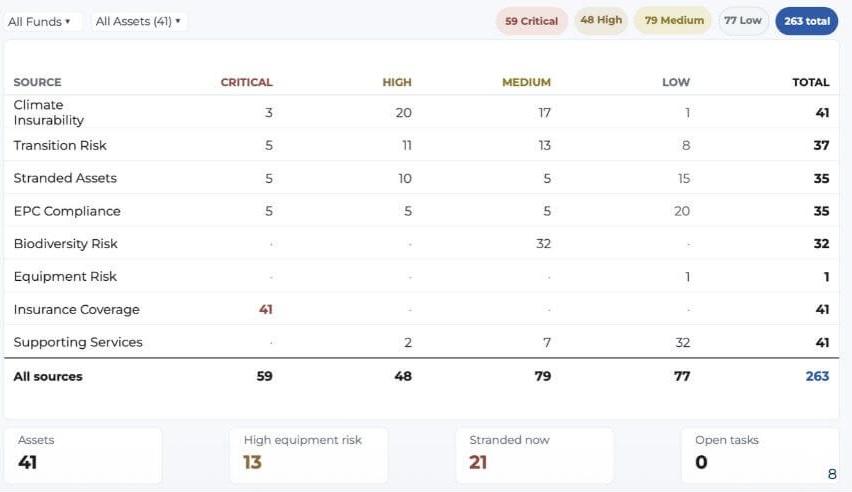
At the core of the new dashboard is a comprehensive suite of advanced features tailored specifically to the demands of modern real estate finance and asset management. The platform incorporates AI-assisted screening capable of processing high volumes of investment opportunities. This capability generates rapid assessments covering overall asset risk, distinct property strengths, critical red flags, and potential data gaps. Furthermore, the AI-driven screening evaluates climate risk adjustments, net operating income (NOI) trajectories, tenant and rent roll sensitivities, and comparable market transactions to give deal teams a holistic view of a prospect.
Another prominent feature of the solution is its sophisticated stranded asset analysis. As global markets move toward a low-carbon economy, properties that fail to meet modern efficiency standards risk losing value or becoming obsolete. The dashboard addresses this challenge by projecting precisely when a building is likely to fall out of alignment with Carbon Risk Real Estate Monitor (CRREM) decarbonization pathways. By calculating required retrofit capital expenditures, potential stranding discounts, vacancy or void risks, and an adjusted asset value, the platform provides financial stakeholders with realistic valuations that reflect future market conditions.
Physical climate risks and surrounding-area resilience analysis also form a critical component of the offering. The software indicates how extreme weather hazards and broader environmental shifts could physically affect the infrastructure surrounding an asset, including municipal services, local roads, and public utilities. Coupled with this is advanced insurability and insurance intelligence, addressing a growing market bottleneck as climate-related disasters drive up premiums and complicate coverage acquisition for vulnerable properties.
To help offset the substantial costs associated with building decarbonization, the dashboard features a specialized matching engine. This tool connects specific required equipment upgrades directly to applicable government incentives, tax credits, green loans, and transition funding mechanisms available across international jurisdictions. In addition, the platform integrates global real estate-specific regulation monitoring, allowing users to track complex benchmarking mandates, carbon tax modeling deadlines, and regional compliance requirements in real time.

Operational oversight is further enhanced through building monitoring capabilities that track equipment lifecycles, energy performance metrics, manufacturer warranties, and comprehensive servicing records. To ensure seamless enterprise-wide reporting, the new real estate dashboard connects directly to ESG Playbook’s established carbon management tools. This integration supports Scope 1, 2, and 3 emissions reporting aligned with major global frameworks, including the Greenhouse Gas (GHG) Protocol, the Task Force on Climate-related Financial Disclosures (TCFD), the International Sustainability Standards Board (ISSB), and the Corporate Sustainability Reporting Directive (CSRD). Additionally, the software accommodates EU Taxonomy and Sustainable Finance Disclosure Regulation (SFDR) requirements, alongside Partnership for Carbon Accounting Financials (PCAF) financed-emissions reporting specifically tailored for lenders.
Sonia Zugel, CEO and Founder of ESG Playbook, emphasized the pressing need for defensible data in contemporary property investment, pointing out that market participants can no longer rely on traditional valuation methods alone.
"Real estate investors need to future-proof their portfolio for climate and transition risk with numbers they can defend," Zugel said. "A deal team should be able to walk into an investment committee and say what the building will need, when it will need it, what funding can help pay for it, and where every figure came from."