



By Professional News Staff
In an ongoing personal experiment to redefine professional and personal goals, life design principles popularized by Stanford University design professors Bill Burnett and Dave Evans are taking center stage. Following a recent review of the bestselling book Designing Your Life, the author of the initiative has embarked on a collaborative journey alongside two peers—longtime partner Kim and college classmate Craig—to work through the core exercises outlined in the publication.
Rather than treating the self-help text as a solitary read, this small group is actively deconstructing its exercises over the course of several months. To respect the intellectual property of the authors, the project avoids publishing verbatim reproductions of the curriculum. Instead, it offers a broad overview of the process, paired with candid, personal reflections from the participants as they navigate the foundational steps of designing their lives.
The first major milestone in the framework centers around a vital concept familiar to financial planners and life coaches alike: beginning with a grounded assessment of current realities.
Start Where You Are
The foundational premise of the Designing Your Life methodology dictates that individuals must first evaluate their present circumstances before attempting to map out a new future. This initial self-assessment mirrors the advice frequently given to individuals trying to stabilize their financial trajectories: start precisely where you are.
Burnett and Evans instruct readers to conduct a holistic self-evaluation by examining four key pillars of daily life—health, love, play, and work. Each category requires an individual numerical rating alongside a brief, descriptive summary of its current status.
Participants emphasize that this initial exercise is entirely diagnostic rather than actionable. Much like calculating a net worth statement, the assessment serves as a static snapshot in time, offering a clear baseline of an individual’s current location on life’s metaphorical map. Once this baseline is established, the methodology shifts toward building the tools necessary for future navigation—specifically, constructing a personal compass.
Building a Compass
In the second chapter of the book, readers are prompted to draft two distinct reflective essays known as a Workview and a Lifeview. These brief statements of purpose function similarly to personal mission statements, designed to anchor decision-making during times of transition or uncertainty.
While the group’s third member, Kim, has yet to share her completed reflections, Craig and the author recently connected via video conferencing to discuss their respective philosophies on work and existence. The conversation yielded unexpected insights, revealing deep overlaps in core values and fostering a stronger appreciation for their shared history as Willamette University alumni.
With Craig’s permission, these personal reflections offer a unique window into how two individuals with shared educational backgrounds conceptualize their contributions to society.
Workview
Craig’s perspective on labor emphasizes fairness, experiential growth, and the avoidance of greed or status-driven competition. While acknowledging the inescapable realities of operating within a capitalist system, his philosophy prioritizes tangible outcomes and environmental stewardship.
"I work for money happily for a while if the pay seems fair, but experience, learning, and growth are essential if I am to remain happy for long," Craig noted in his written reflection. He further highlighted the importance of "right livelihood," an aspirational concept focused on ensuring that daily labor does not inflict permanent harm on natural systems, while expressing a deep personal satisfaction in producing tangible goods and fostering agricultural abundance.
In comparison, the author’s perspective similarly balances financial sustainability with societal contribution, drawing upon the Japanese concept of ikigai—the intersection of what one loves, what one is good at, what the world needs, and what one can get paid for.
"Work plays several roles for me. It’s my primary means to earn money, of course, but it’s also a chance for me to spend my time in a way that brings me fulfillment while also contributing something to society at large," the author wrote. The stated objective involves maintaining a clear focus on passion and purpose, ensuring that platforms like Get Rich Slowly remain reliable, reader-focused resources even if monetary gain remains a secondary priority.
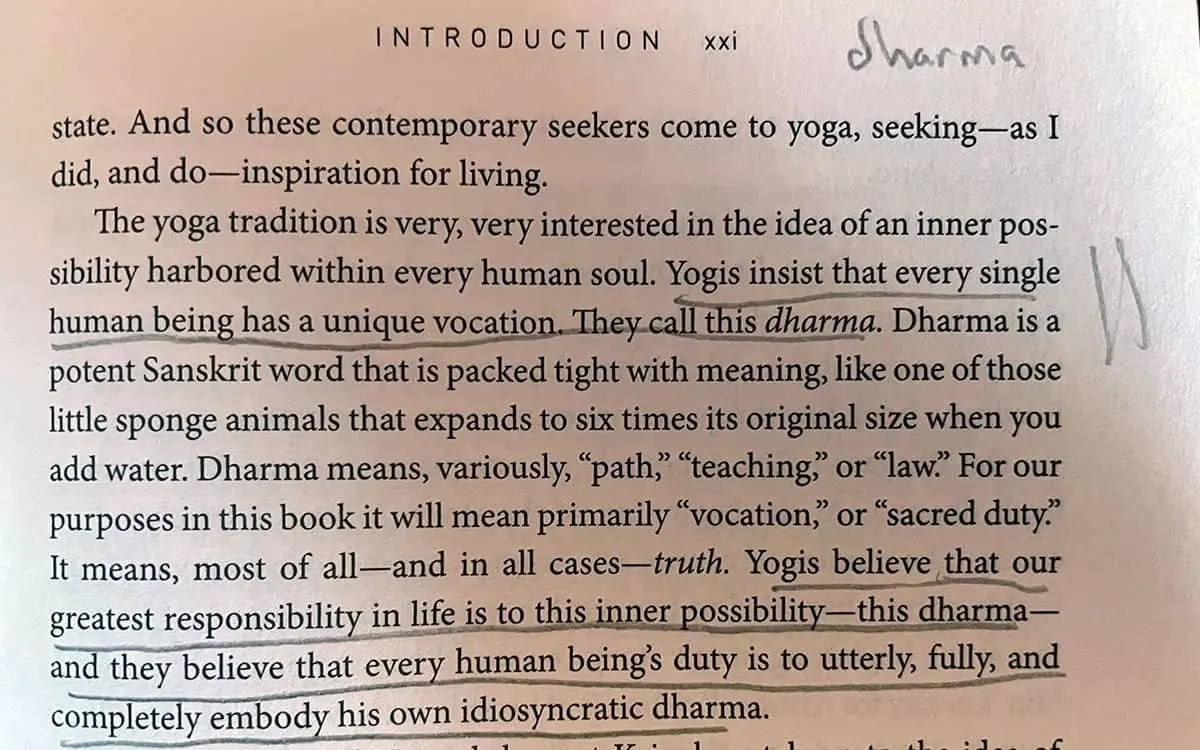
Despite slight variations in phrasing, both participants recognized a shared belief that labor should extend beyond mere financial compensation. Their discussions bridged ancient philosophical traditions, touching upon the Buddhist notion of right livelihood, the Japanese framework of ikigai, and Stephen Cope’s explorations of personal dharma in The Great Work of Your Life. Ultimately, both individuals concluded that modern work should strive to achieve mutual, win-win outcomes that generate abundance for both the worker and the broader community.
Lifeview
Moving from professional labor to existential philosophy, the participants’ reflections on the broader meaning of life displayed an even more striking alignment, despite having been written independently.
Craig’s Lifeview centers on foundational ethical principles, beginning with the mandate to do no harm while actively contributing positive impacts where possible. His reflection embraces the scale of the universe, finding comfort in humanity’s transient nature against the backdrop of cosmic time and space. Furthermore, he emphasizes humor as an essential mechanism for coping with life’s uncertainties, quoting Jane Austen’s Pride and Prejudice regarding the shared absurdity of human existence.
Similarly, the author’s Lifeview rejects the notion of inherent universal meaning, viewing existence instead as a blank canvas upon which individuals must forge their own purpose.
"I believe that life has no inherent meaning. This could easily be a source of despair… I choose instead to see it as an opportunity to create my own meaning, to find my own sense of purpose," the author noted. The reflection places paramount importance on morality as a measure of interpersonal behavior and the treatment of vulnerable populations, while championing intellectual curiosity, kindness, and mutual aid.
Following the exchange of their Lifeviews, the pair deliberated on the broader sociological concept of social capital—a topic Craig originally introduced nearly two decades ago through Robert Putnam’s seminal text Bowling Alone. Both participants expressed concern over the apparent decline of social cohesion in modern American society, suggesting that digital connectivity may inadvertently be eroding the deep, localized community bonds necessary for a healthy populace.
Not Unto Ourselves Alone Are We Born
The remarkable similarity in worldview shared by the participants invites questions regarding its origin. One prominent common denominator is their shared alma mater, Willamette University, which counts other independent commentators and writers among its alumni who espouse similar philosophical frameworks.
The institution’s historic Latin motto, non nobis solum nati sumus—translating to "not unto ourselves alone are we born"—appears to have left a lasting imprint on the graduates, deeply influencing how they approach both their careers and their civic responsibilities. According to the framework of Designing Your Life, these articulated Workviews and Lifeviews serve as functional compasses, designed to provide directional clarity whenever an individual reaches a critical fork in the road.
The positive reception of these exercises has prompted consideration of integrating similar reflective workshops into broader public presentations, filling perceived gaps in conventional purpose-driven seminars.
As the project moves forward, the participants are preparing to dive into the next phase of the methodology, which involves tracking daily energy levels and engagement through a specialized activity log known as a "Good Time Journal." This upcoming step will utilize mind-mapping techniques to analyze patterns and uncover further insights into personal fulfillment, continuing a structured exploration of intentional living.