



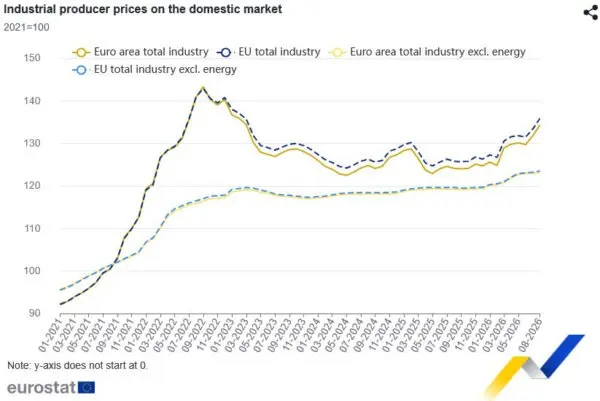
Eurozone producer-price inflation accelerated sharply in August, driven predominantly by a resurgence in energy costs that sent shockwaves through the region’s industrial sector. According to data released by Eurostat, industrial producer prices jumped significantly on both a monthly and annual basis, underscoring persistent cost pressures working their way through the European economy. The latest figures reveal that monthly producer-price inflation climbed from 1.6% to 1.9%, while the year-on-year rate experienced a much more dramatic leap, surging from 5.8% to 8.2%. July’s readings remained unrevised, leaving August’s numbers to tell the unvarnished story of renewed economic headwinds facing manufacturers across the currency bloc.
Energy remained the undisputed dominant driver behind the headline inflation pressure. Energy producer prices skyrocketed by a staggering 5.6% compared to the previous month and rocketed 21.0% higher over the course of the year. This aggressive acceleration in the energy sector accounted for the vast majority of the renewed upward pressure on the headline figures, illustrating just how vulnerable Europe’s industrial pipeline remains to fluctuations in energy markets.

However, a deeper dive into the data reveals that the problem is no longer confined to the energy sector alone. Underlying price pressures firmed noticeably across the board during August. Producer prices excluding energy rose by 0.2% month-on-month, a notable tick up from the flat 0.0% reading recorded in July. On an annual basis, core producer-price inflation—which strips out volatile energy components—accelerated from 3.1% to 3.4%.
This broad-based build-up in costs is reflected in various segments of the production chain. Intermediate-goods inflation strengthened to 6.8% year-on-year, indicating that raw materials and semi-finished products are continuing to cost more for manufacturers. At the same time, durable consumer goods registered a 3.4% increase compared to the same month last year, while capital goods prices rose by 2.6%. The only major exception to this widespread upward trend was non-durable consumer goods, where prices remained subdued, still down 0.8% year-on-year. On a geographical level, the data showed that producer prices increased across all member states on a month-on-month basis, leaving no corner of the Eurozone untouched by the rising cost environment.
The August release points directly to a renewed pipeline inflation impulse. While the headline surge was overwhelmingly driven by energy, the steady and gradual rise in ex-energy measures suggests that broader cost pressures are firmly establishing themselves further down the production chain. This steady accumulation of costs reinforces the firmer inflation signals that have recently been observed in various Eurozone business surveys and purchasing managers’ indices.
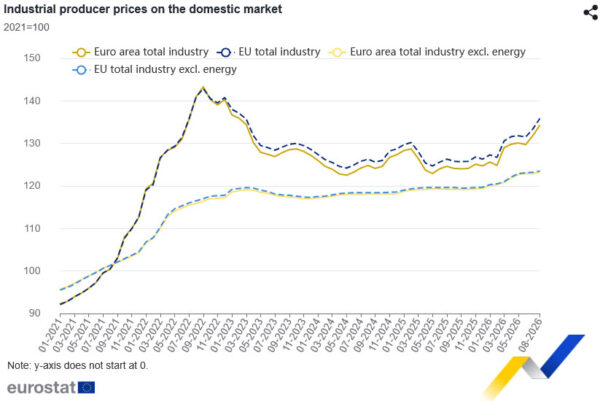
The key distinction in the August dataset is the divergence between headline and underlying measures. While the headline figures displayed a dramatic, energy-led surge, the underlying measures moved higher in a more gradual fashion, indicating a stubborn and entrenched cost dynamic rather than a temporary spike. As these pipeline pressures continue to build, policymakers and market participants alike will be watching closely to see how effectively businesses can pass these rising costs onto consumers, and what implications this will have for the broader economic outlook in the Eurozone.