



As the Federal Open Market Committee (FOMC) prepares for its upcoming policy meeting on October 27–28, financial markets and economic analysts widely anticipate that the central bank will leave its federal funds rate target unchanged. Following a quarter-point increase in September that brought the target range to 3.75 to 4.00 percent, key Federal Reserve officials have signaled that there is little immediate urgency to implement another rate hike.
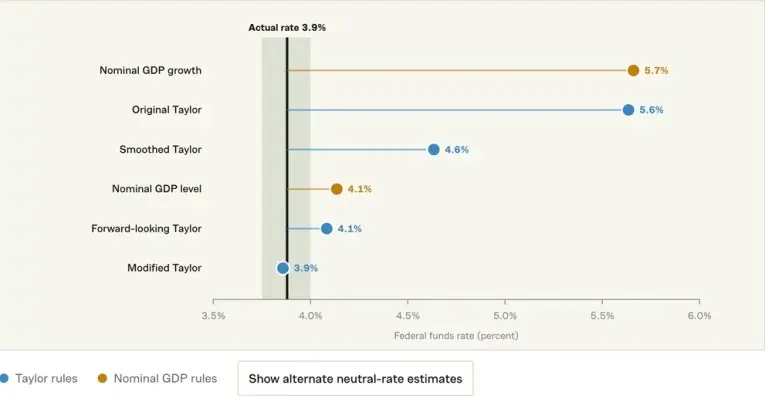
Recent commentary from top central bank leaders reflects a measured approach. New York Fed President John Williams has noted that the institution has adequate time to gather and evaluate incoming economic information before making its next move. Similarly, San Francisco Fed President Mary Daly has argued that additional monetary tightening will likely be necessary to achieve the central bank’s long-term objectives, but that such action does not need to be taken immediately. Leading monetary policy rules leave room for this patient strategy, prescribing a policy rate ranging from approximately 3.8 percent to 5.7 percent.
While the lower end of those rule-based estimates aligns comfortably with holding steady at the current target range, a broader look at the data reveals underlying pressures. Nine out of twelve prominent monetary policy variations favor a tighter policy stance, suggesting that any pause at the October meeting will likely be temporary. Inflation remains stubbornly elevated, the unemployment rate continues to sit at historically low levels, and overall economic spending remains remarkably robust. If these macroeconomic trends persist, further policy tightening will be required to steer inflation back toward the Fed’s stated 2 percent target.
What the Rules Say
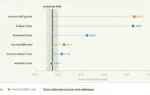
Insights from the AIER Monetary Rules Dashboard illustrate the delicate balance facing policymakers. A modified Taylor Rule and a nominal GDP level rule currently prescribe benchmark interest rates ranging between roughly 3.8 and 4.1 percent. These estimates are broadly consistent with the Fed’s existing policy stance, supporting the notion of a temporary pause at the upcoming meeting.
However, an original Taylor Rule and an NGDP growth rule point toward interest rates well above the 5 percent threshold. Taken together, these standard economic models suggest that September’s rate hike successfully brought monetary policy back into a defensible range, but they also indicate that the central bank likely has more work to do before its job is finished.
Taylor Rules: Inflation Is Still Too High
Taylor-type monetary rules dynamically adjust central bank policy based on fluctuations in inflation and economic activity. When inflation climbs above the Fed’s 2 percent target, these rules call for a higher federal funds rate to cool demand. Conversely, when unemployment rises or economic activity weakens, they point in the opposite direction toward easier monetary conditions.
The Federal Reserve officially measures its 2 percent inflation goal using the personal consumption expenditures (PCE) price index. The latest available PCE data for August showed headline inflation at 3.4 percent and core PCE inflation at 3.0 percent, keeping both measures firmly above target. Because September PCE data will not be released until after the FOMC concludes its October meeting, the September consumer price index (CPI) serves as the most up-to-date broad inflation indicator, even though PCE data are traditionally used in constructing Taylor rule estimates.
The September CPI data demonstrate that the inflation component of the Taylor rule calculation is exerting strong pressure toward higher interest rates. Overall inflation rose 0.6 percent from August to September, pushing the year-over-year rate to 3.7 percent. This figure represents an acceleration from August’s 3.4 percent reading and remains well above the Fed’s 2 percent goal. Core inflation, which strips out volatile food and energy prices, similarly registered 2.6 percent higher than the previous year. While energy costs accounted for a notable portion of the monthly increase, the broader inflation narrative is no longer confined solely to gasoline and isolated supply-side disruptions.
Prices tied to the ongoing artificial intelligence investment boom offer a clear example of demand-driven pressures extending beyond traditional sectors. Prices for computers, peripheral equipment, and smart-home assistants in September were 9.7 percent higher than they were a year earlier, while computer software and accessories surged by 28.4 percent. Although these specific categories represent relatively small components of the overall CPI, their rapid price increases highlight how intense demand fueled by AI investment is driving costs higher outside of the energy market.
Even more concerning for central bankers is accelerating inflation within the service sector. Prices for all services, excluding energy services, stood 3.1 percent higher year-over-year in September. Subcategories showed sharp gains, with hospital services up 5.6 percent, motor vehicle maintenance and repair rising 5.8 percent, and food away from home increasing 3.5 percent. The sheer breadth of these price increases makes it increasingly difficult to dismiss current inflation as the temporary result of energy disruptions or localized supply shocks.
Meanwhile, the economic activity and labor market side of the Taylor rule equation rests on firmer ground. The national unemployment rate remains at a relatively low 4.2 percent. However, some policymakers have expressed caution regarding underlying labor market dynamics. Job growth has slowed considerably, with nonfarm payroll employment increasing by just 29,000 in September. Additionally, the share of long-term unemployed workers has crept upward over the past few years.
While potential stress in the labor market warrants close monitoring, these developments do not reflect the type of severe labor market deterioration that would necessitate a pivot toward looser monetary policy. Sluggish job growth may simply represent a new normal shaped by low net migration and an aging population entering retirement. Furthermore, long-term unemployment is often driven by structural challenges, such as skill mismatches, which monetary policy is fundamentally ill-equipped to resolve.
Ultimately, inflation remains uncomfortably high while the labor market preserves a reasonable degree of stability. This economic combination explains why many variations of the Taylor rule continue to point toward a tighter policy stance, even before accounting for the more acute inflation pressures visible in recent CPI reports.
NGDP Rules: Spending Is Still (Too) Strong
Rules based on nominal gross domestic product tell a remarkably similar story about the state of the economy. Nominal GDP measures total dollar spending across all sectors. An NGDP growth rule implies that the Fed should raise the federal funds rate when nominal spending expands at a pace faster than 4 percent annually, and lower rates when spending grows more slowly. This 4 percent benchmark is derived from a 2 percent inflation target combined with average long-term output growth of roughly 2 percent, mirroring pre-pandemic historical trends. Similarly, an NGDP level rule calls for higher interest rates when total spending rises above its long-term trend line, and lower rates when spending dips below it.
Recent GDP revisions reinforce ongoing concerns that nominal spending is expanding far too quickly. The Bureau of Economic Analysis initially estimated second-quarter nominal GDP growth at a robust 7.9 percent. That figure was subsequently revised upward to 8.0 percent in the second release and further adjusted to 8.5 percent in the third release. Real GDP growth was also revised substantially higher, moving from an initial estimate of 1.5 percent up to 2.2 percent.
Economic indicators for the third quarter show little sign of a significant slowdown. The Federal Reserve Bank of Atlanta’s GDPNow forecasting model currently estimates third-quarter real GDP growth at 3.6 percent. If inflation remains anywhere near its current trajectory, nominal spending growth will once again finish well above the 4 percent threshold. The Bureau of Economic Analysis is scheduled to release official third-quarter GDP figures on October 29, just one day after the conclusion of the FOMC meeting.
The massive artificial intelligence infrastructure buildout is undoubtedly a contributing factor to the strong NGDP numbers. The exact same investment boom that is exerting upward pressure on consumer prices for computers and software is simultaneously supporting broader capital investment and overall economic activity. However, AI is far from the only source of demand-driven pressure in the economy. Consumer spending remained remarkably resilient through August, and Cleveland Fed President Beth Hammack recently described underlying business activity as generally strong to booming when arguing the case for a more restrictive policy stance to successfully return inflation to 2 percent.
More Tightening Ahead
Federal Reserve officials appear to recognize that any decision to hold interest rates steady in October will likely be temporary. New York Fed President John Williams has stated that if economic data continue to evolve as anticipated, an additional rate hike may prove appropriate before the close of the year. More hawkish members of the central bank, such as Hammack and Dallas Fed President Lorie Logan, have advocated for tighter policy measures without delay.
The prevailing consensus among FOMC members aligns closely with the policy path prescribed by standard monetary rules: pausing adjustments in October is defensible, but additional rate hikes will likely be required in the months ahead.
The Fed’s own economic projections tell a consistent story. During their September meetings, the median FOMC participant projected that the national unemployment rate will hover near 4.1 percent through the end of 2026, while PCE inflation will finish the year at 3.7 percent. These projections pointed toward one additional quarter-point hike in the federal funds rate, which would bring the projected target rate to approximately 4.1 percent. Notably, core PCE inflation is projected to reach 3.4 percent, indicating that officials anticipate year-over-year price growth to continue rising through the end of 2026, even after stripping out food and energy categories directly exposed to geopolitical volatility.
With inflation lingering substantially above the Fed’s 2 percent target well into its fifth year, the current lack of urgency to continue tightening policy in October—while technically defensible from the perspective of policy rules—remains difficult to reconcile with the central bank’s own internal economic outlook.
Market participants are likewise positioning themselves for further monetary tightening. The Atlanta Fed’s market-probability tracker currently assigns roughly a 94 percent probability to at least one additional rate hike occurring before the end of the year. Furthermore, CME FedWatch data indicate an 80 percent probability of a quarter-point rate increase arriving at the December FOMC meeting.
With Federal Reserve officials and investor sentiment broadly aligned around a temporary pause in October followed by resumed tightening in December, the path forward relies heavily on incoming data. Unless there is a significant and sustained improvement in inflation readings, clear evidence of a deteriorating labor market, or a meaningful slowdown in overheated nominal spending, the central bank will face compelling arguments to proceed with another interest rate hike before the year concludes.