


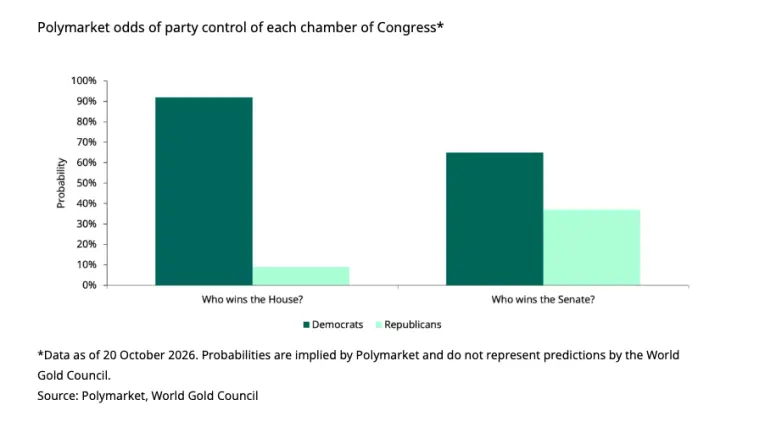
For the precious metals market, this looming political realignment raises a critical and pressing question: How will a shift in congressional control impact the price and performance of gold?
According to historical precedent and analysis from the World Gold Council, the answer depends almost entirely on how a change in legislative power translates into actual policy outcomes. Rather than reacting directly to the ballot box results on election night, the gold market has historically taken its cues from the broader economic, fiscal, and monetary policy shifts that follow.
Prediction markets currently anticipate that a Democratic sweep of Congress would effectively halt or significantly hinder the legislative agenda of President Trump. If the executive branch is met with a hostile or opposition-controlled legislative branch, the most likely outcome for Washington is a return to stark political gridlock. Such a scenario would likely prevent major legislative overhauls, tax initiatives, or sweeping spending packages from passing easily through Congress.
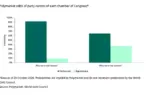
Historically, domestic demand for physical gold, such as bars and coins, tends to experience a modest upward trend during Democratic administrations. However, looking at the broader picture, elections themselves have not historically exerted a lasting, decisive influence on gold’s performance on the global stage over the long haul.
Market analysts emphasize that gold is a globally traded asset driven by a massive, interconnected network of international supply and demand forces. Because of this vast geographic diversity, single-country political events must be weighed carefully against international market drivers.
According to insights provided by the World Gold Council, what truly matters for investors is whether the resulting policy changes from a shift in Washington are sufficiently consequential for the global gold market, and whether those domestic shifts possess the weight required to offset the broader global forces that regularly drive bullion prices.
This dynamic has played out repeatedly in recent political history. For instance, following the victories of Donald Trump in both 2016 and subsequent election cycles, initial market reactions saw gold prices fall as broader equity markets surged. Investors anticipated a pro-growth, reflationary policy agenda characterized by deregulation and tax cuts.
However, much of that initial market movement quickly unwound as the immediate excitement of election day faded. As attention shifted away from the election results themselves and focused squarely on the actual policies likely to be implemented, asset prices recalibrated to reflect economic reality.
Analysts at the World Gold Council expect a very similar pattern to unfold during the upcoming midterm elections. Any initial volatility or sharp market reactions immediately following the election results will likely prove short-lived. Instead, the true, lasting impact on gold will be driven by the political gridlock and subsequent legislative bargaining that is widely expected to follow a Democratic victory.
Regardless of the specific outcome of the midterm results, historical data demonstrates that the price of gold reacts primarily to the economic, fiscal, and monetary policies that ensue over time, rather than to the immediate outcome of election day itself.
The World Gold Council has highlighted several key policy areas that could experience a notable shift if the Democratic Party secures control of Congress, pointing to the ways legislative oversight and budgetary control could influence broader economic sentiment.
Nevertheless, the fundamental takeaway for investors and market participants is that a mere shift in party control is unlikely to move the global gold market over the long term. Any election-related market movements that materialize in the immediate aftermath of the vote are expected to be temporary ripples in a much larger financial pond.
Ultimately, market participants will need to look past the political headlines and observe how the newly established balance of power in Washington actually impacts policy. Only by evaluating the resulting legislative landscape can investors begin to project the more substantial, longer-term effects on the gold market.