


Here we go again.
The latest economic data has once again disrupted market expectations, proving that stubborn price pressures are far from conquered. The Bureau of Labor Statistics (BLS) released the October Consumer Price Index (CPI) data, revealing an inflation reading that came in noticeably hotter than consensus forecasts. This persistent price acceleration has rapidly shifted market sentiment regarding the Federal Reserve’s upcoming policy meeting, reviving expectations for a December interest rate hike. With inflation proving more resilient than many anticipated, a growing segment of financial analysts now believes the central bank may be forced to implement a more aggressive 50-basis-point increase to rein in runaway costs.
While the headline CPI figures paint a thoroughly gloomy picture for the trajectory of consumer prices, the reality facing households and policymakers is arguably even worse. Each month, the release of the Consumer Price Index serves as the primary gauge for policymakers, market pundits, and economists trying to make sense of the economic landscape. Yet, relying solely on the CPI to evaluate the health of the economy and the severity of inflation is akin to simply checking the outdoor temperature and claiming you fully understand the weather.
The CPI is designed to track price inflation by measuring changes in the cost of a standardized basket of consumer goods and services. However, classical economic definitions describe inflation far more accurately as an expansion in the aggregate supply of money and credit within an economy. Under this framework, rising consumer prices are merely a secondary symptom of underlying monetary inflation. Because the CPI captures past monetary creation rather than predicting its future course, analysts must look beyond standard consumer price metrics to grasp the complete inflation story. To gain a comprehensive understanding of inflationary pressures, observers must track multiple indicators simultaneously, including shifts in the M2 money supply, changes to the Federal Reserve’s balance sheet, and broader benchmarks like the Chicago Fed National Financial Conditions Index.
October CPI Highlights Persistent Price Pressures
According to the BLS report, consumer prices rose by 0.4 percent on a month-over-month basis in October, overshooting the consensus forecast of a 0.3 percent increase. Notably, the government agency did not release annual CPI comparisons for this period, as data collection was interrupted the previous year due to a federal government shutdown, leaving no baseline figures for direct annual comparison. Even without year-over-year metrics, the trajectory remains clear: the monthly index has consistently outpaced the Federal Reserve’s stated 2 percent inflation target for an astonishing 68 consecutive months.
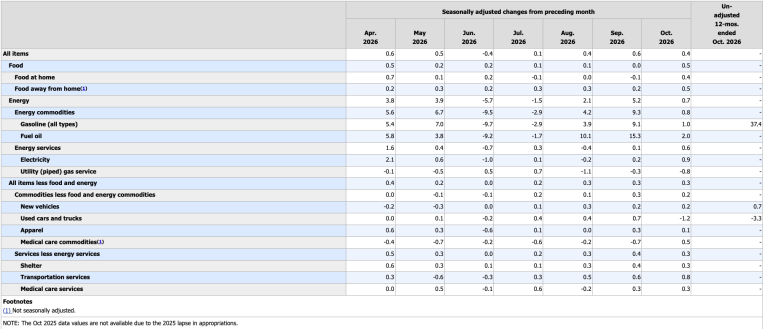
When stripping out volatile food and energy components—categories of spending that everyday consumers cannot simply choose to ignore—core CPI increased by 0.3 percent, beating forecasts that had centered on a 0.2 percent gain. This marks the third consecutive month in which core CPI has posted a 0.3 percent monthly increase, a pace that translates to an annualized, compounded rate of roughly 3.7 percent.
Energy prices continued to exert significant upward pressure on the broader index last month. The energy index advanced 0.7 percent month-on-month, following a staggering 5.2 percent monthly surge in September. Gasoline prices played a major role in this climb, rising another 1 percent in October on top of a 9.3 percent price explosion the previous month. Meanwhile, shelter costs maintained their upward drift with a 0.3 percent increase, and food prices jumped 0.5 percent overall. This grocery store inflation was driven by notable spikes across several staples, including a 1 percent increase in snack prices, a 0.9 percent surge in beef costs, and a 0.5 percent increase in the prices of poultry, fish, and eggs. On the transportation front, services jumped 0.8 percent month-on-month, while new vehicle costs ticked up 0.2 percent.
M2 Money Supply Growth Points to Underlying Monetary Expansion
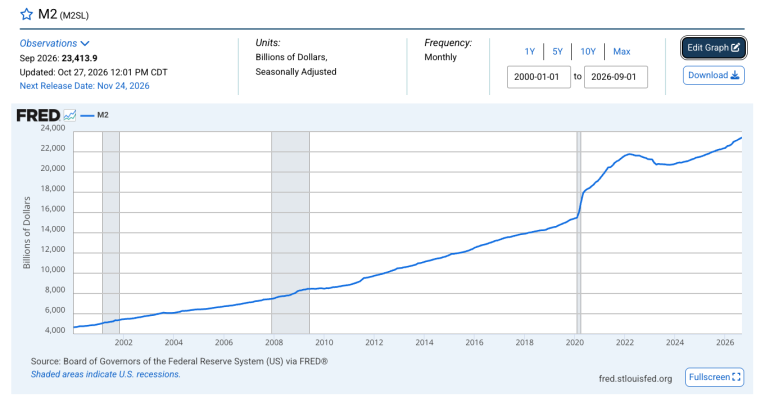
While consumer prices capture public attention, developments beneath the surface of the financial system reveal why inflationary forces remain potent. The total money supply has been expanding for months, and the pace of this growth is visibly accelerating. By strict definition, an expanding money supply constitutes inflation itself, even though its full impact on general consumer price levels typically takes months to filter through the broader economy.
Between September of last year and this September, the broader M2 money supply surged from $22.15 trillion to $23.41 trillion. This trajectory points to an underlying monetary inflation rate running at approximately 5.7 percent. In September alone, the M2 money supply expanded by an extraordinary $113 billion, representing a 0.49 percent gain over the previous month. Throughout the year, the money supply has grown by an average of $136 billion every month—a staggering 89 percent higher than the average monthly expansion recorded in the previous year. This ongoing monetary inflation will inevitably find its eventual expression in higher consumer prices, or manifest visibly through appreciating asset values in real estate and equity markets.
The Federal Reserve Balance Sheet Paradox
A primary driver behind this accelerating money supply growth is ongoing central bank intervention. Even as central bank officials project a tough stance against rising prices, the Federal Reserve has actively engaged in quantitative easing (QE) operations. These technical maneuvers create artificial, sustained demand for U.S. Treasuries, effectively holding bond yields lower than free-market forces would otherwise dictate.
To execute these operations, the central bank purchases U.S. Treasuries on the open market and absorbs them onto its own balance sheet. Because the Fed funds these bond purchases by creating brand-new money out of thin air, newly minted capital is systematically injected directly into the economy. By definition, this mechanism constitutes monetary inflation.
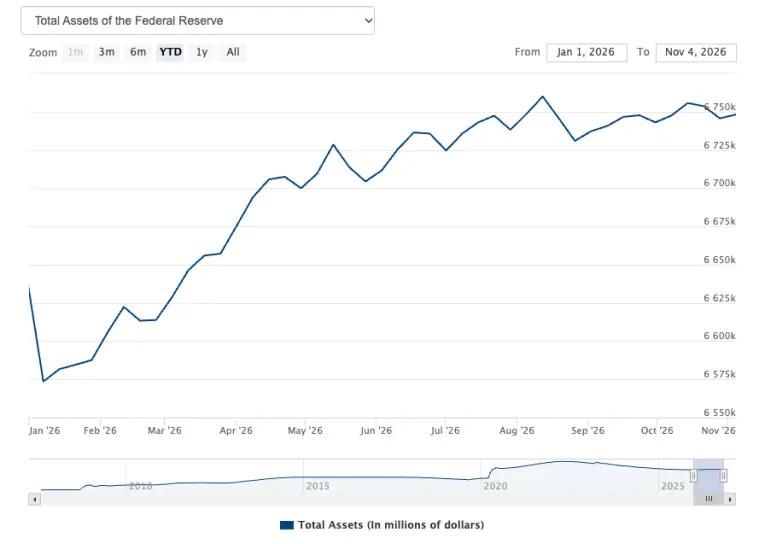
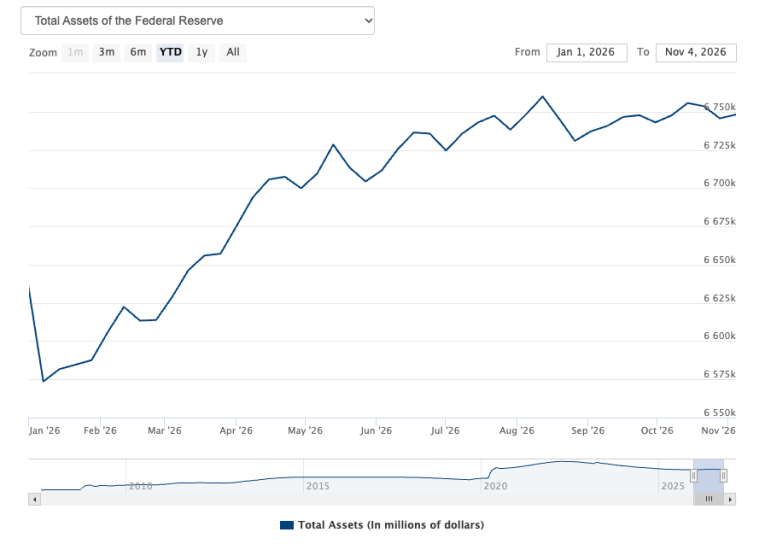
While the central bank routinely characterizes these operations as technical adjustments necessary to maintain smooth liquidity and clear plumbing within the financial system, the practical economic outcome remains unchanged: the balance sheet expands, and fresh liquidity enters circulation. The central bank’s balance sheet began creeping upward late last year, and that upward trajectory has persisted. In October alone, the balance sheet expanded by approximately $5 billion, bringing total growth to $212.4 billion since its recent low point.
Crucially, the Federal Reserve must continually execute these operations simply to prevent its balance sheet from contracting, as older government bonds mature and roll off its holdings every month. Consequently, the central bank must actively purchase new securities just to replace retiring assets. This reality highlights a profound policy contradiction: the Federal Reserve continues to ease monetary conditions through balance sheet expansion even as it publicly claims to be waging an aggressive war on consumer price inflation.
While the absolute monthly expansion of the balance sheet appears modest, the fundamental question remains: if policymakers are truly serious about subduing inflation, why is the balance sheet not actively shrinking? The answer lies in the evolving bond bear market. Facing rising yields that continuously drive up the federal government’s borrowing and interest servicing costs, the Fed has little practical choice but to intervene and support the underlying Treasury market.
National Financial Conditions Reveal Historically Loose Policy
Despite popular assumptions that monetary policy has been pushed deep into restrictive territory, a broader historical perspective reveals that financial conditions have remained surprisingly loose throughout the entire cycle. This reality is underscored by the Chicago Fed’s National Financial Conditions Index (NFCI).
Through the end of October, the NFCI stood at -0.46. In the index’s methodology, a negative reading indicates that overall financial conditions remain historically loose relative to long-term economic baselines. Strikingly, the NFCI never crossed into positive territory during the height of the Federal Reserve’s much-publicized interest rate tightening campaign, reaching a peak high of just -0.09 in October 2022.
This sustained loose financial environment demonstrates that the central bank’s fight against inflation was never as aggressive as public communications suggested. Policymakers maintained historically accommodative conditions throughout the inflation cycle, reflecting an economy deeply dependent on easy money. The reluctance of the central bank to drive financial conditions into genuinely restrictive territory stemmed from a persistent fear of collapsing a debt-saturated bubble economy, rather than any genuine belief that inflation had been decisively neutralized.
Conclusion
The latest Consumer Price Index report paints a deeply concerning picture of persistent inflation. When evaluated alongside broader monetary metrics, there is little reason to expect inflationary pressures to subside anytime soon. The Federal Reserve ultimately failed to take sufficiently aggressive action to vanquish the inflation unleashed during the pandemic. Despite persistent talk of a hawkish central bank, monetary policy has remained historically loose when viewed through a comprehensive lens.
While most market analysts anticipate another benchmark interest rate increase in December, with some speculating that officials may opt for a more aggressive half-percent hike, the broader economic context remains precarious. This aggressive posturing has already triggered sharp sell-offs in commodities like gold as investors position themselves for higher borrowing costs.
Yet, this path is constrained by the enormous mountain of public and private debt currently burdening the financial system. Central bankers find themselves trapped in a classic policy dilemma. While incoming inflation data strongly argues for higher interest rates to cool the economy, the sheer scale of debt dependency suggests that an overly aggressive rate environment risks destabilizing the financial sector.
Trying to walk this delicate tightrope, the Fed is widely expected to deliver a measured 25-basis-point rate hike in December while maintaining its hawkish verbal stance. However, another modest rate adjustment will do little to arrest a money supply growth rate approaching 6 percent, nor will it halt central bank monetization. Ultimately, even a small policy tightening step carries enough weight to strain a debt-laden economic structure. If that strain triggers a broader economic downturn or financial instability, history strongly suggests the central bank will quickly pivot back to rate cuts and emergency easing—prioritizing asset values and economic rescue over inflation control, leaving all roads ultimately leading back to inflation.