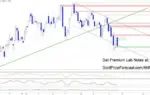



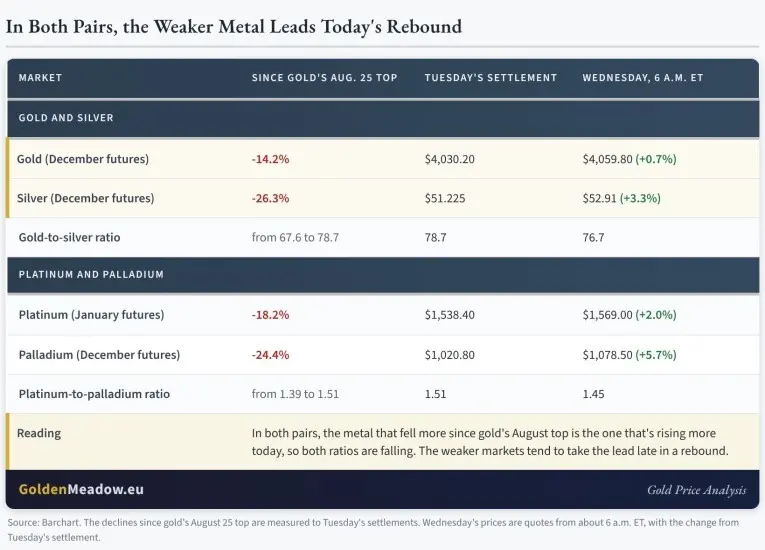
Precious metals markets are experiencing a familiar yet deceptive dynamic as December gold futures hover near $4,060 and silver futures trade around $53. Following a sharp $84.30 slide earlier in the week, gold has managed to regain about a third of its losses, while silver has completely erased its decline, pushing the widely watched gold-to-silver ratio downward. At the same time, palladium is logging even stronger gains than silver, continuing a trend where smaller, historically weaker markets display outsized volatility.
Market observers note that this behavior—where investors rush into underperforming assets late in a rally—often signals caution rather than underlying strength. As historical market patterns demonstrate, late-cycle surges in secondary precious metals typically reflect speculative bargain-hunting rather than robust, broad-based demand for the entire sector.
The Weaker Metal Leads in Both Pairs
The current price action highlights a clear pattern across major precious metals pairings: the asset that has suffered the steepest declines is leading the immediate recovery. Ever since gold reached its peak on August 25, silver has experienced a much deeper correction than gold. Similarly, palladium has suffered heavier losses than platinum. In both cases, the historically weaker metal is currently outpacing its stronger counterpart on the upside.
Reflecting this shift, the gold-to-silver ratio declined from 78.7 at Tuesday’s market close to below 77. Concurrently, the platinum-to-palladium ratio dropped from 1.51 to approximately 1.45.
Palladium remains the most vulnerable among the four major precious metals. At the close of trading on Tuesday, its valuation sat roughly 30 percent below its level from the same time a year prior. Furthermore, on November 3, palladium closed at its lowest price point in over a year. Despite this persistent weakness, it recently jumped by nearly $60 in a single session—climbing nearly twice as much as platinum in absolute dollar terms, even though its overall market price remains a third lower.
This dynamic demonstrates that smaller and historically weaker markets are vastly outperforming their larger counterparts during current sessions. Market analysts point out that this specific phenomenon frequently appears near the tail end of rallies or immediately preceding broader market downturns, driven by distinct psychological and structural market mechanics.
Why Strength in the Weakest Markets Is Not Bullish
When commodities experience prolonged downward trends lasting several months, assets that have suffered the most severe sell-offs frequently begin to resemble bargains. Investors frequently pile into these deeply
discounted metals simply because they appear inexpensive on a relative basis, often overlooking the fundamental reasons why those prices fell so precipitously in the first place.
Market capitalization and liquidity also play critical roles in this phenomenon. The silver market is substantially smaller than the gold market, while the palladium market is smaller still. Consequently, a wave of speculative buying that would barely register as a ripple in the massive gold market can trigger dramatic price swings in silver or palladium. This disproportionate sensitivity explains why rallies in secondary metals often look remarkably impressive to casual observers while ultimately conveying very little about the genuine health of the broader precious metals sector.
Recent trading sessions have already illustrated this boom-and-bust mechanism in real time. On November 4, silver surged significantly faster than gold, only for the white metal to slide lower over the subsequent two sessions while gold held its ground. A similar pattern unfolded at the start of the week when silver again outperformed gold ahead of the broader market slide triggered by a hotter-than-expected Consumer Price Index (CPI) report.
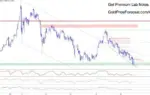
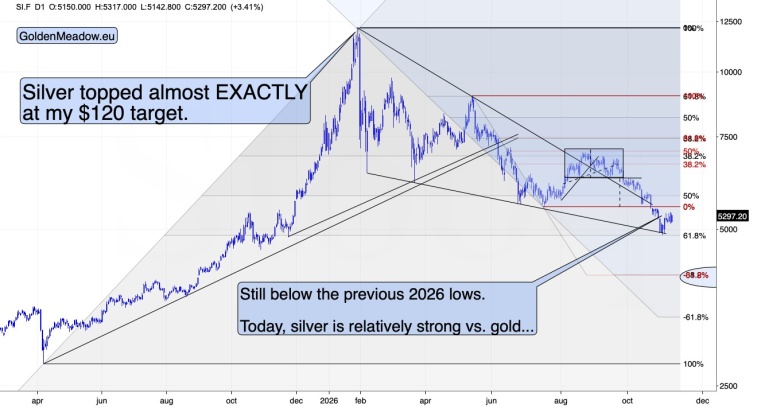
Despite its recent bounce, silver’s relative strength remains superficial. Prices are still trading below previous 2026 lows, meaning the technical breakdown below those support levels has not been invalidated. Market forecasts continue to view silver-led rebounds as inherently corrective rather than the beginning of a sustainable new bull leg.
Adding to the skepticism surrounding the precious metals rebound is the strengthening performance of the U.S. currency.
The Dollar Is Breaking Out
The broader macroeconomic environment presents further headwinds for precious metals, led by a decisive technical breakout in the U.S. dollar. Following recent inflation data, market expectations have shifted, driving renewed upward momentum in the USD Index.
USD Index futures, which closed at 102.13 on Tuesday, climbed above 102.4 to reach their highest level since October 14. This movement pushed the index futures past their declining resistance line, confirming a technical breakout. With prices trading slightly above the highest daily close of the year—previously established at 102.375—the USD Index appears positioned to challenge new yearly highs.
For the gold market, a surging U.S. dollar historically serves as a major bearish catalyst, though the negative impact can sometimes experience a delayed reaction. A parallel scenario unfolded earlier in October when the USD Index futures touched yearly highs while gold remained relatively insulated for a brief period before suffering a swift and severe $290 correction over the following two and a half weeks.
Where This Leaves Us
The combination of silver and palladium leading the recent rebound while the USD Index breaks out to new multi-week highs paints a challenging technical picture for gold. Market analysts suggest that this confluence of indicators points toward further downside pressure, with gold’s next major test potentially carrying prices down toward the $3,500 region.
Ultimately, when the historically weakest metals outpace their blue-chip counterparts during a recovery, market history suggests that the rebound is typically much closer to its termination point than its beginning.