





Managing rental properties across multiple limited liability companies, tracking complex income and expenses by individual property, and keeping security deposits rigorously organized requires far more than a standard business checking account. Today’s real estate investors and portfolio operators face operational hurdles that traditional high street banks were simply never designed to accommodate. For modern property owners, selecting a specialized financial platform can mean the difference between seamless cash flow management and hours of agonizing manual reconciliation at tax time.
Whether an operator manages a single suburban rental or oversees a sprawling portfolio spanning dozens of properties across different states and entities, choosing a banking platform tailored to real estate investing is critical. The right financial infrastructure helps organize cash flow across separate properties while directly connecting daily banking activity with automated bookkeeping and accurate tax reporting workflows.
The evolution of financial technology has introduced a wide array of options for investors, ranging from digital-first platforms built explicitly for landlords to national brick-and-mortar institutions offering commercial real estate lending and treasury services. Understanding how these platforms stack up against one another is becoming an essential part of scaling a modern real estate business.
Why Real Estate Investors Need Specialized Banking
Banking for rental properties differs fundamentally from standard small business banking. A real estate investor or operator managing multiple properties across different LLCs has vastly different daily requirements than a traditional retail business owner who operates out of a single checking account. When investors rely on separate bank logins and disjointed mobile applications, financial information becomes fragmented across various systems. This separation makes reconciliation, auditing, and tax preparation significantly more time-consuming than necessary.
A robust banking solution designed specifically for real estate investors and operators must support property-level accounting, seamless rent collection, secure handling of tenant security deposits, and clean categorization for tax deductions. Without these specialized features, investors often find themselves buried under piles of receipts, struggling to match incoming wire transfers to the correct property, or paying steep monthly fees for basic commercial accounts that offer zero real estate utility.
The market for real estate financial services now encompasses several distinct categories of institutions, including digital platforms built exclusively for property owners, traditional national banks with robust commercial real estate lending arms, and online business banks offering advanced cash flow organization tools.
Digital Platforms Built for Real Estate
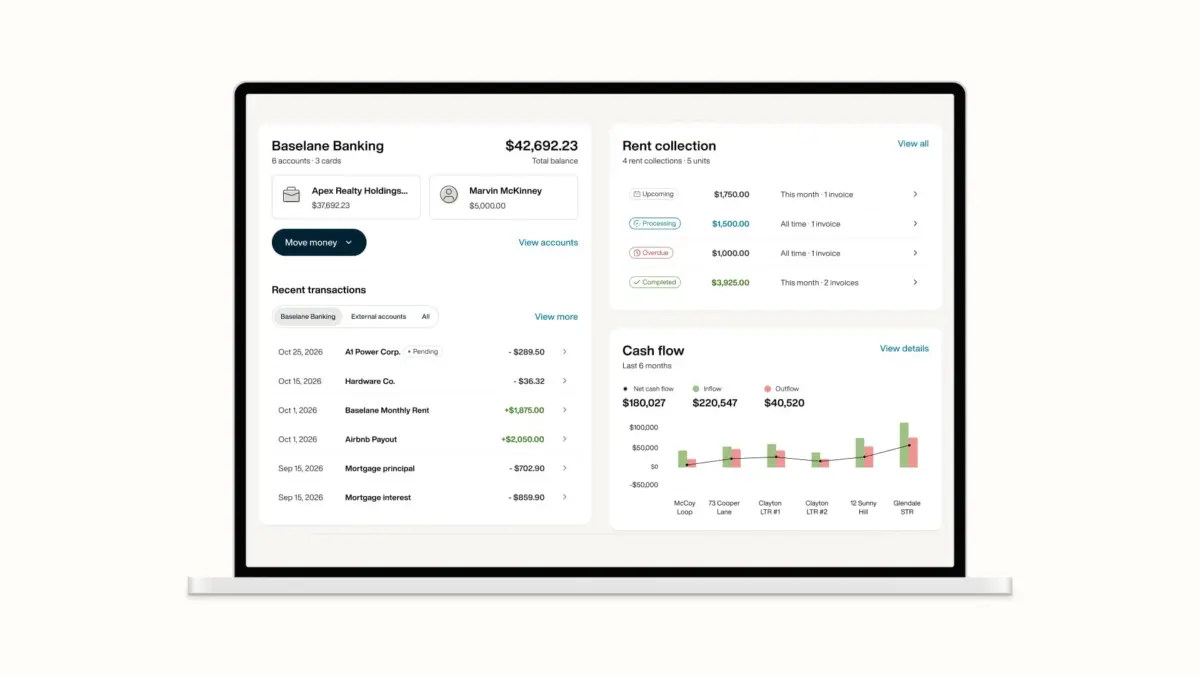
Platforms like Baselane have emerged to address the core operational challenges faced by multi-property operators by combining property-level banking accounts, automated bookkeeping, and rent collection into a single, integrated system. Baselane allows real estate investors to open unlimited checking and savings accounts organized by property, entity, or specific financial purpose, all managed from a centralized dashboard. Transactions are automatically assigned to the correct property and tax category using a comprehensive set of real estate-specific categories, drastically reducing the manual workload required at year-end. While digital-only platforms lack physical brick-and-mortar branches, they often provide access to fee-free cash deposits through partner networks and offer high-yield savings rates that far exceed national averages for traditional business accounts.
Similarly, Stessa approaches financial tracking from a property management perspective. Based in Oakland, California, the platform incorporates cash management accounts alongside its broader portfolio tracking, rent collection, and maintenance tools. While Stessa suits investors who want a comprehensive property management hub that includes financial oversight, investors whose primary need is deep banking and bookkeeping automation often evaluate how these features integrate with their daily administrative routines

.
Online Business Banks and Cash Flow Tools
Beyond real estate-specific fintechs, several general online business banking platforms have gained traction among property owners. Bluevine provides online business checking accounts featuring high-yield interest alongside access to business lines of credit. It serves investors who want to separate funds using subaccounts within a single banking relationship while maintaining quick access to working capital for unexpected property repairs or portfolio expansions. However, because Bluevine is designed for general small business use, investors still require separate tools for property-level bookkeeping automation and Schedule E tax reporting.
Relay, another prominent online business banking platform, places a strong emphasis on multi-account cash flow management and team collaboration. It allows investors managing multiple properties to enforce strict per-property cash separation across complex multi-LLC portfolios. The platform supports up to fifty checking accounts depending on the plan, enabling percentage-based auto-transfer rules inspired by cash management methodologies. While powerful for cash allocation, Relay focuses primarily on multi-account management rather than real estate-specific automation, meaning investors may still need auxiliary software for automated property bookkeeping and integrated rent collection.
Other online options like Mercury cater to tech-forward holding company structures requiring API access for custom financial workflows, though users must note that Mercury is not FDIC-insured in the same manner as traditional chartered banks. Axos Bank offers digital banking solutions combined with online rental property loan programs, appealing to investors pursuing debt service coverage ratio financing strategies without the need for physical branch visits.
Traditional Banking Institutions and Commercial Lending
Despite the rise of digital-first alternatives, traditional brick-and-mortar banks continue to play a vital role for real estate investors who require physical branch access, cash handling capabilities, and direct commercial real estate financing.
Major institutions such as Chase offer extensive branch networks exceeding 5,100 locations, making them a practical choice for investors who regularly handle physical cash, require merchant services, or prefer a nationwide traditional banking relationship. Wells Fargo provides deep business banking services backed by specialized multifamily lending capabilities, catering primarily to experienced investors with large-scale portfolios who require agency financing programs through major government-sponsored enterprises.
U.S. Bank maintains a strong footprint for traditional investment property loans spanning multifamily, office, warehouse, and mixed-use properties, often pairing these lending products with free business checking options. Meanwhile, online institutions like Live Oak Bank have built strong reputations as national leaders in specialized small business administration financing, serving investors who seek SBA-backed funding for acquisitions or major commercial renovations through streamlined digital application processes.
Evaluating the Future of Property Financial Management
As the real estate landscape continues to evolve, investors increasingly recognize that traditional banking models are ill-equipped to handle the granular tracking demanded by modern property portfolios. Whether choosing an integrated digital platform that automates bookkeeping down to the individual Schedule E category or maintaining a relationship with a traditional commercial lender for large-scale acquisitions, the primary objective remains clear: reducing administrative friction and gaining complete visibility into portfolio performance. By aligning banking infrastructure with the unique operational realities of real estate investing, operators can focus less on manual reconciliation and more on scaling their portfolios.