




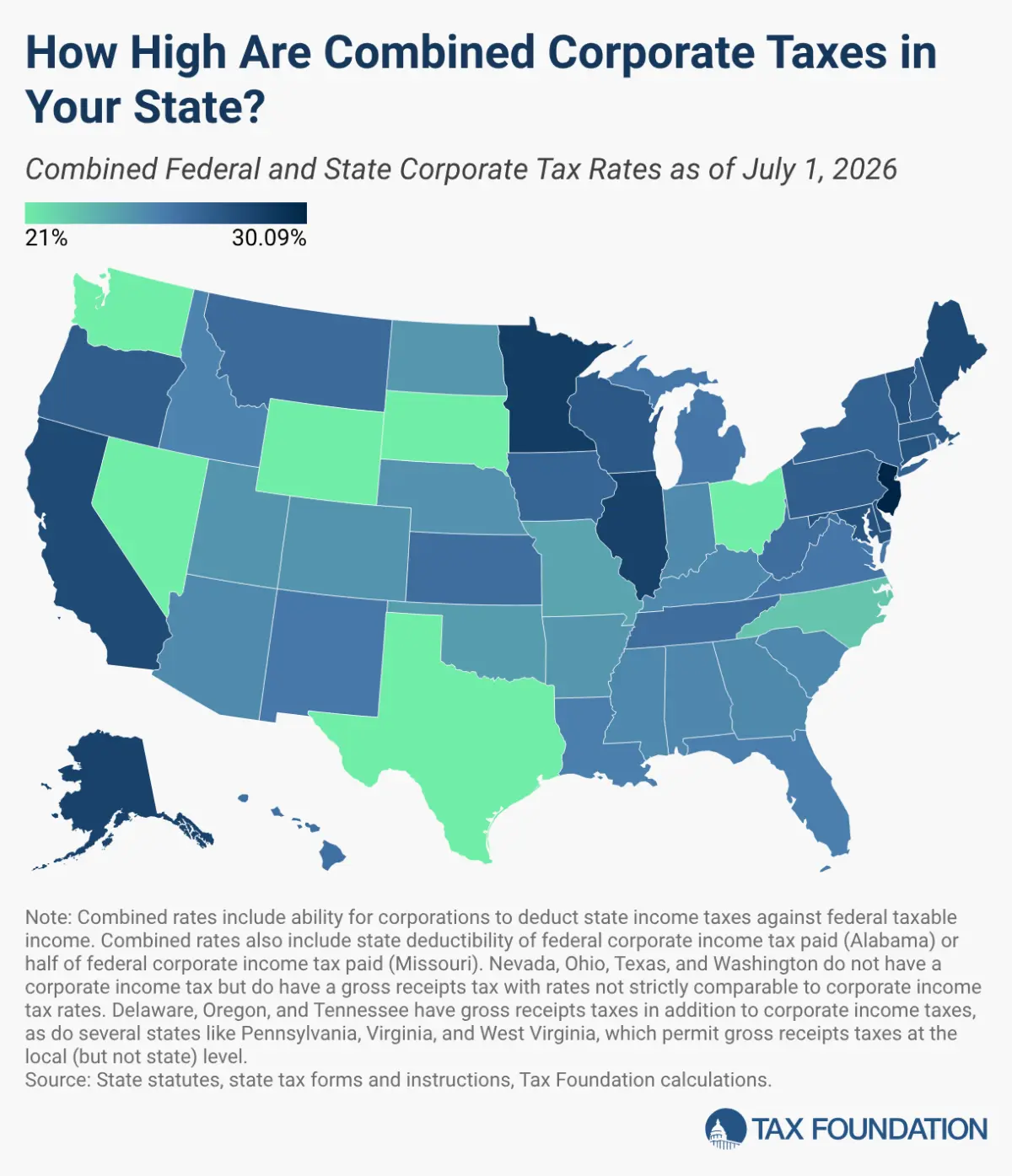
Corporate taxation in the United States is a multi-layered system involving federal, state, and sometimes local levies that significantly impact business profitability, economic competitiveness, and investment decisions. While corporations across the country are subject to a standard federal corporate income tax rate of 21 percent, the overall tax burden varies dramatically depending on where a business operates. Forty-four states, alongside the District of Columbia, impose their own taxes on corporate income, creating a diverse patchwork of rates, structures, and overlapping obligations that companies must navigate.
When examining the state-level landscape, top marginal corporate income tax rates span a wide spectrum. On the lower end, North Carolina levies a top marginal rate of just 2.0 percent, offering a relatively light tax burden at the state level. At the opposite end of the spectrum, New Jersey imposes a top marginal rate of 11.5 percent, the highest in the nation. To structure these levies, states generally fall into two categories: 13 states utilize graduated corporate income tax rates, where the tax percentage increases as a company’s taxable income rises, while 31 states and the District of Columbia opt for a flat rate applied uniformly to corporate earnings.
The corporate income tax itself is defined as a levy imposed by federal and state governments on net business profits. However, it is worth noting that many businesses escape this specific tax classification entirely. Because they are organized as pass-through entities—such as sole proprietorships, partnerships, or S-corporations—their business income is instead reported under individual income tax returns rather than subject to the corporate income tax (CIT) regime.
For traditional C-corporations, state tax systems go far beyond standard income levies. In four states—Nevada, Ohio, Texas, and Washington—corporations are not subject to corporate income taxes at all. Instead, these jurisdictions levy gross receipts taxes. Furthermore, Delaware, Oregon, and Tennessee take a dual approach, imposing both a traditional corporate income tax and a separate levy based on gross receipts. Meanwhile, local governments in Pennsylvania, Virginia, and West Virginia step in with their own municipal-level gross receipts taxes, adding another layer of compliance and cost for businesses operating within certain localities.
Gross receipts taxes operate fundamentally differently from corporate income taxes or standard retail sales taxes. Applied directly to a company’s gross sales, these levies allow for no deductions for routine business expenses, such as employee compensation, the cost of goods sold, or facility overhead. Because they are assessed at every stage of the production process—from raw material extraction to final assembly and retail—gross receipts taxes frequently lead to what economists call tax pyramiding, where the same economic value is taxed multiple times before reaching the ultimate consumer. In contrast to this complex web of taxation, only two states in the entire country—South Dakota and Wyoming—levy neither a corporate income tax nor a gross receipts tax, leaving businesses in those jurisdictions free from direct state-level revenue demands of these types.
Because businesses rarely pay taxes to just one level of government, evaluating the true cost of taxation requires calculating combined tax burdens. When factoring in both federal and state obligations, the state with the highest combined corporate income tax rate is New Jersey, reaching an imposing 30.1 percent. Several other states push corporations toward similarly high combined burdens; in Alaska, Illinois, Maine, and Minnesota, corporations face combined state and federal rates at or above 28 percent. Conversely, the six states that levy no state corporate income tax—Ohio, Nevada, South Dakota, Texas, Washington, and Wyoming—expose businesses only to the 21 percent federal rate, though four of these states offset the lack of an income tax with statewide gross receipts taxes.
The interaction between federal and state tax codes also introduces nuanced adjustments to a corporation’s final tax liability. Under current rules, corporations are generally permitted to deduct state corporate income taxes paid from their federal taxable income. This deduction effectively lowers the corporation’s effective federal tax rate. For example, a corporation subject to Rhode Island’s flat 7 percent corporate income tax can deduct that state tax payment against the 21 percent federal corporate income tax. This mechanism reduces the effective federal rate to 19.53 percent, resulting in a combined overall tax rate of 26.53 percent rather than a simple addition of the two rates.
Conversely, a small number of states provide relief by allowing corporations to deduct federal corporate income tax liability against a portion of their state corporate income tax obligations. Alabama stands out by allowing full deductibility of federal corporate income tax liability against state tax liability, while Missouri permits a 50 percent deduction. These provisions effectively lower the net corporate income tax rate faced by firms operating within those specific state borders.
Averaging across the entire country, including the states that impose no corporate income taxes at all, the average combined state and federal corporate tax rate in the United States stands at 25.5 percent. Economists and policy analysts emphasize that evaluating these combined burdens is crucial for understanding how tax policy influences business behavior, investment flows, and corporate location decisions.
Among the various revenue-raising mechanisms available to governments, corporate income taxes are widely considered by economic researchers to be among the most economically damaging ways to generate public funds. Because capital is highly mobile, heavy corporate tax burdens can discourage business investment, slow wage growth, and dampen overall productivity. Consequently, tax policy experts often point to corporate tax reform as a prime opportunity for states to enhance their economic competitiveness, foster a more welcoming environment for job creators, and promote sustainable long-term economic growth that benefits both enterprises and the workers they employ.