



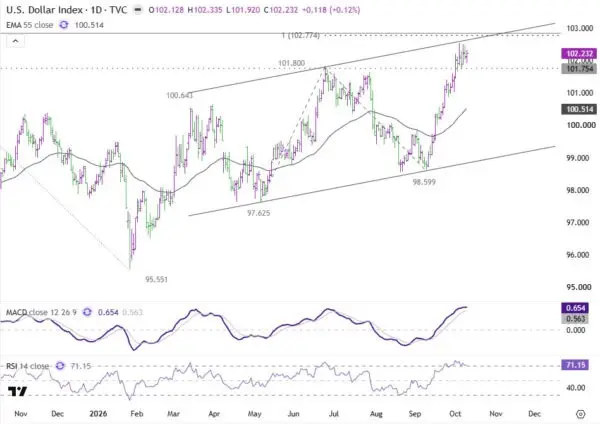
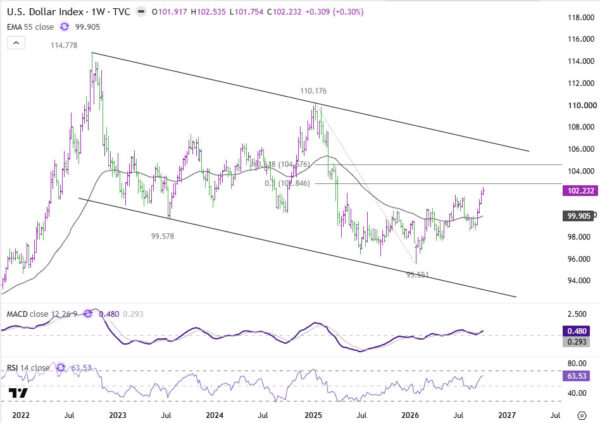
The mighty US Dollar rally has officially lost its aggressive momentum, though it has not yet surrendered its upward trajectory. The benchmark Dollar Index (DXY) recently stalled out at 102.232, hitting a ceiling as the Federal Reserve’s sense of policy urgency visibly fades, long-end Treasury yields successfully attract eager buyer demand at two-decade highs, and France is left shouldering a heavier burden of the greenback’s remaining support. Absent a sizeable shock from the upcoming US Consumer Price Index (CPI) report, the Dollar appears increasingly primed for a period of consolidation, with plenty of room to drift lower as markets look ahead to the crucial midterm elections.
Why This Matters
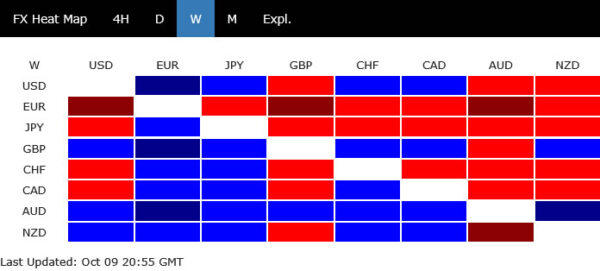
The greenback ultimately wrapped up the trading week in positive territory, yet it did so with noticeably less underlying strength than what characterized the earlier stages of the broader rally. DXY managed to close at 102.232 after testing a high of 102.536, but it completely failed to extend its gains even as the Euro remained the undisputed weakest major currency across the weekly currency heat map.
This deceleration does not definitively establish a Dollar top, but it strongly suggests that the three foundational pillars that previously reinforced one another are beginning to diverge. The rally was originally built on a trio of supports: a deeply urgent Federal Reserve tightening cycle, soaring long-term Treasury yields, and persistent Euro weakness driven by European sovereign stress.
Today, however, the Federal Reserve’s urgency has noticeably cooled, long-term bond yields have retreated from their extreme peaks following robust investor demand, and France remains the primary source of Euro vulnerability—though that third pillar entirely hinges on whether sovereign debt stress deteriorates once again. Unless the upcoming US inflation data delivers a sufficiently large surprise to violently reignite the rates trade, the Dollar may find itself consolidating further ahead of the November 3 midterms rather than immediately forging new highs.
Fed Urgency Has Already Faded
The foundational pillar that has experienced the most significant softening is the perception of Federal Reserve urgency. The policy shift began taking shape when New York Fed President John Williams remarked that there was "no need for urgency" following the central bank’s September rate hike, hinting that a single additional increase later in the year might be entirely sufficient should the economy evolve as projected.

Subsequent labor market data reinforced this wait-and-see stance. September payroll growth crawled to just 29,000 jobs, the unemployment rate ticked up to 4.2%, annualized wage growth slowed to a meager 0.1% month-on-month, and prior payroll estimates were aggressively revised downward.
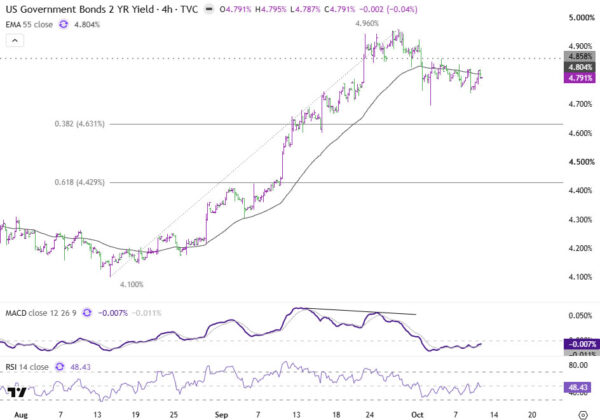
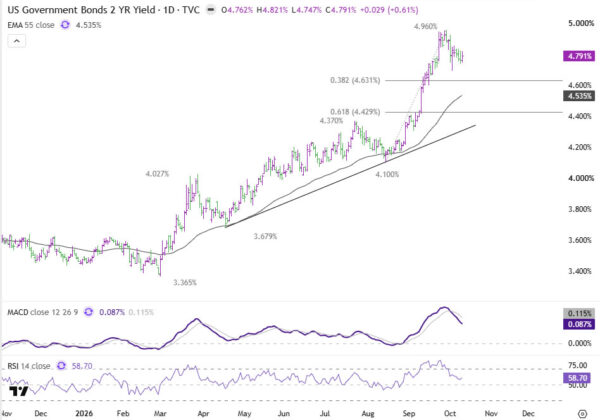
The domestic bond market has rapidly reflected this evolving landscape. The US 2-year Treasury yield peaked at 4.960% around the turn of the month before finishing the week at 4.791%, cleanly unwinding roughly 17 basis points. Subsequent remarks from Fed Governor Christopher Waller—noting that further rate hikes may still prove necessary but "do not need to come at consecutive meetings"—aligned neatly with this ongoing market repricing.
Crucially, the Federal Reserve has not turned definitively dovish. Instead, the critical market development is that the urgency premium has largely evaporated. A back-to-back rate hike in October is no longer the central assumption among institutional investors, even though another policy move later in the year remains firmly on the table.
This distinction carries profound implications for the currency market: the front end of the yield curve can stop providing incremental upside support to the Dollar without forcing market participants to aggressively price in a full easing cycle. The central question is no longer whether the central bank has concluded its tightening campaign, but whether enough policy urgency remains to push short-term yields back toward their recent cyclical highs.
Long-Term Yields Have Started Meeting Buyers
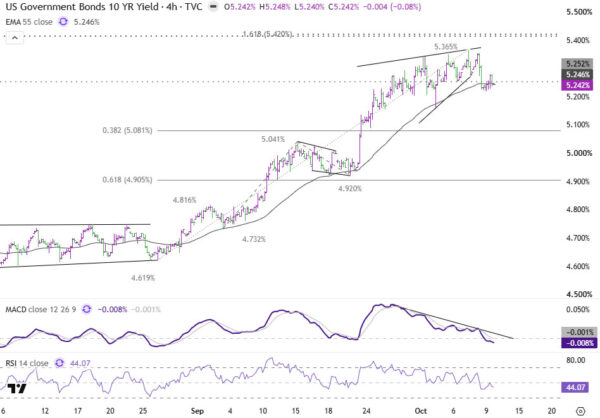
The second pillar supporting the greenback has not broken, but it has officially stopped strengthening. The benchmark US 10-year Treasury yield reached an impressive 5.365% during the week before retreating to 5.242% by Friday’s closing bell. Similarly, the 30-year yield eased from approximately 5.73% down to 5.600%.
Market analysts view these moves not as outright declines, but rather as necessary retreats from extreme historic highs, noting that the 10-year yield remains roughly 45 basis points higher over the course of the past month.
The dynamic shifted primarily in response to incoming Treasury supply. The 10-year Treasury auction cleared at 5.300%—representing the highest auction yield recorded since 2000—yet it paradoxically generated remarkably robust investor demand. The bid-to-cover ratio surged to 2.77, outperforming the historical average of around 2.51, while the auction stopped through by 1.7 basis points and indirect bidders absorbed a massive 80.3% of the offering. The subsequent 30-year auction similarly demonstrated solid indirect demand at 72.3%, even though the overall bid-to-cover ratio slipped slightly to 2.54.
These successful auctions forced investors to ponder a fundamentally different question from the one dominating trading desks only days prior: have Treasury yields finally climbed high enough to organically generate their own resistance and attract waves of long-term capital?
At the margin, pre-midterm political positioning may also be playing a subtle role. While hard positioning data confirming this trend is sparse, the upcoming election carries significant fiscal implications for the broader Treasury market, particularly following Donald Trump’s September proposal for a $5,000 dividend payment and warnings from prominent financial institutions regarding the fiscal risks of a potential political sweep. With the November 3 elections looming large, certain institutional investors appear content to lock in historically elevated yields before the domestic fiscal outlook grows even murkier.
Nevertheless, the most tangible evidence remains the auctions themselves, which proved conclusively that buyers are willing to step in aggressively when yields hit levels not seen in roughly two decades. This does not imply that the long-end uptrend is finished. Relative-yield spreads continue to favor the greenback, with US-Japan and US-Canada 10-year differentials widening over the week, while the US-Germany spread remained broadly unchanged.
The Dollar retains its yield advantage, but the underlying mechanism has fundamentally transformed. Previously, rising long-term yields continuously propelled the currency upward; today, buyers are demonstrating that sufficiently high yields naturally command their own robust demand. The long-yield pillar has stopped growing stronger, but it has not yet turned against the currency.
Oil Keeps the Rates Story From Turning Dovish
Crude oil continues to act as an indirect cushion for the broader rates narrative, rather than serving as the direct catalyst for the recent Treasury yield pullback. Brent crude settled at approximately $104.53 per barrel, remaining safely below September’s peak of $109.97 while still closing higher on the week.
This divergence is critical: energy prices remained elevated even as Treasury yields backed off their multi-year peaks, signaling that the bond market correction was driven far more by organic demand for fixed income than by any meaningful easing of persistent, energy-driven inflationary pressures.
Geopolitical developments have also introduced a delicate balance. President Donald Trump indicated that the United States would not undertake military action against Iran prior to the November 3 midterm elections, while characterizing ongoing diplomatic discussions as productive. This diplomatic pivot has effectively placed a temporary ceiling on the most immediate escalation risks in the Middle East without fully resolving the underlying geopolitical conflict.
For financial markets, the resulting environment is uniquely nuanced. The geopolitical risk premium has been temporarily capped rather than entirely eliminated, and this calm comes with a definitive expiration date attached to it.
Consequently, crude oil can continue keeping broader inflation risks elevated without necessarily sparking an immediate, violent surge in Treasury yields. Unless the outlook regarding Iran shifts drastically in the interim, November 3 stands out as another natural checkpoint where markets will inevitably reevaluate both energy dynamics and broader asset risk pricing.
France Is Carrying More of the Dollar’s Remaining Support
The third vital pillar of the greenback’s resilience lies entirely outside the borders of the United States. French sovereign debt stress has emerged as one of the primary drivers keeping the Euro severely depressed. The yield spread between French OATs and German Bunds widened to roughly 159 basis points earlier in the month before moderating toward 135 basis points, while France’s benchmark 10-year yield retreated from above 5% down toward 4.85%.
While the immediate panic has subsided, the underlying fiscal dilemma remains entirely unresolved. Prime Minister Sébastien Lecornu’s administration is desperately attempting to narrow the national deficit from 5.4% toward 5% while navigating a deeply divided parliament, leaving French borrowing costs exquisitely sensitive to the credibility of the government’s budgetary path. Bank of France Governor Emmanuel Moulin publicly emphasized that France does not currently require intervention from the European Central Bank and that the necessary fiscal solutions must originate from within France itself.
Simultaneously, lingering political uncertainty remains inextricably linked to the broader European political landscape, keeping investors on edge. This persistent European vulnerability helps prop up the US Dollar through the exchange rate channel, with the EUR/USD pair finishing the week hovering near 1.2015, comfortably above its recent lows.
Yet, this dynamic introduces a complex paradox. A renewed widening of the OAT-Bund spread would undoubtedly heap pressure on the Euro and provide a natural tailwind to the Dollar Index.
However, if European sovereign stress were to escalate to the point of generating a global flight to safety, the resulting surge in demand for US Treasuries would drive US yields down, potentially strengthening the Japanese Yen and Swiss Franc in the process. Consequently, French fiscal woes have the distinct capacity to lift the Dollar Index without necessarily translating into a broad, generalized Dollar rally.
This structural divergence explains why the latest DXY consolidation warrants careful observation, as the Euro entered the weekend as the weakest major currency yet the Dollar Index failed to break decisively higher.
Technical Picture Shows a Tiring Rally
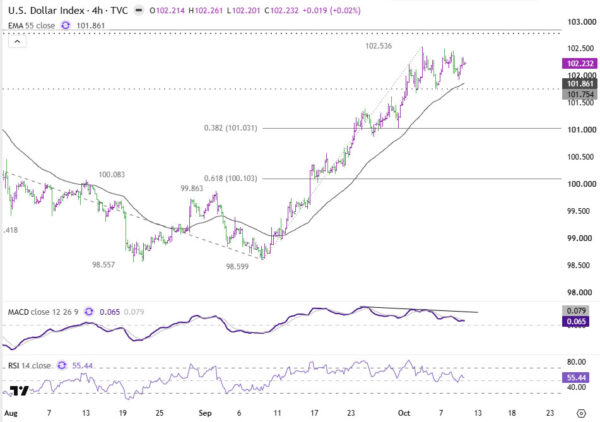
The technical landscape of the currency market mirrors the underlying macroeconomic narrative. The Dollar Index has settled into a tight sideways consolidation pattern after testing the 102.536 threshold. The broader near-term trend remains structurally constructive as long as the 4-hour 55 exponential moving average near 101.86 continues to hold, but momentum indicators clearly show a loss of upward steam.
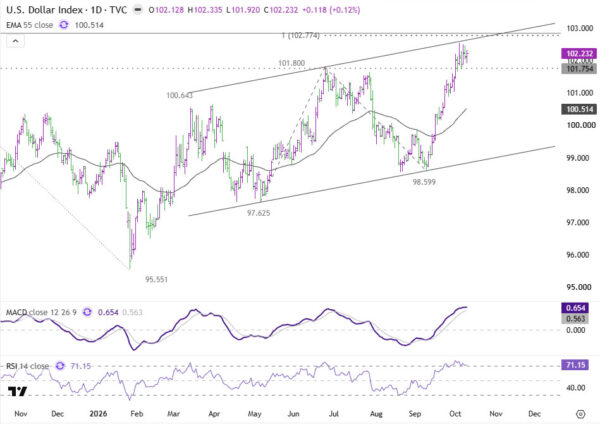
Immediate overhead resistance is densely concentrated just above current market levels. The 100% projection of the move from 97.62 to 101.80 measured from 98.60 sits at 102.77, closely coinciding with the 50% retracement of the larger drop from 110.17 down to 95.55 at 102.84, alongside the upper boundary of the daily rising channel, creating a formidable resistance barrier between 102.77 and 103.00.
Momentum indicators validate this exhaustion warning. The daily Relative Strength Index (RSI) stands at 71.15, signaling marginal overbought conditions, while the 4-hour MACD indicator prints a clear bearish divergence. This combination warns that the ongoing rally is becoming increasingly burdensome to extend, though neither indicator provides formal confirmation of a major trend reversal.
On the downside, the first meaningful technical trigger rests at the 101.75 support level. A sustained breakdown below this threshold would signal that the current consolidation has morphed into a deeper correction, potentially exposing the market to a slide toward the 38.2% retracement of the 98.599 to 102.536 leg at 101.03. Crucially, a retreat to 101.03 would still represent a completely normal technical correction rather than confirmation of a definitive top for the Dollar.
Conversely, a decisive, high-volume break through the 102.77–102.85 resistance zone would largely invalidate the immediate exhaustion thesis and open the door for a push toward the 61.8% retracement level at 104.58.
Yield Charts Confirm Momentum Loss
The short-end and long-end yield charts provide matching technical verification of this broader momentum loss. The 2-year Treasury yield has carved out a distinct short-term peak at 4.960%, accompanied by noticeable bearish divergence on the 4-hour MACD. The front-end yield has repeatedly struggled to punch through the 4-hour 55 EMA, currently hovering near 4.804%.
The immediate resistance level to monitor sits at 4.858%; remaining below this threshold keeps the corrective bias intact and targets the 38.2% retracement of the 4.100% to 4.960% range at 4.631%. A firm recovery back above 4.858%, however, would signal that the front-end correction has exhausted itself and quickly bring the 4.960% peak back into play.
Similarly, the 10-year Treasury yield chart presents a mature structural setup. The impulsive rally from 4.619% to 5.365% can be interpreted as a completed five-wave impulse structure, with the final leg of the advance from 4.920% forming an ending diagonal pattern. This upward push stalled just below the 161.8% projection of the 4.732% to 5.041% move measured from 4.920%, coming in at 5.420% before tumbling below 5.252%.
Momentum across the benchmark 10-year tenor has also weakened significantly. Sustained trading below the 4-hour 55 EMA, currently positioned at 5.246%, will cement this topping thesis and invite a deeper downward correction toward the 38.2% retracement of the 4.619% to 5.365% advance at 5.081%. Conversely, a powerful breakthrough above 5.365% would demonstrate that a secular top is far from established, putting the 5.420% target squarely back on the radar for fixed-income traders.
CPI Takes Precedence Before the Midterms
The most immediate challenge to this prevailing wait-and-see market environment arrives with the release of the US Consumer Price Index data. A softer-than-expected inflation reading could strip away even more of the residual near-term tightening premium, quickly bringing the 4.631% target on the 2-year yield and the 101.03 level on the DXY firmly into play.
Conversely, a hotter-than-forecast inflation print would offer the most direct catalyst for driving 2-year yields back toward 4.960% and prompting a fresh assault on the 102.77–102.85 resistance zone, rendering a prolonged consolidation period unnecessary.
Simultaneously, European developments will provide a parallel foreign exchange trigger. A renewed breakdown in the EUR/USD pair below the 1.1159 mark—particularly if accompanied by French OAT-Bund spreads marching back toward the 150 to 159 basis point zone—would supply an independent stream of upward momentum to the Dollar Index, even if domestic US yields remain subdued.
Following the inflation data, the Federal Open Market Committee meeting scheduled for late October looms on the horizon. With economic projections off the table and market participants overwhelmingly leaning toward an expected policy hold, the central bank gathering may prove less market-moving than the CPI release, though any forward guidance regarding December and subsequent monetary tightening could still shake the broader rates curve.
Ultimately, all roads lead to the November 3 midterm elections. President Trump’s strategic decision to postpone any potential US military action against Iran until after the midterms has imbued that specific calendar date with profound macroeconomic significance that stretches far beyond domestic American politics.
Rally Stalled Does Not Yet Mean Rally Over
The core challenge facing the US Dollar is not that its underlying supports have entirely vanished. Rather, those foundational supports are simply no longer pulling in unison.
Federal Reserve policy urgency has noticeably cooled, the 2-year Treasury yield has undergone a healthy technical correction, and long-term bond yields are successfully finding willing buyers at historically elevated levels. While France remains a persistent source of Euro weakness, French sovereign stress is now forced to carry a heavier share of the burden required to keep the Dollar Index afloat.
This structural disconnect leaves the greenback uniquely vulnerable to a period of consolidation in the weeks ahead. Unless upcoming inflation data delivers a substantial upside surprise, market participants will likely prefer to sit on their hands while awaiting the heavier macro catalysts clustered around late October and the November 3 midterms. In such an environment, a gradual drift toward the 101.03 support level would be entirely consistent with the natural digestion of the preceding advance.
The Dollar rally has unquestionably stalled, but prematurely calling an outright top requires a much higher burden of technical and fundamental evidence.