



The disconnect between corporate performance and market sentiment was on full display in the precious metals sector, as industry giant Newmont—the world’s largest gold miner—reported record third-quarter adjusted net income yet watched its share price tumble. Rather than celebrating the company’s robust financial results, investors focused heavily on the looming headwinds of the fourth quarter, triggering a sell-off that rippled broadly across mining equities.
By Friday’s market close, Newmont shares had dropped 4.6 percent, falling more than twice as fast as the broader VanEck Gold Miners ETF (GDX). The weakness was systemic across the industry. Over the course of the trading week, the junior mining sector suffered even more severe losses, with the Junior Gold Miners ETF (GDXJ) plunging 9.6 percent. Physical gold fared poorly as well, slipping 4.1 percent over the week to drop below the psychological $4,000-per-ounce threshold by Friday. Meanwhile, silver finished the session closing below its 2026 lows for a second consecutive day, underscoring a broad-based retreat in precious metals.
The fact that a record-breaking financial quarter failed to lift the industry’s premier miner highlights a fundamental truth for anyone who owns or follows mining stocks: the market trades on future expectations rather than historical triumphs.
A Share Price Looks Ahead
In the financial markets, a share price looks forward while a record-breaking earnings report looks backward. Investors ultimately allocate capital based on the future profits a mining enterprise is projected to generate. Those prospective earnings hinge entirely on a critical delta between two primary figures: the prevailing market price of gold and the operational cost required to unearth a single ounce of the metal.
During the third quarter, Newmont demonstrated exceptional operating economics, selling gold at an average price of $4,317 per ounce while keeping its all-in sustaining costs at $1,454 per ounce. This dynamic yielded a healthy operating margin of approximately $2,860 per ounce. However, the outlook for the upcoming fourth quarter presents a markedly different financial landscape. Newmont has projected that its all-in sustaining costs will climb to about $1,900 per ounce. This anticipated escalation is driven largely by higher sustaining capital expenditures, alongside persistent economy-wide inflation and rising oil prices.
When measured against a gold price hovering near $4,000, that projected fourth-quarter margin contracts to roughly $2,100 per ounce. This means the anticipated gold price sits approximately 7 percent below the third-quarter average, yet the resulting operating margin shrinks by a striking 27 percent. Consequently, when the closing bell rang on Friday, equity markets completely bypassed the historical record of the third quarter and priced in the compressed margins expected ahead.

The Margin Math
This vulnerability stems from a financial reality inherent to heavy industry known as operating leverage. The vast majority of a mining company’s operational expenditures—such as labor, heavy machinery maintenance, infrastructure development, and compliance—do not decrease when the market price of gold declines. As a result, every single percentage point lost in the price of the underlying commodity extracts an even larger percentage out of the corporate profit margin.
To illustrate this leverage, consider a scenario where gold drops to $3,500 while operational costs remain anchored at $1,900 per ounce. Under those conditions, Newmont’s profit margin would shrink to $1,600 per ounce, representing a 44 percent contraction compared to the third quarter, even though the price of gold itself would be down by 19 percent.
Crucially, operating leverage operates symmetrically in both directions. During a powerful market rally, miners’ profits expand at a much faster pace than the gains in gold, which explains why mining shares consistently outperform the metal during bull runs. Conversely, during a market correction, corporate profits evaporate at an accelerated rate, causing mining equities to lead the downward trend.
Why Junior Miners Fall Harder
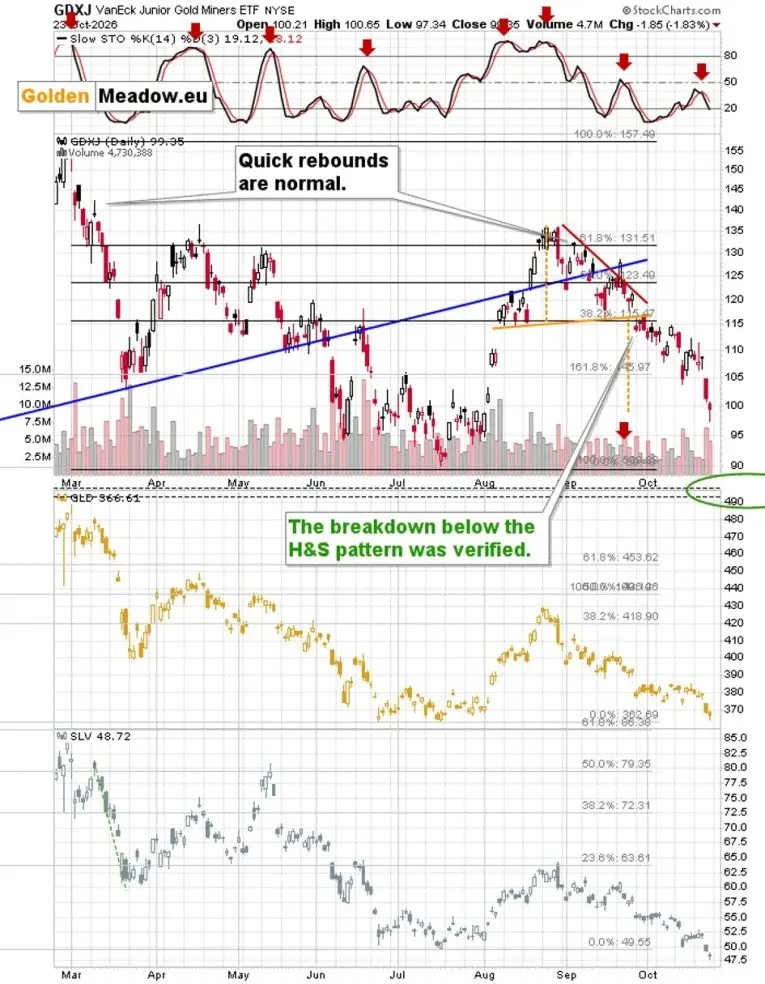
The magnified impact of declining margins is acutely felt further down the market capitalization spectrum, particularly among junior exploration and development companies. Market analysts tracking the junior space had previously outlined technical warning signs for the GDXJ, noting that a verification rebound would likely run into stiff resistance near the $117 neckline, pointing toward downside targets well below $100. Following an early-month relief rally that stalled just beneath $116, the GDXJ ultimately broke lower, closing the week at $99.35.
The structural vulnerability of junior miners is deeply tied to their cost structures. With production costs remaining static, a drop in gold from $4,317 to $3,500 severely impacts a lean producer, but it inflicts catastrophic damage on higher-cost operations. For a producer running on $1,454 costs, the margin reduction is substantial, whereas a higher-cost producer with baseline expenses closer to $2,500 sees its profit cushion obliterated entirely. This fundamental cost disparity explains why junior miners, which frequently feature higher-cost production profiles, experienced an outsized 9.6 percent weekly decline while physical gold fell 4.1 percent.
Trading volume patterns heavily confirmed the bearish momentum. On Thursday, the GDXJ tumbled 6.75 percent on trading volume roughly three times heavier than the previous Wednesday. The selling pressure continued into Friday, with the ETF shedding an additional 1.83 percent on volume exceeding twice the mid-week baseline. Market technicians noted that earlier minor upswings occurred on noticeably weak volume, whereas the sharp declines were accompanied by heavy institutional distribution.

Higher Oil Hits the Miners Twice
Macroeconomic pressures compounded the sector’s woes, beginning with the energy markets. Newmont specifically cited elevated oil prices as a primary contributor to its rising operational expenses. Energy markets reflected these pressures as Brent crude climbed to a six-month high of $116.72.
Beyond directly inflating the cost of running heavy mining equipment, higher oil prices sustain broader inflationary pressures throughout the global economy. Data from consumer sentiment tracking, including the final University of Michigan survey, revealed that year-ahead inflation expectations remained elevated at 4.7 percent, while long-run expectations ticked upward to 3.5 percent compared to 3.4 percent the previous month. This persistent inflation backdrop directly influenced monetary policy outlooks. Futures indicators via the CME FedWatch tool reflected a roughly 84 percent probability of another interest rate hike by the central bank before the conclusion of the year. Because gold is a non-yielding asset, higher prevailing interest rates increase the opportunity cost of holding the precious metal, adding a persistent layer of downward pressure.
Consequently, surging oil prices penalize the mining sector through a dual mechanism: directly inflating corporate extraction expenses and indirectly depressing gold prices through the interest rate channel.
What a Real Bottom Would Look Like
Market history suggests that at genuine market bottoms, mining equities typically demonstrate relative strength by leading the physical metal higher. This behavior is once again explained by operating leverage. As institutional markets begin to price in a future recovery in the gold price, the expected rebound in corporate profitability triggers buying in mining shares ahead of the underlying commodity.
Last week’s market action displayed the exact opposite dynamic. The sharp underperformance of the GDXJ relative to physical gold, combined with the negative reaction to Newmont’s record earnings, signals that capitulation in the sector may not yet be complete. Until mining equities begin demonstrating resilience by either rising during down days for gold or falling at a slower rate than the metal itself, technical indicators suggest the broader sector correction has further room to run.
Similar structural dynamics govern market tops. Earlier in the month, relative strength in silver and a rapid giveback of mining gains signaled impending short-term exhaustion. From those previous resistance levels, junior mining equities experienced a steep double-digit percentage correction, validating the predictive value of inter-market relationships.

The Dollar Adds Pressure
Adding to the complex web of pressures facing precious metals, the US Dollar Index has shown renewed technical strength following a successful test of its previous 2026 highs, where prior resistance successfully transitioned into reliable support. Because gold maintains a historically negative correlation with the US dollar, a confirmed breakout to fresh yearly highs in the currency index points toward continued upward momentum for the greenback.
While gold dropped 4.1 percent over the course of the week even as the US Dollar Index finished relatively flat, any sustained dollar rally moving forward would introduce an additional layer of headwinds for precious metals. Through the amplifying lens of operating leverage, a strengthening dollar and lower gold prices would translate into even sharper margin compression for the mining industry.
Silver Tests Key Support Levels
Industrial and precious metals alike felt the strain, with silver prices breaching significant technical thresholds. Silver closed below its established 2026 lows on Thursday at $55.01 per ounce, followed by a further decline on Friday to finish the week at $53.95. Market technicians monitor consecutive daily closes below major support levels to evaluate trend persistence, noting that additional confirmation sessions would firmly establish the breakdown.
Where This Leaves Us
The events of the week crystallized the cautious mood currently gripping the resource sector. Newmont delivered record adjusted earnings and maintained its operational guidance, yet its equity value retreated because investors looked past past achievements to confront a challenging fourth-quarter reality defined by escalating costs and retreating metal prices. With physical gold sliding alongside silver and junior equities absorbing losses more than double those of the underlying metal, the market has made it clear that strong historical results are currently insufficient to override forward-looking concerns.