



The foundational rule of modern retirement planning may be fundamentally misapplied for a growing generation of younger retirees. That is the conclusion of a collaborative research project between financial blogger "The Mad Fientist" and Nick Maggiulli, author of Just Keep Buying and the financial analytics blog Of Dollars and Data. Following an online discussion about the data-driven methodology behind Maggiulli’s work, the two financial analysts teamed up to run comprehensive historical simulations challenging the traditional assumptions of the widely cited "4% rule."
For decades, the 4% rule has served as the gold standard for retirement readiness. Formulated by financial planner William Bengen in the 1990s, the guideline suggests that retirees can safely withdraw 4% of their initial portfolio value during their first year of retirement, and subsequently adjust that dollar amount upward for inflation each year, with a high probability that the funds will last for a standard 30-year retirement timeline.
However, the core critique raised by the Mad Fientist is not that the 4% rule is fundamentally flawed, but rather that it was never truly designed for early retirement.
The primary disconnect lies in the assumption of lifestyle and spending flexibility. Traditional retirees in their 70s or 80s generally face a fixed set of living expenses with limited capacity to alter their lifestyle or re-enter the workforce if market conditions deteriorate. Conversely, individuals who achieve Financial Independence (FI) and retire in their 30s or 40s possess significantly greater adaptability. Early retirees often maintain marketable professional skills, enjoy higher physical mobility, and frequently engage in alternative income streams, side projects, or partial consulting work. Furthermore, their household structures and long-term financial commitments can flex in ways that a standard retiree’s cannot.
Despite this inherent adaptability, the traditional 4% rule treats all spending identically. It assumes a rigid first-year withdrawal rate followed by mandatory annual inflation adjustments across every single budget category, regardless of whether rising prices actually impact those specific expenses.
Recent discussions in the financial planning community have increasingly highlighted how conservative this approach truly is. During a recent appearance on the Money with Katie podcast featuring William Bengen himself, discussions centered on the fact that the 4% rule inflation-adjusts total spending automatically. In reality, major household expenditures—such as a 30-year fixed-rate mortgage—remain entirely insulated from inflationary pressures for decades. Additional historical analyses discussed in the interview underscore that various other conservative buffers built into the original framework mean the 4% threshold frequently underestimates a portfolio’s true resilience.
Yet, a longer retirement timeline introduces a new mathematical hurdle. While a 30-year horizon fits standard retirement, an early retiree planning for a 40- to 60-year post-work life might intuitively assume they need to drop their initial withdrawal rate significantly lower.
Historical data, however, suggests the adjustment may not need to be as drastic as many fear. Citing insights from previous analyses involving financial planner Michael Kitces, extending a standard retirement horizon by a decade typically requires reducing the initial withdrawal rate by roughly 0.6%. More importantly, historical market simulations show that a retirement portfolio capable of surviving for 40 years possesses a remarkably high historical probability of surviving for 50 or 60 years or more, largely due to the mechanics of Sequence of Returns Risk.
If the baseline 4% rule actually functions closer to a 4.8% rate under certain conditions, and a 40-year horizon requires subtracting about 0.6%, the resulting figure lands right back near the traditional 4% threshold. But that baseline calculation still fails to properly price in the unique flexibility available to early retirees.
To address this gap, Maggiulli ran custom historical simulations exploring how separating essential living costs from discretionary spending could safely unlock higher initial withdrawal rates without sacrificing portfolio longevity.
The strategy begins by categorizing household expenditures into two distinct buckets: essential and discretionary. Essential expenses represent non-negotiable survival costs, such as basic housing, food, healthcare, and utilities. Discretionary expenses encompass lifestyle choices, travel, luxury items, and non-essential hobbies that can be paused or eliminated during difficult economic environments.
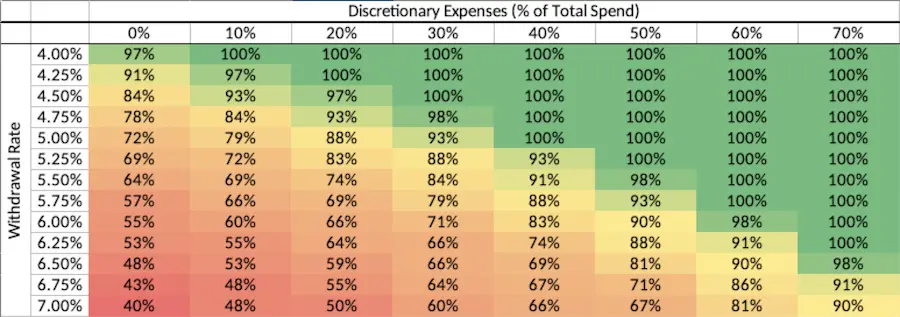
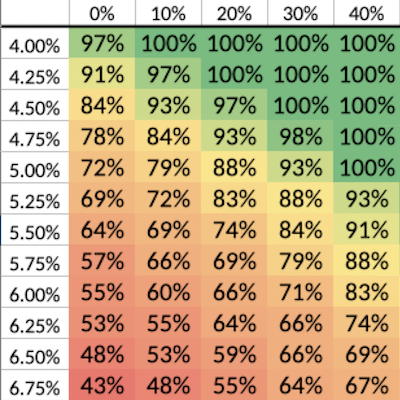
By determining the exact percentage of a budget allocated toward discretionary spending, retirees can consult specialized withdrawal matrices. For a portfolio allocated 80% to stocks and 20% to bonds—spanning historical market data from 1926 through 2022—retirees who incorporate spending flexibility can safely sustain higher initial withdrawal rates while maintaining a success rate exceeding 98%.
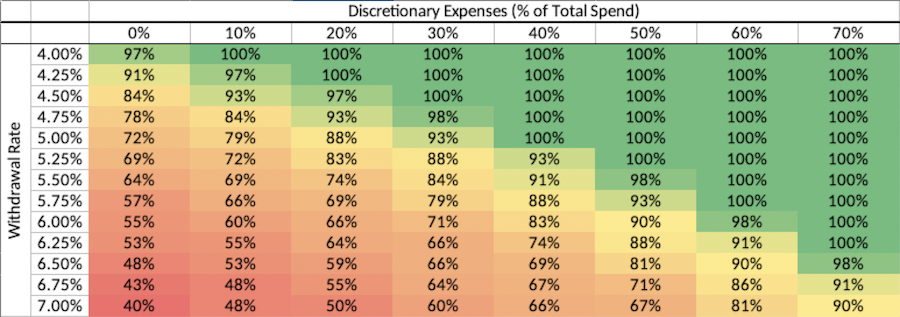
To test the mechanics of this framework, consider a hypothetical retiree with a $1 million portfolio invested in an 80/20 asset allocation. Under the strict 4% rule, this individual could withdraw $40,000 in the first year, indexed to inflation thereafter, resulting in a robust historical success rate of approximately 96.55% across all rolling 40-year periods since 1926.
If that same retiree determines that 50% of their annual expenditures are discretionary, they can raise their initial withdrawal rate to 5.5%—totaling $55,000—while preserving a comparable 98.28% historical success rate. Under this specific protocol, essential spending is prioritized and adjusted upward for inflation annually, while discretionary spending behaves dynamically based on the prior year’s market performance. Following a severe market downturn, discretionary spending is reduced or temporarily suspended, protecting the core portfolio from permanent capital depletion.
This dynamic adjustment mechanism offers a dual benefit. For individuals already aiming for a specific annual budget, a higher safe withdrawal rate significantly reduces the total capital required to declare financial independence, allowing them to exit the traditional workforce years earlier. Conversely, for those who accumulate a traditional nest egg, the strategy provides a built-in buffer against market shocks while supporting a higher standard of living during bull markets.
Beyond portfolio math, the researchers noted that this dynamic withdrawal framework addresses a common psychological hurdle observed among early retirees. Many individuals relentlessly pursue financial independence only to experience profound disorientation once money is no longer a primary daily motivator. By establishing a framework where ongoing portfolio health dictates discretionary lifestyle choices, retirees maintain a tangible connection to economic reality, helping to mitigate the existential stagnation that can accompany early retirement.
While critics might argue that tying personal spending to broader market indices introduces unnecessary complexity, the researchers opted for market-wide benchmarks for simplicity and caution. When macroeconomic indicators flash warning signs during broad bear markets, the wider economy frequently experiences corresponding contractions, making supplemental earned income or part-time consulting more difficult to secure. Aligning personal budget tightenings with broader economic downturns provides a prudent safeguard when external financial conditions turn volatile.
Ultimately, the collaborative simulations demonstrate that early retirees do not need to remain locked into the rigid constraints of a generalized 30-year withdrawal model. By explicitly accounting for household flexibility and differentiating between essential and discretionary costs, younger retirees can safely bridge the gap between early exit timelines and long-term financial security.