




As financial markets and policymakers prepare for next Monday’s crucial October consumer price index (CPI) report, all eyes remain focused on whether elevated global energy costs are beginning to generate broader, more persistent price pressures across the Canadian economy. Serving as the final major inflation reading before the Bank of Canada (BoC) convenes for its upcoming monetary policy decision, the upcoming data release will play a pivotal role in shaping expectations for the central bank’s final interest rate deliberations of the year.
Economists anticipate that headline CPI growth will ease slightly, moving down to 3.0% on a year-over-year basis compared to the 3.1% rate recorded in September. Throughout the transition from September to October, energy prices largely held steady, remaining anchored at levels well above those seen during the same period last year. Meanwhile, food inflation—having steadily drifted downward closer to a more manageable 2.0% annual pace—is expected to have experienced little to no meaningful change over the course of the month.
Core inflation metrics are also projected to show subtle signs of cooling. When stripping out the volatile components of food and energy, the core CPI figure is expected to tick slightly lower from September’s 2.1% reading to 1.9% in October. Furthermore, the Bank of Canada’s preferred core inflation measures, including CPI-trim and CPI-median, are likely to register matching year-over-year growth rates following another benign month-over-month increase of just 0.2%.
Energy Pass-Through Still Muted to Date but Pressure Is Building
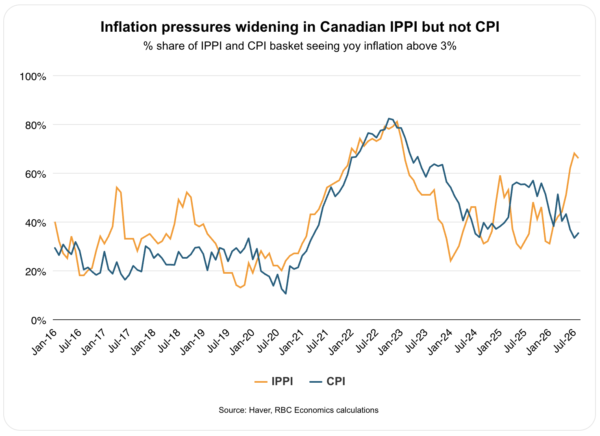
A critical element of the ongoing economic analysis involves tracking how deeply energy shocks are penetrating the broader consumer basket. Specifically, diffusion indices designed to measure the share of consumer items experiencing abnormally high inflation rates suggest that price pressures have remained relatively narrow. Aside from localized categories like inter-city transportation, there has been limited evidence of energy costs spilling over heavily into other sectors of consumer spending.

However, financial analysts caution that a muted pass-through to date does not completely rule out the potential for more significant spillover effects down the road. Driven by these underlying risks, the Bank of Canada opted to hike interest rates during its October meeting, implementing a preemptive measure designed to neutralize potential upside inflation threats before they could fully materialize in the broader economy. Current market projections point toward the possibility of another rate hike in December, a move that would bring the benchmark overnight rate to 2.75%, placing it squarely in the middle of the central bank’s estimated neutral range.
Despite these hawkish considerations, the case for a December rate hike is far from guaranteed. Economic indicators released since the central bank’s last policy gathering have largely leaned toward softness. Notably, the Canadian labour market struggled through its third consecutive month of job losses in October, while gross domestic product (GDP) growth for the third quarter appears on track to fall short of the Bank of Canada’s earlier 2% forecast. Compounding these cooling signals, domestic gasoline prices have declined significantly through November, retreating back toward levels last seen in March as global crude oil prices and refining margins experience a period of normalization.
Nevertheless, the trajectory of global oil markets remains notoriously volatile. Previous episodes of sustained high energy prices mean that significant cost pressures have already accumulated deeper within supply chains. Producer price diffusion indices continue to point toward a much wider scope of industrial inflation, a phenomenon that typically trickles down through manufacturing and distribution networks before eventually appearing in consumer prices with a distinct statistical lag.
Given these competing dynamics, the baseline expectation among major financial forecasts remains a low-conviction interest rate hike when the central bank meets in December.
As the macroeconomic picture continues to evolve, upcoming data releases will offer further clarity on the health of the domestic economy. Next Friday’s release of the September Canadian retail sales report will provide a vital update on how households are managing their spending habits in the face of rising borrowing costs and elevated price levels. Statistics Canada’s preliminary advance estimate points to a 0.7% increase in nominal sales, a finding that aligns broadly with proprietary cardholder data indicating that consumer spending remained resilient through the autumn months.
To round out a busy week of macroeconomic updates for Canada, the latest figures on housing starts are also slated for publication. Analysts anticipate that housing starts will moderate to an annualized rate of 236,000 units in October, retreating from the strong 259,000 reading recorded in September as the broader housing market responds to tighter financial conditions.