

At first glance, recent economic reports suggest that the nation’s inflation landscape has brightened compared to just a month ago. However, a closer examination reveals that this apparent progress is not the result of a sudden improvement in August price stability. Instead, newly released revisions from the Bureau of Economic Analysis (BEA) have retroactively lowered estimates of recent inflation figures without materially altering the underlying trajectory of rapid overall spending. This robust spending growth continues to run far too hot for inflation to return sustainably to the Federal Reserve’s stated 2 percent target, indicating that policymakers still have significant work ahead of them.
According to the latest data released by the BEA, the Personal Consumption Expenditures Price Index (PCEPI)—widely regarded as the Federal Reserve’s preferred metric for tracking inflation—rose 0.3 percent in August. This figure marks an acceleration from the 0.1 percent increase recorded in July. Over the preceding six months, the headline index has climbed at an annualized rate of 3.6 percent, while standing 3.4 percent higher than it was at the same time last year, leaving the annual rate unchanged from July’s revised figures.
A similar pattern emerges when examining the core PCEPI, which strips out volatile food and energy prices to provide a clearer view of underlying trends. The core index increased by 0.2 percent in August, ticking up from a 0.1 percent rise in July. Over the past six months, core inflation has advanced at an annualized rate of 2.7 percent, remaining steady at 3.0 percent higher than a year ago, matching the previous month’s pace.
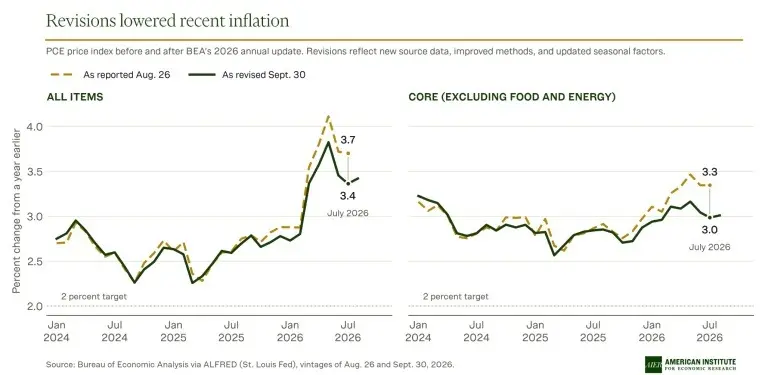
The illusion of a sudden cooling in August largely stems from sweeping revisions included in the BEA’s annual update of the national accounts. Earlier this year, the BEA reported that prices had surged 3.7 percent between July 2025 and July 2026. Following the annual update, the agency now estimates that prices advanced by just 3.4 percent over that exact same twelve-month period. Consequently, the apparent month-over-month improvement reflects retroactive adjustments to historical data rather than any sudden deceleration of price pressures occurring in August.
These extensive revisions go well beyond the BEA’s routine updating of recent monthly estimates. The annual update incorporated newly available and revised source data, refined estimation methodologies, and updated seasonal adjustment factors. Among the notable methodological changes, the agency revised how it calculates and measures prices for specialized sectors such as portfolio-management services, legal services, and computer software.
A retrospective look at the data shows that the old and revised figures tracked each other closely throughout 2025 before beginning to diverge visibly this past spring. The BEA now estimates that headline inflation reached 3.8 percent in May, a downward adjustment from the 4.1 percent previously reported. Similarly, core inflation for July is now pegged at 3.0 percent rather than the 3.3 percent originally published. When evaluated through the lens of these revised datasets, both headline and core inflation rates remained entirely unchanged between July and August.
Crucially, while these statistical revisions successfully lowered the overall level of recent inflation, they did little to alter its broader medium-term trend. Even when using the revised figures, consumer prices are currently rising at a noticeably faster clip than they were a year prior, when the annual inflation rate hovered around 2.7 percent. Over the course of the past three years, both headline and core prices have advanced at an average annual rate of approximately 2.9 percent, comfortably above the central bank’s 2 percent target threshold.
This persistent upward trend explains why the Federal Open Market Committee opted to raise its target range for the federal funds rate by a quarter of a percentage point, bringing it to 3.75 to 4 percent during its September meeting. In an official statement accompanying the decision, the committee noted that inflation remains elevated, emphasizing that the adjustment will support a timelier return to the central bank’s overarching price stability goals.
Beyond consumer price indices, the economic indicator that matters most for determining the future path of inflation is total spending. Nominal spending—defined as the total dollar value of all final goods and services produced within the economy—expanded by 6.3 percent over the year ending in the second quarter, according to the third estimate published by the BEA. Although this figure is slightly lower than the 6.6 percent previously reported, the modest downward revision does little to alter the underlying macroeconomic reality.
Nominal spending growth has consistently exceeded 4 percent in every year-over-year comparison recorded since early 2021, averaging roughly 5.8 percent annually over the past three years. More importantly, this spending growth has recently accelerated, climbing from 4.8 percent in the year ending in the second quarter of 2025 to 6.3 percent over the most recent four quarters.
From a macroeconomic perspective, nominal spending cannot consistently outpace the productive capacity of the broader economy without ultimately fueling higher inflation. The Federal Reserve’s most recent Summary of Economic Projections estimates longer-run real output growth at roughly 2 percent per year. When combined with the central bank’s 2 percent inflation target, nominal spending should ideally expand by about 4 percent annually over the long term. Instead, actual nominal spending has surged by 6.3 percent over the past year, outpacing that foundational benchmark by more than two full percentage points. At such an elevated pace, spending is expanding far too quickly for inflation to settle sustainably at 2 percent, signaling that monetary policy remains too loose.
To be sure, notable progress has been achieved. Core inflation has moderated to an annualized rate of 2.7 percent over the past six months, down significantly from the 3.9 percent rate recorded over the six-month period ending in May. Furthermore, because monetary policy transmits through the complex financial system with a noticeable lag, the full cooling effects of the Fed’s recent September rate hike have not yet fully materialized in the published inflation statistics. Nevertheless, with economic spending maintaining such a rapid pace, inflation is widely expected to struggle to return to the 2 percent target absent additional monetary tightening.
This rapid expansion in nominal spending should ideally dictate the Federal Reserve’s strategic approach during its upcoming meeting scheduled for late October. However, financial markets have interpreted the recent data through a different lens. The downward revisions to recent inflation figures have largely reduced the perceived urgency for further policy tightening, contributing to a noticeable decline in market expectations for a rate increase at the October gathering.
Yet, a careful analysis suggests that these revisions do little to justify a pivot away from vigilance. While measured inflation rates have shifted downward by a few tenths of a percentage point, the fundamental trajectory of nominal spending remains unchanged.
The upcoming December policy meeting will provide the first opportunity for the Federal Reserve to incorporate the BEA’s fully revised inflation and spending datasets into its Summary of Economic Projections. During the September projections, 16 out of 18 participants anticipated at least one additional rate increase before the end of the year, with four officials projecting two hikes. Policymakers have cautioned that lower near-term inflation figures should not prompt premature scaling back of policy while overall economic spending continues to run at such a robust pace.
Complicating the policy timeline, the BEA is scheduled to release its initial estimate for third-quarter gross domestic product just one day after the Federal Reserve concludes its October policy meeting. If that forthcoming report demonstrates that nominal spending continues to expand well above the 4 percent threshold on a year-over-year basis, it will provide further confirmation that monetary conditions remain overly accommodative. Until that persistent macroeconomic gap closes, the Federal Reserve’s ongoing campaign to restore stable price levels remains far from complete.