



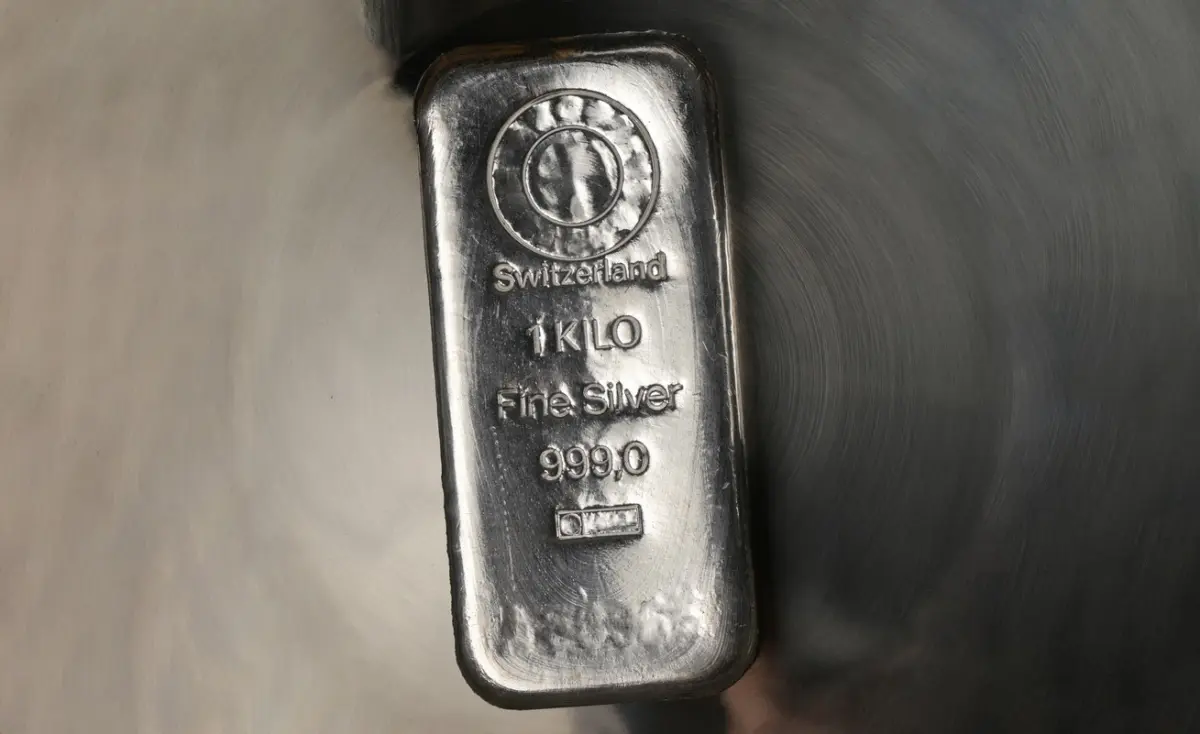
Silver prices faced renewed selling pressure this week, slipping below last week’s key low of 58.46 to briefly touch 58.39. This latest decline occurred against a backdrop of falling US Treasury yields and a softer US Dollar, a divergence that highlights growing weakness unique to the white metal. While Gold has managed to remain relatively stable within its established trading range, the Gold/Silver ratio has accelerated upward toward 71, confirming Silver’s distinct underperformance. Market participants are increasingly viewing these technical developments as a sign that the decline from 71.16 is resuming, with a broader breakdown threatening to bring the larger downtrend originating from 121.64 back into focus.
Silver Loses Traditional Support From Falling Treasury Yields
Silver’s brief recovery from the 58.46 level last week initially coincided with a retreat in US Treasury yields following the 10-year yield’s peak at 5.365%. However, that established macroeconomic correlation has weakened significantly. Despite further downward movement in yields and the broader Dollar index this week, Silver has drifted back toward its October lows while Gold continues to consolidate its position.
This clear divergence suggests that lower nominal yields alone are no longer sufficient to sustain a recovery in Silver. At the same time, industrial metal counterparts such as copper have remained relatively stable, making it difficult to attribute the recent weakness to a broad-based industrial metals selloff. Instead, analysts note that Silver’s relatively small investable market and substantial industrial exposure can often amplify shifts in investor sentiment, even in the absence of a dominant, singular selling catalyst.
Furthermore, falling nominal Treasury yields do not necessarily imply an equivalent decline in real yields, leaving the precise state of Silver’s interest-rate backdrop somewhat ambiguous. The market structure may also be playing a role, as a relatively limited free float combined with heavy industrial demand makes prices exceptionally sensitive to shifts in institutional and retail investor flows. Without fresh positioning data, however, the exact source of the immediate selling remains difficult to pinpoint. The most significant takeaway is that Silver is losing ground even as some of the broader macroeconomic pressures that previously weighed heavily on precious metals begin to ease.
Gold/Silver Ratio Signals Further Underperformance
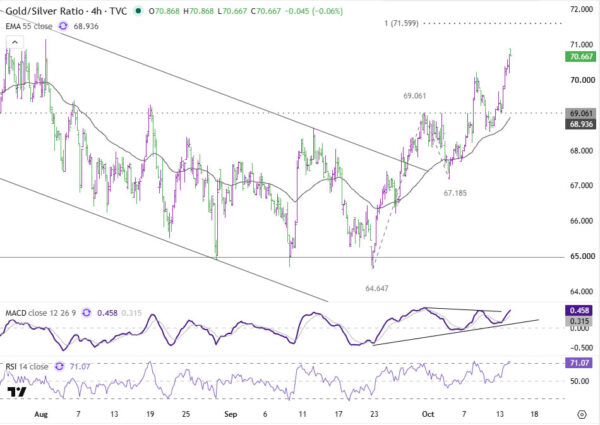
The Gold/Silver ratio continues to provide compelling evidence of Silver’s deteriorating relative performance. The ratio’s rally has gathered renewed momentum this week, with accelerating strength on the 4-hour Moving Average Convergence Divergence (MACD) indicator reinforcing a distinctly bullish outlook for the ratio itself. Having climbed toward 70.67, the ratio has moved comfortably above its former resistance level at 69.06.

From a technical perspective, the previous correction from 72.55 down to 64.64 now appears to be fully complete. This completion raises the distinct probability that the broader upward advance originating from the 52.72 mark is resuming. Further upside continuation for the ratio is favored as long as the 69.06 support level holds firm. The next immediate target sits at the 100% projection of the 64.64 to 69.06 move measured from the 67.18 midpoint, landing at 71.60. A sustained break above that threshold would quickly bring the 72.55 high back into the spotlight.
This broader market structure implies that Silver may remain locked in a prolonged period of relative underperformance against Gold. Even if Gold manages to stabilize or stage a broader rebound in the near term, Silver could struggle to keep pace as long as the ratio maintains its upward trajectory.
Silver Breakdown Raises Risk of a Deeper Decline
On an individual technical basis, Silver’s chart outlook is increasingly fragile. The recent recovery attempt from the 58.46 low was decisively rejected by the falling 4-hour 55 exponential moving average (EMA), which currently sits around the 60.49 mark. Concurrently, a rebound attempt on the 4-hour MACD was turned back by a descending trendline, providing further technical confirmation that the broader decline from 71.16 remains active and intact.
While the initial breach of the 58.46 level was relatively marginal and still requires further confirmation through subsequent closes, it significantly strengthens the case for another downside extension. The near-term market bias remains firmly bearish as long as the 61.45 resistance barrier holds. If selling pressure persists, the next major downside target aligns with the 138.2% projection of the 71.16 to 62.30 move measured from 67.54, which points directly to 55.30.
That projected downside level rests in close proximity to the July swing low at 54.78, while a more aggressive 161.8% projection at 53.21 offers another important technical reference point. Together, these levels establish a critical support zone where selling pressure might eventually find a floor and stabilize.
More importantly, a decisive break below the lower boundary of the prevailing falling channel would signal a sharp downward acceleration. Such a move would raise the troubling prospect that Silver is resuming its much larger historical downtrend from 121.64. If followed by a confirmed break beneath the 54.78 mark, the psychological $50 level would quickly emerge as a primary downside risk.
Conversely, any recovery that manages to reclaim the 4-hour EMA and push back above the 61.45 resistance level would signal that the immediate downward momentum is fading, thereby undermining the near-term bearish outlook.
Upcoming Economic Data and Market Outlook
Upcoming macroeconomic data releases, including the latest US Consumer Price Index (CPI) report, have the potential to inject fresh volatility into the market by influencing Treasury yields and the US Dollar. A softer-than-expected inflation reading could theoretically offer some much-needed relief to the broader precious metals complex, whereas a hotter inflation print would likely renew upward pressure on yields.
However, given Silver’s recent failure to capitalize on the broader Treasury recovery, a favorable CPI reaction alone may not be sufficient to reverse the metal’s underlying weakness. Market participants will be paying closer attention to whether Silver can muster the strength to reclaim the 61.45 resistance level and whether the Gold/Silver ratio can sustain its advance above 69.06.
For the time being, the combination of persistent price weakness in Silver and a strengthening Gold/Silver ratio points toward continued downside potential, with the 55.30 level acting as a near-term objective. The larger scenario involving a test of the psychological $50 threshold remains strictly conditional on a decisive channel breakdown, which would provide definitive confirmation that the broader historical decline from 121.64 has resumed.