



In the world of Financial Independence (FI), travel rewards and credit card points are frequently overlooked as minor perks rather than what they truly represent: a lucrative, alternative portfolio capable of supplementing long-term investments. Over several years of tracking the tangible returns yielded by miles and points, financial commentators and practitioners are beginning to quantify just how substantial these yields can be. For long-time personal finance advocates, these rewards function as a dynamic asset class that reduces the pressure on traditional equity and bond portfolios.
The Financial Impact of an Alternative Portfolio
Tracking the monetary value of accumulated travel points over an extended period reveals a consistent and impressive stream of financial returns. Historical data from personal tracking demonstrates significant annual yields: $2,614 in 2019; $4,401 in 2020; $6,080 in 2021; $6,192 in 2022; a temporary dip to $648 in 2023; a massive rebound to $10,593 in 2024; $4,253 in 2025; and $5,917 projected or realized for 2026.
Averaging out these figures reveals an annual return exceeding $5,000 in direct value. When viewed through the lens of standard Financial Independence mathematics—specifically a 4% safe withdrawal rate—generating $5,000 a year in travel and lifestyle value equates to having roughly $127,175 that does not need to be locked away inside a traditional investment portfolio. This reduction in the required capital nest egg highlights why strategic point accumulation deserves serious consideration within the broader framework of modern wealth management.
Building and Simplifying the Wallet
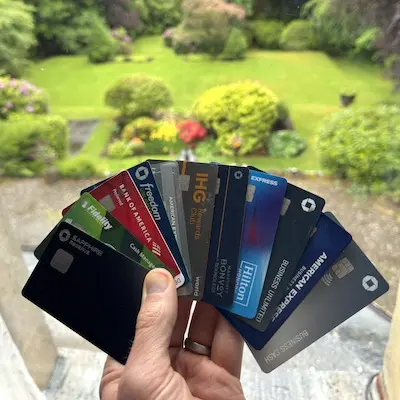
While early stages of personal finance optimization often involve juggling dozens of specialized credit cards to capture fractional percentage gains, long-term practitioners frequently pivot toward simplification. Over the years, the approach to wallet composition can shift away from aggressive optimization toward a streamlined set of reliable tools. Maintaining a consistent set of cards for a prolonged period eliminates the friction of constant management while preserving maximum efficiency for daily expenditures.
Among the various financial products utilized, a few select cards stand out as foundational elements of a streamlined wallet.
The Core Go-To Card
The cornerstone of modern travel hacking and everyday spending for many enthusiasts remains the Chase Sapphire Reserve. Acquired soon after its market debut in 2016, this premium travel card frequently serves as the primary instrument for the vast majority of daily transactions. Industry experts, such as analysts at The Points Guy, routinely value Chase Ultimate Rewards points at over two cents per point. Consequently, earning elevated multipliers on categories like travel, hotels, and dining translates to an effective cash-back equivalent of over 6% to 8% on major household expenditure categories.
Beyond direct point accumulation, premium travel cards offer structural benefits that generate substantial cash savings and lifestyle improvements. Airport lounge access, for instance, frequently saves travelers considerable sums per trip while significantly reducing the fatigue and stress associated with modern commercial air travel. Recent adjustments to annual fees and accompanying perks have introduced a new wave of statement credits and benefits, yielding thousands of dollars in annual value for active users who align their spending habits with available promotions.
Essential Banking and Specialized Cards
Complementing premium reward cards with flexible banking products is essential for international travel and everyday liquidity. The Fidelity Cash Management Debit Card, for example, operates without earning standard travel miles, yet it serves as an indispensable tool due to its structural financial advantages. When traveling abroad, the ability to withdraw local currency directly from foreign automated teller machines eliminates the need for expensive physical currency exchanges. Furthermore, because the institution fully reimburses all domestic and international ATM fees, cardholders enjoy complete freedom to utilize any available ATM without worrying about surcharge penalties.
Additional specialized cards round out a comprehensive financial toolkit without adding unnecessary complexity. Everyday consumer spending at supermarkets is often routed through cards optimized for grocery store purchases, while legacy hotel-branded cards—such as legacy IHG products and the Marriott Bonvoy Boundless card—are retained for their specific utility. Despite modest annual fees, these hotel cards provide an annual free night award that easily surpasses the cost of retention, making them efficient long-term holds for frequent travelers.
Business owners also benefit from targeted financial products that offer high flat-rate returns on all commercial purchases without imposing annual fees. Utilizing cards that yield elevated point returns on general business expenditures ensures that commercial operations remain as lucrative as personal finances.
Maximizing Card Perks and Lifestyle Spending
The evolution of premium credit card perks has transformed how cardholders approach discretionary spending. While traditional personal finance advice often warns against allowing credit card perks to drive consumption, sophisticated consumers can leverage these benefits to consciously expand their spending in areas that enhance their quality of life. For individuals who have mastered saving and are actively learning how to enjoy their wealth, structured statement credits provide a guilt-free mechanism to fund experiences they might otherwise skip.
Recent utilization of updated card perks highlights the substantial scale of these financial instruments. Statement credits applied toward upscale hotel stays in destinations like downtown Denver—complete with substantial daily breakfast vouchers and property credits—demonstrate how ancillary card benefits reduce out-of-pocket travel costs. Similarly, dining credits can subsidize high-end culinary experiences at specialized restaurants, while entertainment credits cover tickets to major hockey games, concerts, and live performances.
Furthermore, hitting high-tier annual spending thresholds unlocks additional rewards, such as substantial airline statement credits and elite airline status that eliminates baggage fees and streamlines the boarding process. When combining hotel credits, dining allowances, entertainment stipends, airline benefits, and foundational travel rewards, the total value extracted from a single premier credit card can easily exceed several thousand dollars annually. This extensive return on investment underscores why well-managed travel rewards programs continue to serve as a powerful supplementary portfolio for those pursuing financial independence.