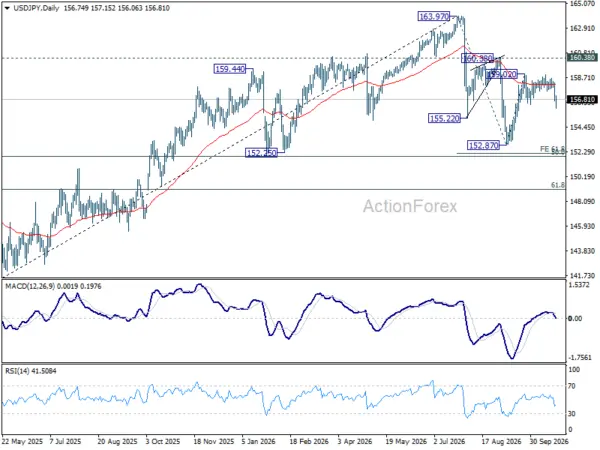




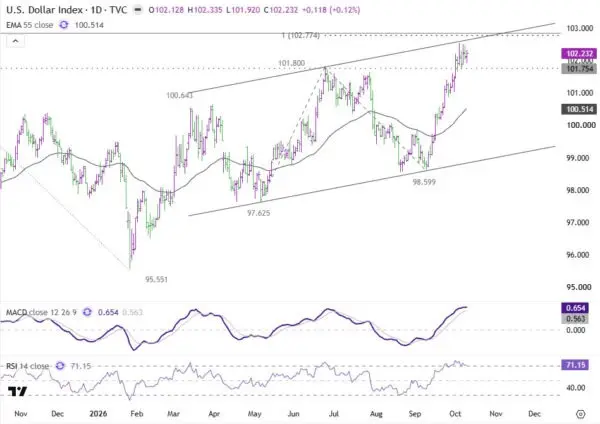
The formidable rally that has driven the United States Dollar higher in recent weeks is showing unmistakable signs of fatigue. Rather than signaling an abrupt reversal in direction, the recent price action indicates that the greenback’s upward trajectory has lost its previous momentum. The Dollar Index (DXY) recently stalled at 102.232 after touching a high of 102.536, weighed down by a confluence of fading Federal Reserve urgency, long-end Treasury yields meeting robust buyer demand at two-decade highs, and a shifting macroeconomic landscape where European sovereign stress is increasingly forced to shoulder the burden of the Dollar’s remaining support.
Absent a sizeable surprise in the upcoming United States Consumer Price Index (CPI) report, the Dollar looks primed for an extended period of consolidation. Market participants are increasingly leaning toward a wait-and-see approach, leaving the currency with ample scope to drift lower toward interim technical supports as the political calendar builds toward the November 3 midterm elections.
Why This Matters
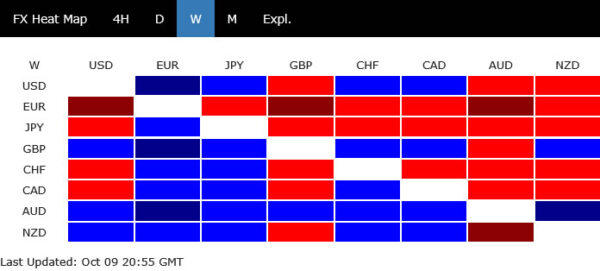
The broader implications of this market shift center on the fragmentation of the core pillars that previously propelled the currency higher. While the Dollar managed to close the week in positive territory, it did so with noticeably less underlying force than earlier in its advance. DXY failed to extend its gains even as the Euro remained firmly entrenched as the weakest major currency on the weekly heat map.
This deceleration does not establish an absolute top for the Dollar, nor does it mean the underlying macroeconomic narrative has completely inverted. Instead, it suggests that the powerful forces which previously reinforced one another are beginning to separate.

The initial rally rested securely on three distinct supports: the aggressive pricing of Fed policy tightening, relentless upward pressure on long-term Treasury yields, and persistent vulnerabilities within the Eurozone, specifically driven by French sovereign debt concerns. However, unless the upcoming week’s inflation data delivers a shock substantial enough to reignite the rates trade, the Dollar may find itself consolidating further rather than immediately breaching fresh highs as investors look past near-term noise toward late-October monetary policy meetings and the November 3 midterms.
Fed Urgency Has Already Faded
The foundational pillar supporting the Dollar—the expectation of aggressive and continuous monetary tightening by the Federal Reserve—has experienced the most notable softening. The narrative shifted decisively on September 29, when New York Fed President John Williams publicly remarked that there was "no need for urgency" following the central bank’s September rate hike. Williams further suggested that a single additional increase later in the year could prove sufficient if the broader economy evolves largely as anticipated.
Subsequent macroeconomic data reinforced the case for a more patient approach. September nonfarm payrolls showed job growth of just 29,000, while the national unemployment rate ticked up to 4.2%. Concurrently, wage growth slowed to a modest 0.1% month-on-month, and previous payroll estimates were subjected to downward revisions.
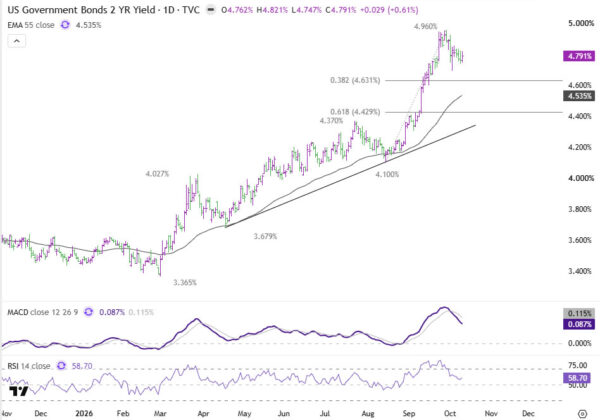
The domestic bond market has rapidly reflected this pivot in sentiment. The US 2-year Treasury yield peaked near 4.960% around the turn of the month before finishing the week at 4.791%, effectively unwinding roughly 17 basis points. Subsequent remarks from Fed Governor Christopher Waller—noting that further rate hikes may still be necessary but "do not need to come at consecutive meetings"—aligned neatly with this ongoing repricing.
Crucially, this does not imply that the Fed has turned dovish. The crucial distinction for foreign exchange markets is that the urgency premium has largely evaporated. A back-to-back interest rate increase in October is no longer the central assumption among market participants, even though another move later in the year remains a distinct possibility. This shift matters because the front end of the yield curve can stop providing incremental support to the currency without requiring markets to price in an aggressive easing cycle. The central question is no longer whether the central bank has finished tightening, but whether enough policy urgency remains to push short-term yields back toward their recent highs.
Long-Term Yields Have Started Meeting Buyers
The second core pillar of the Dollar’s strength—surging long-term bond yields—has not collapsed, but it has officially stopped accelerating. During the week, the US 10-year Treasury yield reached a peak of 5.365% before retreating to 5.242% by Friday’s close. Similarly, the 30-year yield eased from approximately 5.73% down to 5.600%. These movements are best characterized as pullbacks from extreme highs rather than an outright collapse in borrowing costs, given that the 10-year yield remains roughly 45 basis points higher over the course of the past month.
The dynamic shifted in response to heavy Treasury debt issuance. The benchmark 10-year auction cleared at 5.300%, marking the highest auction yield seen since 2000, yet it generated surprisingly fierce demand. The bid-to-cover ratio reached an impressive 2.77, comfortably above the historical average of roughly 2.51. Furthermore, the auction stopped through by 1.7 basis points, with indirect bidders snapping up 80.3% of the offering. The 30-year auction similarly displayed solid indirect demand at 72.3%, despite overall bid-to-cover slipping slightly to 2.54.
These successful auctions forced investors to confront a novel question: have Treasury yields finally climbed high enough to create their own natural resistance?
Secondary influences, such as pre-midterm positioning, may also be playing a marginal role. While concrete positioning data is sparse, the upcoming elections carry substantial fiscal implications for the Treasury market, particularly in the wake of proposals like President Donald Trump’s September call for a $5,000 dividend payment and warnings from institutions like DBS that a Republican sweep of both congressional chambers could escalate fiscal risks. With November 3 fast approaching, institutional investors may simply prefer locking in historically elevated yields before the broader fiscal outlook becomes obscured by political outcomes.
For the moment, the clearest evidence remains found in the primary debt auctions, where buyers decisively stepped in once yields reached levels unseen in nearly two decades. This does not signal the end of the long-end uptrend. Relative yield spreads continue to favor the Dollar, with US-Japan and US-Canada 10-year differentials widening over the course of the week, while the US-Germany spread remained largely unchanged. The greenback has not lost its fundamental yield advantage, but the transmission mechanism has transformed. Previously, rising long-term yields continuously reinforced currency strength; now, market participants are proving that sufficiently elevated yields attract heavy organic demand.
Oil Keeps the Rates Story From Turning Dovish
Energy markets continue to play a critical, albeit indirect, role in maintaining pressure on inflation expectations, preventing the broader rates narrative from tilting prematurely into dovish territory. Brent crude settled at approximately $104.53 per barrel, remaining well below its September peak of $109.97 but still higher on a weekly basis.
This divergence is notable. Crude prices remained elevated even as Treasury yields pulled back from their intraday peaks, demonstrating that the bond market correction was driven predominantly by organic demand for fixed income rather than any meaningful alleviation of energy-driven inflation pressures.
Geopolitical considerations add another layer of complexity. President Donald Trump stated that the United States would not undertake military action against Iran prior to the November 3 midterm elections, while describing bilateral discussions as productive. This development places a temporary ceiling on immediate escalation risks in the Middle East without fundamentally resolving the underlying geopolitical conflict.
For financial markets, the outcome is an unusual equilibrium. The geopolitical risk premium has been temporarily capped rather than removed entirely, and this policy pause comes with a definitive expiration date. Consequently, crude oil prices can continue to sustain elevated inflation risks without necessarily forcing another immediate surge in Treasury yields. Unless the outlook on Iran deteriorates substantially beforehand, November 3 stands as a natural pivot point around which markets will likely re-evaluate both energy pricing and broader macroeconomic risk.
France Is Carrying More of the Dollar’s Remaining Support
The third vital pillar of the Dollar’s recent resilience originates entirely outside the United States. Sovereign stress within France has emerged as a primary catalyst keeping the Euro under heavy downward pressure. The spread between French OATs and German Bunds widened to roughly 159 basis points before easing back toward 135 basis points, while France’s 10-year borrowing costs retreated from above 5% to approximately 4.85%.
While immediate market pressures have abated somewhat, the underlying fiscal dilemma remains entirely unresolved. Prime Minister Sébastien Lecornu’s administration is striving to narrow the national deficit from 5.4% down toward 5% while attempting to navigate a deeply divided parliament. French borrowing costs remain acutely sensitive to the perceived credibility of the government’s fiscal consolidation path. Bank of France Governor Emmanuel Moulin noted that France does not currently require intervention from the European Central Bank, emphasizing that the necessary remedies must originate domestically.
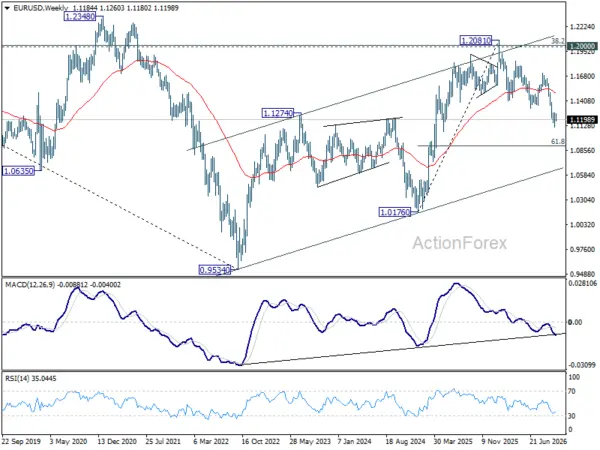
Simultaneously, political uncertainty remains tightly entwined with the looming 2027 presidential race, as opposition figures continue to shape fiscal platforms that alarm bond market investors. This ongoing European vulnerability provides consistent, indirect support to the Dollar through the exchange rate channel, with EUR/USD ending the week near 1.12015, hovering not far above its 1.1159 support level.
However, this dynamic introduces a notable complication for currency traders. A renewed widening of OAT-Bund yield spreads would inevitably pressure the Euro and offer fresh upside momentum to the DXY. Yet, if French fiscal stress were to escalate to a degree that sparks a broader flight-to-safety demand for US Treasuries, falling American yields could simultaneously drive a sharp appreciation in safe-haven currencies like the Japanese Yen and the Swiss Franc. Consequently, French instability has the capacity to lift the Dollar Index without necessarily translating into a broad-based, universally driven Dollar rally.
Dollar Index Is Tiring, Not Yet Topped
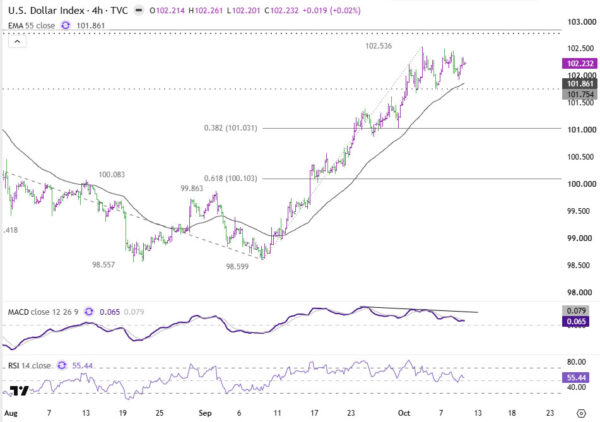
From a technical perspective, price action in the DXY mirrors the underlying macro narrative of consolidation and fatigue. The currency index has moved predominantly sideways after registering its peak at 102.536. The broader near-term trend remains constructive as long as key moving averages, such as the 4-hour 55 exponential moving average near 101.86, remain intact, but momentum indicators show clear signs of exhaustion.
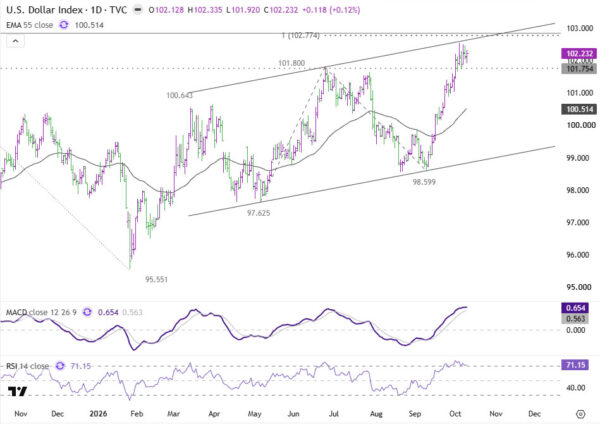
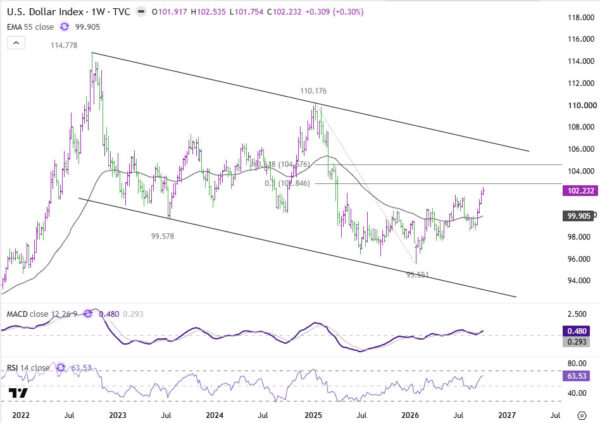
Immediate overhead resistance is densely concentrated just above current market levels. Convergence points include the 100% projection of the move from 97.62 to 101.80 measured from 98.60 at 102.77, the 50% retracement of the larger decline from 110.17 to 95.55 at 102.84, and the upper boundary of the daily rising price channel. These technical hurdles cluster tightly around the 102.77 to 103.00 zone.
Momentum oscillators further support this cautious technical outlook. The daily Relative Strength Index rests at 71.15, indicating mildly overbought conditions, while the 4-hour Moving Average Convergence Divergence displays clear bearish divergence. Together, these signals warn that extending the current rally will prove increasingly difficult, though neither indicator provides definitive confirmation of a major market reversal.
The first meaningful downside trigger to monitor rests at the 101.75 support level. A sustained break beneath this threshold would signal that routine consolidation has deepened into a more substantial correction, potentially opening the door for a slide toward the 38.2% retracement of the advance from 98.599 to 102.536 at 101.03. Significantly, a retreat to 101.03 would still represent a normal technical correction within an established uptrend rather than confirmation of a definitive top for the Dollar. Conversely, a decisive breakout through the 102.77–102.85 resistance band would invalidate the immediate exhaustion thesis and expose the 61.8% retracement level at 104.58.
Two-Year Yield Confirms the Loss of Momentum
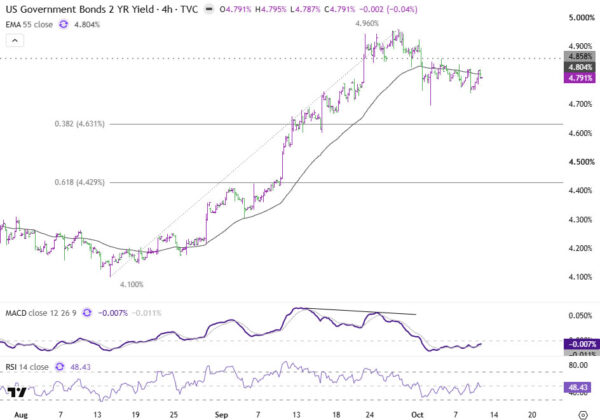
The behavior of the US 2-year Treasury yield reinforces the broader picture of a market experiencing a loss of upward momentum. The front-end yield has formed a short-term peak at 4.960%, accompanied by noticeable bearish divergence on the 4-hour MACD indicator.
Furthermore, the yield has repeatedly encountered selling pressure near the 4-hour 55 EMA, currently situated around 4.804%. The primary technical hurdle overhead is located at 4.858%. As long as yields remain constrained below this threshold, the ongoing corrective pullback remains intact, targeting the 38.2% retracement of the move from 4.100% to 4.960% at 4.631%. A firm and decisive recovery back above 4.858% would suggest that the front-end correction has run its course, quickly bringing the 4.960% peak back into focus for bond traders.
Ten-Year Yield May Have Completed Its First Major Upswing
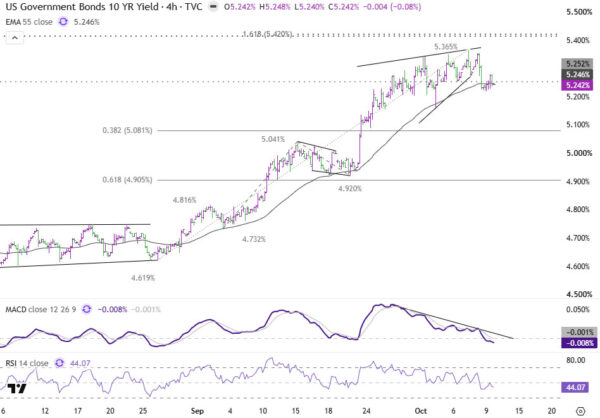
The benchmark 10-year Treasury yield presents a similar, albeit more mature, technical setup. The sharp advance from 4.619% to 5.365% can be interpreted as a completed five-wave impulse pattern, with the final leg of the advance from 4.920% taking the shape of an ending diagonal structure. This upward move stalled just below the 161.8% projection of the move from 4.732% to 5.041% measured from 4.920% at 5.420%, subsequently breaking below 5.252%.
Underlying momentum has visibly deteriorated alongside this price action. Sustained trading beneath the 4-hour 55 EMA, currently positioned at 5.246%, will validate this structural interpretation and invite a deeper downward extension toward the 38.2% retracement of the broader rally from 4.619% to 5.365% at 5.081%. On the other hand, a sudden, firm break above the 5.365% high would signal that a definitive top has not yet been established, immediately shifting market attention back toward the 5.420% resistance area.
CPI Comes First, Then the Midterms
The most immediate catalyst capable of challenging this emerging wait-and-see environment is the upcoming release of United States Consumer Price Index data. A significantly softer-than-expected inflation report could strip away remaining near-term tightening premiums from the front end of the curve, placing the 4.631% target on the 2-year yield and the 101.03 level on the DXY firmly into play. Conversely, a hot inflation print would provide the most direct route for the 2-year yield to retest 4.960% and prompt a fresh assault by the Dollar Index on the 102.77–102.85 resistance zone, preempting any need to wait for November catalysts.
Parallel to domestic inflation figures, European developments remain a critical variable. A renewed breakdown in EUR/USD below the 1.1159 mark, particularly if accompanied by French OAT-Bund yield spreads widening back toward the 150 to 159 basis point range, would supply an independent source of upward pressure for the DXY, even if US Treasury yields remain subdued.
Following the inflation release, attention will turn toward the Federal Open Market Committee meeting scheduled for late October. With no new economic projections anticipated and market participants already pricing in a policy hold, the meeting may carry less decisive weight than the inflation report, though any forward guidance regarding December rate decisions retains the capacity to move the rates curve.
Ultimately, the market calendar culminates in the November 3 midterm elections. President Trump’s decision to defer potential military actions involving Iran until after the midterms has imbued that date with exceptional market significance, anchoring domestic political outcomes directly to international risk sentiment.
Rally Stalled Does Not Yet Mean Rally Over
The central challenge facing the US Dollar is not that its underlying supports have vanished; rather, they are no longer reinforcing one another in unison. Federal Reserve policy urgency has visibly faded, the 2-year yield has entered a corrective phase, long-term Treasury yields are successfully encountering robust buyer demand at historically elevated levels, and while France remains a persistent source of Euro weakness, European sovereign stress is shouldering an increasingly heavy share of the burden required to keep the DXY afloat.
This synchronization failure leaves the currency vulnerable to a period of consolidation in the weeks ahead. Unless incoming inflation data delivers a substantial surprise, market participants will likely prefer to remain on the sidelines, waiting for major catalysts clustered around late October and the November 3 midterms. In such an environment, a gradual drift toward technical support at 101.03 would be entirely consistent with the orderly digestion of the prior advance. The Dollar rally may have decisively stalled, but declaring an outright top demands substantially more technical and fundamental evidence.