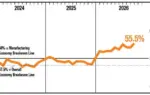




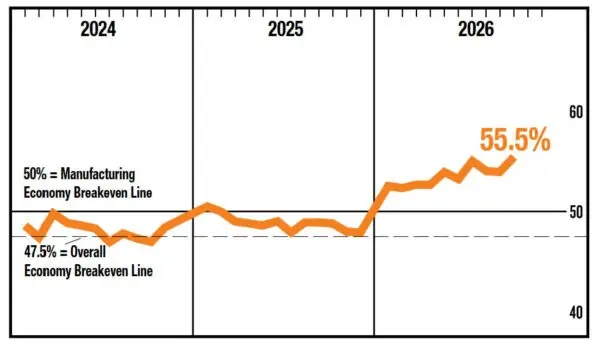
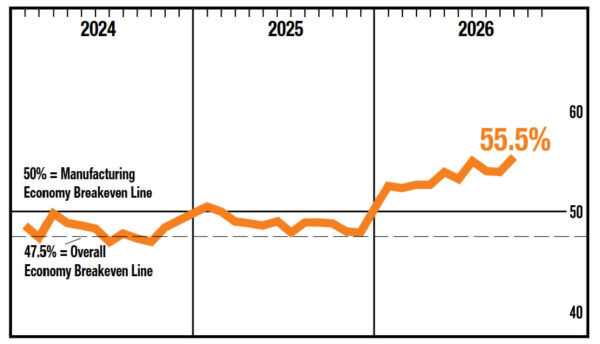
United States manufacturing activity expanded at a faster-than-expected pace in October, driven by a significant surge in factory production and a rebound in inventories. The Institute for Supply Management (ISM) reported that its manufacturing Purchasing Managers’ Index (PMI) rose to 55.5 in October, up from 54.5 in September. The latest reading comfortably beat consensus expectations, which had projected a modest rise to 54.7, and extended the industrial sector’s current expansion streak to ten consecutive months.
The underlying details of the survey reveal that the strongest momentum within the manufacturing economy came directly from factory floor output. The production index climbed sharply from 56.7 to 59.0, marking its highest level since November 2021. This substantial acceleration highlights a concerted effort by manufacturers to ramp up operations, even as broader demand signals presented a more mixed picture.
New orders continued to grow, marking the tenth consecutive month of expansion, though the pace of increase was relatively modest compared to production. The new orders index edged up from 55.3 to 55.5. Notably, all five of the core subcomponents that directly contribute to the headline PMI calculation remained firmly in expansionary territory, pointing to broadly positive and resilient manufacturing conditions across the board.

The widening gap between production growth and incoming demand indicates that October’s stronger headline figure was heavily influenced by internal operational adjustments, such as inventory accumulation and high production tempos, rather than a sudden explosion in new end-user demand. Inventories returned to growth after a prior contractionary phase, with the inventory index climbing from 48.6 to 51.4. This return to inventory building aligns with sustained factory activity and preparations for future orders.
At the same time, labor market dynamics within the manufacturing sector showed signs of modest moderation. Employment growth slowed slightly as the employment index eased from 52.7 to 52.4. Order backlogs also grew at a more subdued pace, with the backlog index declining from 56.4 to 54.6, suggesting that factories are managing their existing workloads more efficiently and working through unfulfilled orders.
International trade indicators provided a reassuring backdrop to the domestic figures. Both new export orders and imports showed signs of renewed strength. The new export orders index ticked up from 50.9 to 51.2, while the import index rose from 51.0 to 52.9. These movements suggest that cross-border trade flows and international demand are holding up alongside domestic production efforts, maintaining a steady pulse across global supply chains.
Input Price Pressures Ease Yet Remain Elevated
While operational activity accelerated, cost pressures facing manufacturers showed some signs of relief, though they remained stubbornly high. The Prices Paid Index fell from 77.9 in September to 75.2 in October, coming in below market expectations that had anticipated a reading of around 77.5. Despite the downward movement, the index remains at an elevated level, continuing to signal widespread and persistent increases in manufacturing input costs.
Respondents to the survey reported ongoing cost pressures across critical industrial inputs, including energy, various metals, and electronic components. These persistent price pressures reflect a lingering cost burden that factories continue to navigate as they source raw materials and components necessary for production.
Meanwhile, supply chain conditions remained tight. The Supplier Deliveries index edged up slightly from 59.0 to 59.1. A reading above 50 indicates slower delivery times, and the October figure points to continued sluggishness in logistics and delivery networks. Shortages persisted across several key industrial inputs, reinforcing the reality that while some inflationary pressures are moderating, structural supply bottlenecks have not entirely vanished.
Overall, the October ISM manufacturing survey paints a picture of a resilient and strengthening industrial sector. The expansion is robustly supported by high production volumes and inventory replenishment, even though customer demand is growing at a more measured pace and supply-related inflation pressures continue to command attention from corporate decision-makers.