

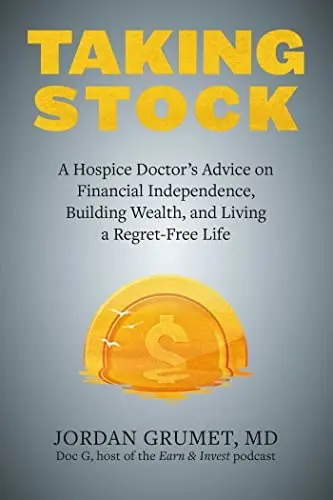
When Jordan Grumet practiced medicine as a physician, he spent a great deal of time conversing with an unusual confidant: a
local undertaker. Through their philosophical and practical discussions about mortality, Grumet quickly realized that those engaged in the business of death and dying possess profound insights into the human condition. As he often remarked, when an undertaker speaks, people should listen.
Professionals who make death and dying their daily business may seem like unlikely investment advisers. Yet, because both Grumet and his undertaker friend spent extensive time in close proximity to human mortality, they gained a unique perspective on what is genuinely worth investing in. These insights were not gleaned by observing the wealthy on their difficult journeys, nor were they siphoned from the secret playbooks of financial tycoons. Instead, they emerged as simple, straightforward truths gathered from walking a lonely path with individuals who were reluctant to make the final journey.
Surprisingly, most of what Grumet learned about investing over the course of his career had nothing to do with money. His observations form the foundation of his book, Taking Stock, which explores how non-financial assets ultimately shape a person’s final perspective.
Invest in Yourself
Personal investment takes many forms, but chief among them is the practice of self-forgiveness. Remorse is a common human trait shared by both the living and the dying, and its psychological toll can be devastating. Whether the specific regret involves an action taken or avoided, a fractured relationship, or a missed opportunity, the human capacity for self-blame appears limitless. People frequently spend endless amounts of time lamenting past choices and wishing they had handled situations differently.
While a degree of self-blame can prompt introspection and improve future outcomes, it often leaves a path of destruction in its wake. It is exceptionally difficult for individuals to look forward when they are constantly anchored to the past. The key to breaking this cycle lies in changing what can be changed and learning to forgive oneself for the rest.
Grumet recalls a patient named Gerald, whose regret over losing a job decades before a cirrhosis diagnosis set off a tragic chain of events leading to severe alcoholism. His marriage ultimately collapsed, and he became estranged from his ex-wife and his daughter, Sandy. While Gerald eventually achieved sobriety and found employment, the physical damage to his liver and the emotional distance from his daughter could not be undone. A significant portion of Gerald’s end-of-life review with a social worker was spent processing the grief surrounding his daughter. He eventually found a modicum of peace and forgave himself, realizing that had he granted himself that grace earlier, he might have abandoned alcohol long before his body suffered irreversible damage.
Another vital way to invest in the personal self is by slowing down. Society often encourages large, audacious goals with immediate results. Yet, much like the fable of the tortoise and the hare, slow, incremental gains ultimately win the race. Achieving progress toward a major goal by just one percent per month generates phenomenal annual returns over the long run, a principle that applies equally to acquiring a skill, nurturing a relationship, or pursuing any significant ambition without letting limiting beliefs stand in the way.
Furthermore, individuals must invest in experiences. Experience compounds over time in much the same way monetary assets do. As people learn and grow, they hone skills that elevate them both as professionals and as human beings. Anyone who has risen through corporate ranks to become a chief executive understands that professional growth is exponential rather than linear, echoing Benjamin Franklin’s observations on the compounding nature of interest.
Invest in Education
Education remains a cornerstone of self-investment. While formal academic paths offer distinct advantages, modern society provides myriad ways to acquire knowledge—through reading, discussions, online courses, and rigorous intellectual debates. The world is filled with educators of all backgrounds.
Knowledge serves as an emergency fund that shields a person’s happiness. When all other resources are exhausted, accumulated knowledge helps secure employment, build shelter, or guide critical decision-making during moments of crisis. Skimping on self-improvement is counterproductive, and individuals should not hesitate to invest financially in their own education, knowing those expenditures will compound into lasting skills.
Embracing new opportunities often requires saying yes, even when hesitation sets in. Opening oneself to unfamiliar requests and stepping into uncomfortable situations is often the only way to discover passions and build deeper relationships. Maintaining an inquisitive mindset ensures that people continue to learn. Grumet observed countless patients dying with a book on their nightstand or an unfinished intellectual debate on their minds. Even in their final days, these individuals woke up with a plan for how to spend their time, demonstrating that inquisitive people often face the end of life with the same curiosity and engagement that defined their living years.
Invest in Other People
The ultimate measure of an individual, regardless of wealth or status, is found in the people they leave behind. Grumet notes that this serves as the ultimate indicator of success. Walking into the room of a dying patient immediately reveals whether that person invested in human relationships; successful investors are typically surrounded by photographs, letters, cards, and a steady stream of visiting friends. Laughter and conversation often echo through the hallways, celebrating a life well-connected.
If a person invests in human relationships, the compound interest multiplies into a lifetime of love and happiness. Long after an individual is gone, their essence survives in the memories and expressions of those they touched. For Grumet, discovering his community through writing and podcasting in the personal finance space provided the connections he needed to redefine his identity and purpose after years of searching.
Invest in Children
Beyond general community ties, individuals must invest their time, love, and resources into children. By building the foundations of their adulthood and happiness, imparting humility and kindness, and leading by virtuous example, adults provide a blueprint for success and freedom. Teaching children the practical realities of financial management helps them understand what money can and cannot achieve in pursuit of their life goals.
Investing in children produces lifelong dividends, providing them with emotional resilience and a connection to future generations. Time on earth is limited, but progeny carry forward a person’s spark, ensuring they live on in the hearts and minds of descendants. Grumet experienced this legacy firsthand when hospital colleagues occasionally called him by his father’s name during rounds—a testament to how a parent’s enduring influence shapes a child’s career and passions decades later.
Invest in Physical and Mental Health
Physical and mental health form the foundational framework upon which all other well-being is built. True financial security cannot be fully appreciated without concurrent mental and physical health, as managing money and future planning require conscientious decision-making that is difficult to sustain while unwell.
Mental health requires intentional recovery, utilizing practices such as meditation, physical exercise, and listening to classical music to calm the mind. Seeking professional counseling provides an outside perspective that can quiet disruptive internal thoughts. Similarly, physical health prolongs quality of life and yields enduring emotional benefits. Maintaining moderate physical activity, such as walking for thirty minutes a day, supports physical needs without becoming burdensome. Furthermore, moderating substance use is essential, as recreational or excessive habits frequently cloud an individual’s health and obscure long-term goals.
Invest in the Market
Even in a philosophy centered largely on non-monetary wealth, the fundamentals of personal finance cannot be ignored. A comprehensive approach to the future requires traditional investing in the stock market to build a stable financial foundation.
Financial literacy and basic market participation provide the practical tools necessary to secure one’s livelihood. However, financial mechanics represent only a necessary baseline; they are not sufficient on their own to guarantee a meaningful life. The ultimate goal of acquiring financial stability is to free up the time and energy needed to pursue deeper human connections, personal growth, and purposeful living.
Ultimately, how an individual invests their time, energy, and relationships determines their perspective in life’s final chapters. Building a life of meaning and resilience requires preparation, patience, and the willingness to invest wisely in oneself, in education, in children, and in the community before the end comes into view.