


The 2026 United States midterm elections delivered a decisive and
unexpected verdict for Washington’s political establishment, handing Democrats a resounding victory over incumbent Republicans. More than just a routine congressional realignment, voters used the ballot box to issue a withering judgment on President Trump’s core policy agenda, most notably his military campaign against Iran.
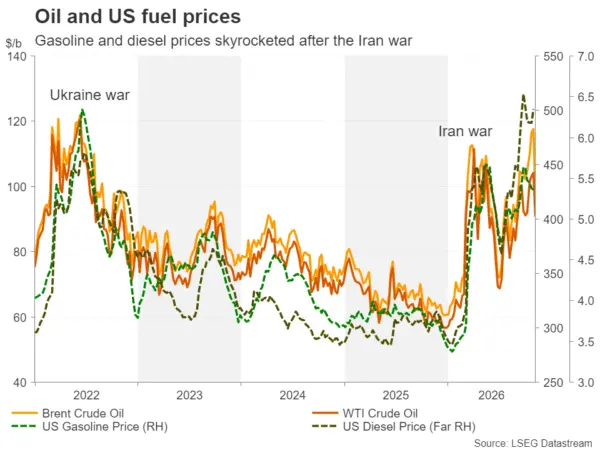
The political fallout was swift. Soaring energy prices, which have severely inflated the cost of gasoline and diesel for American consumers, combined with broader inflationary pressures stemming from the administration’s controversial "Liberation Day" tariffs, severely eroded President Trump’s popularity. This economic squeeze ultimately cost the Republican Party dearly, turning long-established party strongholds and key battleground states into Democratic wins.
It remains a striking irony of modern American politics that the very issue which propelled Trump to his decisive election victory in 2024—the high cost of living—has now become the catalyst for voters to abandon the Republican Party in the midterms. The scale of the Republican defeat caught nearly everyone by surprise. Not even the most optimistic Democratic strategists had predicted they would clinch such a commanding majority in both the Senate and the House of Representatives, seizing overall control of Capitol Hill for the final two years of Trump’s presidency.
A Lame-Duck Presidency and the Legislative Gridlock
In historical market terms, a lame-duck president is rarely viewed as the worst-case scenario for investors, who frequently prefer the checks and balances of a split Congress that can successfully curtail the legislative ambitions of both parties. However, the emergence of a definitive blue wave sweeping through both chambers of Congress introduces a new layer of uncertainty. Investors are currently weighing what this sudden shift means for an American economy that, despite navigating tariff turmoil and an ongoing energy crisis, has largely thrived under the banner of deregulation and tax cuts championed by Republicans.

While President Trump retains the formidable power to veto major legislation, and Democrats will ultimately need to forge some level of consensus with Republicans to keep the government functioning, the fundamental balance of power on Capitol Hill has shifted dramatically. Armed with majorities in both the House and the Senate, Democrats now possess the legislative leverage to pursue structural modifications to the tax code. These could include raising the corporate tax rate, boosting healthcare spending by restoring expired Affordable Care Act subsidies, and rolling back parts of Trump’s environmental agenda by reinstating tax credits for renewable energy projects.
Even so, legislative realities dictate that Democrats would likely secure presidential approval for their primary objectives only by offering significant concessions to Republicans, particularly regarding entitlement programs like Medicare. Despite the historical nature of their midterm victories, the election results have officially ushered in a renewed era of divided governance for the remainder of the presidential term.
Relief for the Bond Market and Treasury Yields
For financial markets, the immediate and most critical implication of the election outcome centers on US Treasuries, especially against the backdrop of persistent anxiety surrounding America’s mounting national debt. The ongoing conflict in Iran has continually driven up energy expenses, stoking renewed fears of inflation and prompting expectations of further monetary tightening by the Federal Reserve.
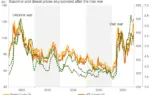
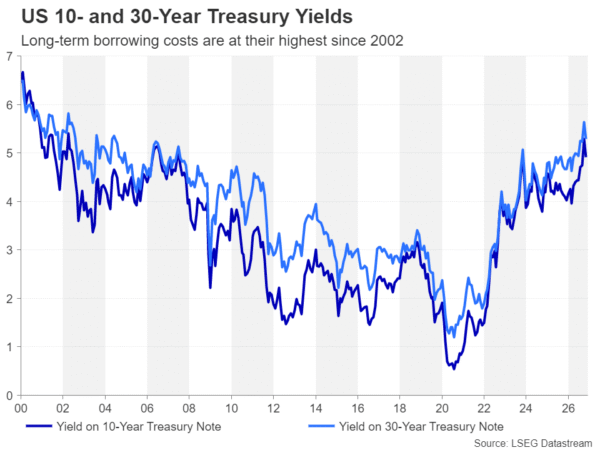
Earlier in the year, the bond market suffered its most punishing rout in years, pushing long-term borrowing costs to levels not seen since 2002. Pressured by a volatile mix of stubbornly high inflation and a massive wave of debt issuance from both government and corporate sectors, elevated yields unleashed considerable volatility across foreign exchange, equity, and commodity markets. Throughout this turbulence, the US dollar largely maintained its traditional safe-haven status, insulating itself from the broader selloff thanks to its role as the world’s primary reserve currency.
With Democrats now holding the reins in Congress, market analysts anticipate that it will prove far more difficult for the Trump administration to push through expansive tax giveaways that exceed the scope of the previously established "Big Beautiful Bill." Conversely, the Democratic leadership will face similar constraints preventing them from enacting runaway federal spending increases.
In the immediate aftermath of the election results, Treasury yields drifted lower. This downward adjustment reflects a growing market consensus that the risk of the US budget deficit spiraling further out of control is substantially mitigated by the onset of legislative gridlock. Furthermore, the upcoming debt ceiling debate, which is expected to demand congressional attention within the first six months of 2027, is viewed as a potentially more straightforward process when a single party manages both legislative chambers.
However, fiscal negotiations leading up to the critical federal funding deadline on December 11—occurring even before newly elected lawmakers officially assume office—threaten to become contentious. Without a carefully negotiated stop-gap spending bill to kick the can down the road, the risk of a temporary government shutdown remains a distinct possibility.
Economic Growth, AI Regulation, and the Federal Reserve
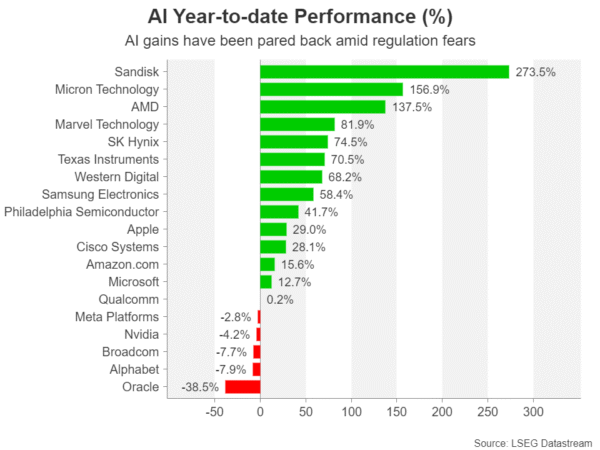
Looking past these near-term fiscal hurdles toward 2027, the prospect of a more disciplined fiscal outlook is not the only factor applying downward pressure on Treasury yields. The broader inflation narrative has begun to shift under the influence of a Democratic-led Congress, supported not only by tighter fiscal projections but also by the increased likelihood of heightened regulatory scrutiny over businesses. In particular, potential federal and state-level regulations targeting the rapidly expanding artificial intelligence sector could act as a dampening force on overall economic activity.
Any significant regulatory push could notably cool the breakneck pace of corporate investment in artificial intelligence. Even if federal legislation struggles to make swift progress, state governments controlled by Democrats could independently move to slow down the construction and expansion of energy-intensive data centers, intensifying existing market anxieties regarding the long-term sustainability of high AI demand.
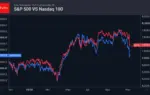
For Wall Street and the US dollar, this scenario presents a complex set of downside risks. Yet, the reaction across US equities has been nuanced rather than uniformly negative. A cooling domestic economy driven by scaled-back capital expenditures in artificial intelligence would likely reduce the necessity for aggressive monetary tightening by the Federal Reserve. As policymakers turn increasingly cautious regarding interest rate hikes, equity traders could find some measure of comfort.
This shifting sentiment has already begun to manifest across asset classes. Most major technology firms have found support in a more favorable interest-rate trajectory alongside reduced capital expenditure requirements for AI infrastructure. Meanwhile, shares of certain semiconductor manufacturers have faced downward pressure amid mounting expectations that a slowdown in data center buildouts would naturally dent future demand for specialized chips.
Shifting Geopolitics and Hopes for an Iran Ceasefire
The midterm election results introduce a third critical dimension to the inflation outlook: the trajectory of the war in Iran. President Trump’s military engagements in the Middle East have proven deeply unpopular among the American electorate, primarily because the conflict has directly fueled higher retail prices for gasoline and diesel.
While the ultimate authority to direct military operations remains with the executive branch, Democrats have signaled they could leverage their legislative power—including potential threats to curtail defense appropriations—if the administration orders fresh military strikes. With Republican lawmakers increasingly acknowledging that the economic fallout from the war contributed heavily to their electoral losses, pragmatic members of the party may ultimately find common ground with Democrats should the administration delay disengaging from the region.
Market participants are inherently mindful of tail risks, such as a sudden escalation initiated by Iran that would compel Washington to respond defensively. Barring such an escalation, however, investors are increasingly pricing in the likelihood of a quicker diplomatic resolution to the conflict. This shift in expectations was immediately mirrored by a sharp decline in global oil prices following the election.
More importantly, the prospect of lower energy prices and a less aggressive inflation path has dampened expectations for future Federal Reserve rate hikes, with futures markets pricing in no more than two rate increases over the next twelve months. This monetary backdrop has offered a vital safety net for battered AI-related equities while simultaneously lending support to small-cap and value stocks. Within the broader equity landscape, the healthcare and financial sectors are widely viewed as potential beneficiaries of the new congressional alignment, whereas defense and energy equities face a more challenging outlook.
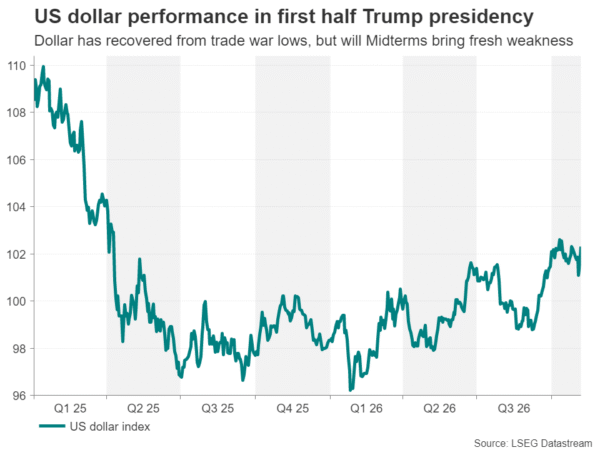
For the US dollar, however, a shallower trajectory for interest rates presents a clear headwind, though the currency may still find pockets of support if trade tensions continue to de-escalate. While Congress lacks the explicit authority to unilaterally dismantle existing executive tariffs—overriding a presidential veto requires a formidable two-thirds supermajority in both the House and the Senate—lawmakers may still attempt to carve out exemptions for specific products or push for legislative measures to curb executive authority over international trade policy.
Even before the electoral defeat, the administration had demonstrated surprising progress in trade negotiations with Canada toward establishing a modernized framework, suggesting that a major re-escalation of global trade conflicts is unlikely under the new political equilibrium.
Changing Fortunes for Gold and Cryptocurrency Regulation
The convergence of declining Treasury yields, a softer US dollar, and lower crude oil prices has created an environment highly favorable for gold. While the ultimate catalyst for a deeply bullish run in precious metals would be a conclusive end to the Middle East conflict accompanied by sustained lower oil prices, the altered domestic political landscape provides a firm foundation of support for bullion.
At the same time, reduced fiscal volatility should cap runaway Treasury yields even if energy markets experience temporary bouts of strength. Similarly, economic growth may moderate due to a cooling in the AI infrastructure rollout, which in turn reins in aggressive monetary tightening. Nevertheless, prolonged distress in technology equities could occasionally create cross-currents for gold, as investors are sometimes forced to liquidate safe-haven bullion holdings to cover equity losses or margin calls elsewhere in their portfolios.
On the legislative front, Democrats have made it clear they intend to utilize their subpoena and investigative powers to scrutinize the family business dealings of the Trump administration. While these inquiries are unlikely to carry immediate macroeconomic significance for financial markets, lawmakers are expected to focus heavily on the financial sector, specifically targeting the CLARITY Act.
Democrats are anticipated to push for amendments that introduce stricter restrictions regarding cryptocurrency transactions involving the president and his immediate family, alongside enhanced consumer safeguards and rigorous anti-money laundering provisions.
For major digital assets such as Bitcoin and Ether, the eventual passage of the CLARITY Act would still represent a net positive by delivering much-needed regulatory certainty. However, the scope of potential market gains would likely be tempered compared to what might have transpired under a unified Republican legislature. Conversely, any scenario where a gridlocked Congress stalls the legislation indefinitely risks leaving the cryptocurrency market navigating a period of regulatory limbo through at least 2028.
The definitive impact of a Democratic-led Congress on the broader macroeconomic landscape will only come into sharper focus as the new legislative session begins and party leaders formally unveil their policy priorities. Risks remain, particularly if partisan friction leads to a government shutdown during budget negotiations, or if geopolitical tensions in the Middle East flare up unexpectedly before a durable ceasefire can be formalized.
Yet, investors take reassurance from the reality that political support for further military escalation in Iran is severely constrained across Washington. As the dust settles from a transformative election cycle, both policymakers and financial markets must navigate a newly redrawn balance of power.