




The National Bank of Poland (NBP) has officially crossed a major strategic threshold, achieving its long-standing target of accumulating 700 tonnes of gold reserves. The milestone marks the culmination of an aggressive, multi-year acquisition campaign that has positioned the central bank as the most prolific state buyer of the precious metal on the global stage.
Speaking at a press conference last Thursday, National Bank of Poland Governor Adam Glapiński confirmed that the institution successfully hit the 700-tonne goal last month. The announcement follows a strategic roadmap laid out in January, when bank leadership first announced plans to procure an additional 150 tonnes of gold to bolster the national reserves.
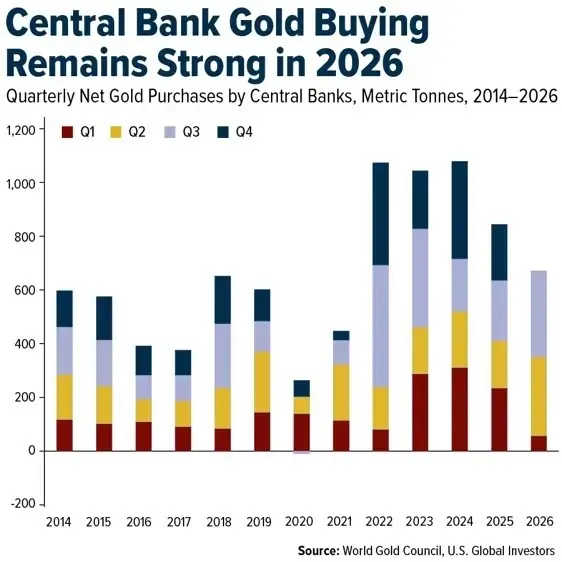
Official data highlights Poland’s unprecedented dominance in the global bullion market. Based on officially reported figures, Poland purchased more gold than any other central bank throughout 2025, a trend that has continued uninterrupted into 2026. Over the course of 2026 alone, the National Bank of Poland has expanded its gold reserves by a staggering 123 tonnes. Government figures show that as of the end of September, the central bank held 673 tonnes of the yellow metal. With Glapiński confirming the 700-tonne milestone was reached last month, it indicates that the NBP acquired roughly 27 tonnes of gold during October, even though official data for that specific month has not yet been formally released.
Reflecting on the achievement during last week’s press briefing, Glapiński noted that while the target has been met, the geopolitical and economic landscape remains fluid. "We had set a target of 700 tonnes, and we have achieved it, though the world is, of course, changing," Glapiński told reporters. "We monitor what other countries are doing and monitor potential threats to Poland."
The accumulation represents a dramatic transformation for the Polish central bank over the past three decades. To understand the scale of the current strategy, financial analysts often point to historical context: back in 1996, the National Bank of Poland held a modest 14 tonnes of gold in its vaults. Today, the nation’s massive gold holdings are officially valued at an extraordinary 356 billion zlotys, equivalent to approximately $91.4 billion.
Last year, Poland’s aggressive acquisition pace made international headlines when its total gold holdings officially eclipsed those of the European Central Bank. As the central bank continues to outpace its international peers, questions naturally turn to what lies ahead for the institution’s reserve management strategy.
When asked by reporters about the bank’s next steps following the completion of the 700-tonne objective, Glapiński suggested that a pause is not necessarily on the horizon. "We need to sit down and think it through calmly," he said, before adding, "I see no reason why we should stop buying gold. I believe that our gold reserves should grow in line with our overall reserves."
Over the past few years, the National Bank of Poland has repeatedly revised its internal targets upward as global economic uncertainty has intensified. The central bank initially signaled a major shift in its holding strategy in 2021. Later, in 2024, Governor Glapiński outlined a specific policy objective to expand the country’s gold portfolio until it accounted for roughly 20 percent of Poland’s total foreign exchange reserves.
This sustained accumulation has not gone unnoticed by international markets and ratings agencies. According to Glapiński, the disciplined approach to securing state wealth has tangible benefits for the country’s standing. "This makes Poland a more credible country; we have a better standing in all ratings, we are a very serious partner, and we will continue to buy gold," he stated.
When he first unveiled plans to dramatically expand Poland’s gold reserves, Glapiński characterized gold as "the only safe investment for state reserves" amid "difficult times of global turmoil and the search for a new financial order." Expanding on these themes in a 2024 interview, the governor emphasized that physical gold operates entirely independently of national economic policies, making it a reliable safe haven during systemic crises and a dependable store of real value over the long term.
"It is a symbol of stability that enhances our credibility in the eyes of investors and foreign partners," Glapiński explained at the time.
According to official positions published on the NBP website, physical gold carries a distinct advantage for institutional investors because it is not a liability and remains completely free from counterparty risk. When launching the expansion initiative in 2021, Glapiński elaborated on the foundational rationale of national financial security, framing the acquisition policy as an essential safeguard against extreme, worst-case scenarios.
"Gold will retain its value even when someone cuts off the power to the global financial system, destroying traditional assets based on electronic accounting records," Glapiński remarked during the initial rollout of the policy. "Of course, we do not assume that this will happen. But as the saying goes—forewarned is always insured. And the central bank is required to be prepared for even the most unfavorable circumstances. That is why we see a special place for gold in our foreign exchange management process."
Furthermore, the governor has repeatedly underscored the physical and economic properties of the metal, pointing out that gold is entirely free from credit risk, immune to the policy decisions or currency devaluations of any single country, and exceptionally durable—virtually indestructible across centuries.
As the volume of Poland’s gold reserves has expanded, the central bank has also given careful consideration to the physical storage and geographic distribution of the bullion. In 2019, the Polish central bank executed a high-profile, covert operation to repatriate 100 tonnes of gold from international storage facilities in London to a secure facility in Warsaw.
Currently, the majority of Poland’s vast gold reserves remain held in London. However, Glapiński has previously outlined a long-term geographic distribution model for the country’s assets. Ultimately, the governor aims to store roughly one-third of Poland’s gold in New York, one-third in London, and the remaining third within national borders in a vault located in Poland.
Achieving that domestic storage balance is a logistical work in progress. "The issue with our own vault is that we do not currently hold that one-third share there, because these rapid acquisitions take place in London and that’s where the majority is," Glapiński explained.
To bridge this gap, the central bank plans to increase the proportion of gold stored physically within the country once ongoing infrastructure projects are finished. Specifically, the NBP will expand its domestic holdings once it completes the renovation of a major Warsaw building designated to house a state-of-the-art, large-scale vault capable of securely managing a significant share of the nation’s multi-billion-dollar treasury.