



The global foreign exchange market opened the week with a distinct display of divergence, as the Australian and Canadian dollars surged to lead the major currency pack on Monday. However, market analysts were quick to emphasize that these gains are far from indicative of a broad, synchronized risk-on rally across international financial assets. Instead, currency strength is being powered by highly selective regional catalysts, contrasting sharply with retreating European equities and intensifying fiscal anxieties in France, where government bond yields are pressing uncomfortably close to the critical 5% threshold.
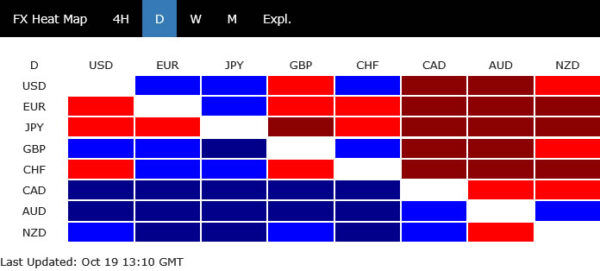
This multi-asset divergence was clearly visible across the board. While the Australian dollar (AUD), Canadian dollar (CAD), and New Zealand dollar (NZD) occupied the upper echelons of the currency performance rankings, traditional safe havens like the Japanese yen (JPY) and the Swiss franc (CHF) lagged behind, leaving the US dollar sitting more comfortably in the middle. At the same time, major European stock indices suffered steep losses, with Germany’s DAX tumbling 1.29%, France’s CAC 40 shedding 1.44%, and Britain’s FTSE 100 dropping 1.21%. Commodities also presented a mixed picture, with crude oil retreating from recent highs while industrial metals traded unevenly. This fragmented landscape reinforces the view that the day’s currency movements are driven by localized fundamental drivers rather than an overarching improvement in global risk appetite.
Aussie Surges on Stronger China Growth and Persistent RBA Tightening Prospects
The Australian dollar emerged as the standout performer among major currencies, extending its advance not just against the greenback, but also outperforming the euro, the Canadian dollar, the New Zealand dollar, and the yen. These broad-based gains strongly suggest that domestic and regional developments are offering far more support to the Aussie than the general macroeconomic environment alone.
A primary catalyst for the Australian currency came from the latest batch of economic data out of China, which pointed to firmer-than-expected economic momentum. China’s third-quarter GDP expanded by 4.5% year-on-year, beating the 4.4% forecast and improving upon the previous reading of 4.3%. Accompanying figures showed September retail sales rising 1.1% year-on-year, outpacing the 0.5% expectation and a meager 0.4% prior print. Meanwhile, industrial production increased by 5.5% annually, beating both the 5.4% forecast and the previous month’s 5.2%. While these indicators highlight a healthier economic rhythm, analysts noted that persistent weaknesses in China’s property and fixed-asset investment sectors continue to cap the overall breadth of the recovery.
Adding further wind to the Aussie’s sails were hawkish undertones from domestic monetary policymakers. Comments from Reserve Bank of Australia Assistant Governor Christopher Kent challenged the prevailing market conviction that the central bank’s interest rate tightening cycle has definitively ended. Kent acknowledged growing evidence that neutral interest rates are rising both domestically and globally, a dynamic that could render the current 4.60% cash rate less restrictive than previously assumed. He characterized monetary policy as "somewhat restrictive," while publicly questioning whether the current degree of restraint is entirely sufficient to anchor inflation over the medium term.
At the same time, Kent was careful to balance his remarks by acknowledging that Australia’s labor market is loosening at a pace faster than the RBA had initially anticipated. Official figures showed employment dropping by 39,300 in September, driving the unemployment rate up to a five-year high of 4.7%. This sudden labor market deterioration has tempered expectations for an immediate back-to-back rate hike, yet Kent’s assessment has ensured that the possibility of further tightening cannot be entirely dismissed by investors.

Financial markets are currently pricing in a modest 25% to 30% probability of another interest rate increase at the upcoming November policy meeting. While a rate hike remains outside the baseline market consensus, the tail risk is meaningful, particularly if upcoming domestic data points surprise to the upside. Attention will now turn squarely to Australia’s quarterly consumer price index report scheduled for release on October 28, which will serve as the ultimate litmus test ahead of the RBA’s November meeting.
Canadian Dollar Holds Ground Despite Softer Core Inflation and Energy Support
The Canadian dollar also displayed notable resilience, outperforming many of its peers despite receiving a mixed signal from domestic inflation data. Canada’s headline consumer price index for September accelerated slightly from 3.0% to 3.1% on an annual basis, though this came in just below the consensus forecast of 3.2%. More significantly for monetary policy, all three of the Bank of Canada’s preferred core inflation measures softened. The trim-mean measure eased from 1.9% to 1.8%, the median gauge fell from 2.0% to 1.9%, and the common core metric dropped from 2.6% to 2.4%, with every single indicator undershooting economists’ predictions.
The divergence between headline inflation and underlying core pressures was almost entirely driven by the energy sector. Gasoline price inflation jumped sharply from 22.8% to 27.8%, lifting overall energy inflation from 15.4% to 19.0%. Conversely, when excluding gasoline, the broader CPI slowed from 2.4% to 2.2%, reinforcing the broader narrative of moderating underlying price pressures despite the headline acceleration.
The loonie experienced a fleeting knee-jerk depreciation following the data release, but the sell-off was remarkably contained. The USD/CAD exchange rate drifted higher from approximately 1.4077 to 1.4105, moving in tandem with a modest strengthening of the broader US dollar index. Crucially, Canadian government bond yields did not experience a commensurate downward correction, signaling that the inflation miss did not trigger an immediate, widespread reassessment of the Bank of Canada’s interest rate trajectory.
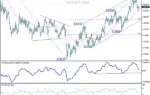
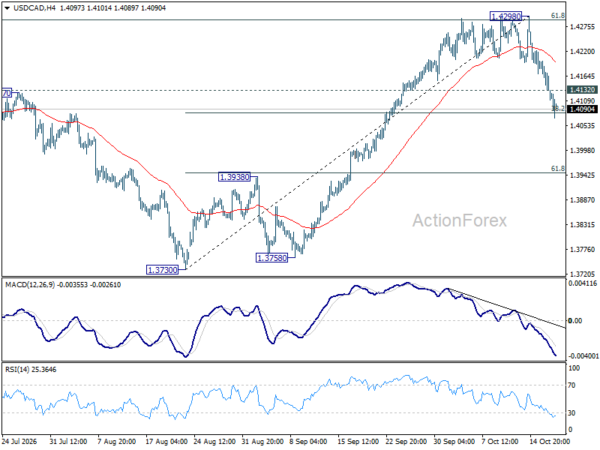
From a technical perspective, USD/CAD has been testing the 38.2% Fibonacci retracement level of the larger upward move from 1.3730 to 1.4298, located at 1.4081. The pair has managed to find considerable support around this technical floor, as softer core inflation restricts further downside momentum without validating a convincing bullish reversal for the greenback.
Beyond domestic data, the Canadian dollar continues to draw structural support from elevated global crude oil prices. Even though Brent crude pulled back on Monday, the substantial gains accumulated over preceding weeks remain a powerful tailwind for Canada’s energy-exporting economy. With the Bank of Canada widely anticipated to hold interest rates steady at its upcoming policy meeting, currency traders are weighing whether moderating core inflation will eventually weigh more heavily on the loonie, or if commodity-related inflows can sustain its current resilience.
Oil Pulls Back While Retaining Its Broader Geopolitical Risk Premium
Crude oil prices softened during Monday’s session, yet the pullback failed to erase the substantial rally registered over the previous week. The recent resurgence in energy prices had been heavily fueled by mounting anxieties over potential global supply disruptions. Lingering Middle East tensions continue to command a significant geopolitical risk premium, underscored by persistent security incidents involving shipping lanes around the Strait of Hormuz, threats to critical energy infrastructure in Saudi Arabia, and renewed drone and missile strikes against Russian refining and export facilities.
Monday’s downward correction in oil prices reflected competing market narratives, specifically the prospect that additional Russian crude could gradually find its way back into international markets should adjustments be made to existing US sanctions and trade measures. Consequently, the global oil market is currently caught between the persistent threat of supply bottlenecks and the offsetting possibility of improved export availability, failing to deliver a definitive directional trend for the broader commodity complex.
For the Canadian dollar, this nuanced dynamic is of paramount importance. While elevated crude valuations provide a healthy macroeconomic cushion, any prolonged weakness in oil prices could gradually erode that advantage. The loonie’s ability to maintain its ground in the face of softer domestic core inflation is impressive, but long-term strength will ultimately depend on broader macroeconomic drivers beyond last week’s energy-led surge.
French Bond Yields Approach 5% as Political Volatility Weighs on the Euro
While commodity-linked currencies enjoyed a supportive start to the week, the European economic landscape presented a more cautious and fragile picture. The euro remained under moderate selling pressure, with the EUR/USD pair hovering near 1.1212, marking a decline of roughly 0.24%. Adding to the single currency’s woes, political and social unrest in France over the weekend injected fresh uncertainty into an already fraught fiscal situation just as the government prepares to tackle critical budget negotiations.
Large-scale demonstrations protesting the cost of living and educational reforms escalated into violent clashes in several major French cities, resulting in over 2,000 arrests and widespread property damage. In response, President Emmanuel Macron called for urgent consultations with student leaders, teachers, labor unions, and business representatives, while simultaneously promising a stricter crackdown on public disorder.
Financial markets reacted to the unrest less out of concern for its immediate economic disruption and more because of what it portends for the government’s fiscal consolidation plans. France’s minority government is already locked in a difficult battle to balance mounting public spending demands with aggressive deficit-reduction targets. Heightened political friction risks derailing the legislative budget process, thereby reinforcing the sovereign risk premium demanded by investors holding French debt.
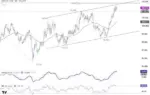
Reflecting this anxiety, France’s 10-year government bond yields have been pressing toward the critical 5% threshold, trading near 4.88% and testing the upper boundaries of their recent consolidation range. These yields remain firmly entrenched well above their 55-day exponential moving average, highlighting a steady deterioration in market sentiment toward French sovereign debt that has been building since the summer months.
The yield spread between French OATs and German Bunds hovered around 145 basis points, indicating that bondholders continue to demand a substantial risk premium for holding French debt over safer German equivalents. A decisive breakout above the 5% threshold in French 10-year yields would serve as a powerful warning sign that capital flight and selling pressure are intensifying, especially if accompanied by a further widening of the sovereign spread.
Immediate tests for French assets loom large, with the National Assembly scheduled to vote on the revenue portion of the 2027 budget, followed closely by a rating review from Moody’s regarding France’s Aa3 sovereign rating, which currently carries a negative outlook. Any political setbacks or an unfavorable credit rating downgrade could amplify downward pressure on French assets, whereas any legislative progress through the budget process would offer a welcome window for market stabilization.
Ultimately, Monday’s foreign exchange market behavior underscores a landscape driven by idiosyncratic, localized developments rather than a unified global macroeconomic trend. The Australian dollar is advancing on the back of resilient Chinese growth metrics and potential RBA tightening, the Canadian dollar is holding firm supported by historical energy gains, and European markets are grappling with distinct political and fiscal headwinds. This deep divergence between selective currency outperformance and European financial fragility strongly suggests that the session should not be misconstrued as a broad-based revival of global risk appetite.