



If you want to understand why the world’s central banks are aggressively stacking gold, the most straightforward approach is simply to ask a central banker. The answer points directly to mounting fiscal imbalances, escalating geopolitical tensions, and a growing distrust of sovereign debt instruments that have long served as the bedrock of the global financial architecture.
Global gold reserves expanded by another 39 tonnes over the course of a recent month, marking yet another chapter in a relentless buying spree that has now stretched across several years. According to Bundesbank President Joachim Nagel, this decisive shift away from traditional fiat-backed securities and toward physical bullion makes fundamental sense when viewed against the backdrop of rapidly expanding government debt loads worldwide.
The dynamics governing global reserve management have grown increasingly complex in recent months. On the surface, rising yields across sovereign debt markets have theoretically made bonds significantly more attractive to institutional investors and reserve managers alike. Yields on benchmark 10-year and 30-year U.S. Treasuries have climbed to levels not witnessed since 2001, creating formidable headwinds for precious metals like gold and silver. Historically, higher yields increase the opportunity cost of holding non-yielding assets such as bullion, putting downward pressure on prices.
However, Bundesbank President Nagel argues that the underlying reasons driving these yields higher should give careful bond investors severe pause. The forces pushing yields up are not merely a reflection of robust economic growth or healthy capital demand; rather, they are increasingly tied to systemic fiscal strain.
Elaborating on this shifting landscape in a speech delivered in Italy, Nagel pointed directly to the structural vulnerabilities currently plaguing the global bond market.
"The recent rise in global government bond yields has boosted the relative attractiveness of debt securities again," Nagel noted. "At the same time, rising debt levels have increased concerns about the credit risk of these assets. Furthermore, geopolitical risks are likely to continue to shape reserve management decisions."
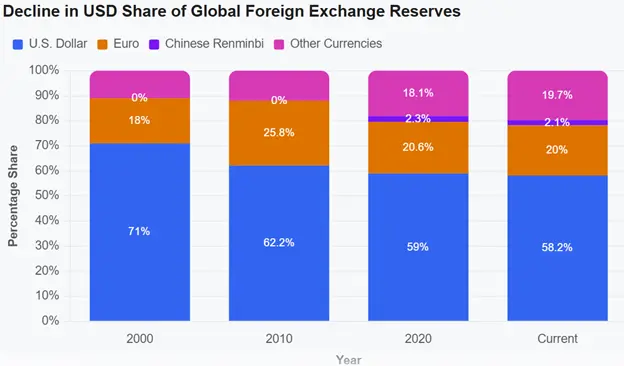
These mounting anxieties regarding soaring U.S. government borrowing and spending—compounded by an apparent lack of political will in Washington to address the structural deficit problem—are fueling a massive reallocation of capital. When combined with growing international worries over the weaponization of the U.S. dollar as a primary foreign policy and economic sanctioning tool, these factors are driving what financial pundits have increasingly dubbed "the debasement trade."
This burgeoning investment strategy emphasizes holding tangible, counterparty-free assets such as gold, silver, and other essential commodities to protect institutional and private wealth against the relentless debasement of fiat currencies and their steadily dwindling purchasing power.
Central banks are essentially leading the charge in executing this exact defensive playbook. By systematically limiting their direct exposure to U.S. Treasuries and aggressively stacking physical gold, monetary authorities are fundamentally reshaping global financial reserves. Earlier this year, this structural realignment was officially confirmed when the European Central Bank acknowledged that gold had officially overtaken U.S. Treasuries to become the top global reserve asset.
Financial analysts at Bloomberg have identified Russia’s invasion of Ukraine and the subsequent unprecedented western sanctions—particularly the freezing of foreign exchange reserves held in dollars and euros—as a major catalyst for the widespread adoption of the debasement trade. Those sanctions served as an unprecedented wake-up call for non-Western central banks, demonstrating the inherent vulnerabilities of holding sovereign debt within a Western-dominated financial infrastructure.
Addressing this paradigm shift, Bloomberg noted in its coverage that "more recently, growing worries about the U.S.’s growing debt load have fueled expectations that central banks could diversify away from the dollar and boost their gold holdings further."
Nagel echoed this sentiment during his remarks in Italy, concluding that given the ongoing weaponization of the global reserve currency and persistent U.S. fiscal malfeasance, "the case for further diversification into gold remains significant."
This perspective is far from isolated within the global central banking community. According to the latest comprehensive World Gold Council survey, central bankers overwhelmingly anticipate that global official gold reserves will continue to expand over the coming 12 months. Specifically, officials representing roughly 45 percent of the central banks surveyed confirmed that they plan to actively add to their existing reserves within the next year, signaling that the multi-year buying trend has considerable momentum remaining.
This sustained, institutional demand from central banks has played a crucial role in supporting the precious metals market, providing a solid technical and psychological floor even as higher bond yields have periodically hammered spot prices lower.
As Gold Newsletter publisher Brien Lundin explained regarding the mechanics of the current market environment, gold is undoubtedly facing temporary pressures from surging bond yields. However, Lundin emphasized that investors need to look deeper at the root causes behind those rising yields, noting that when examining the broader picture, "the message for gold becomes much more bullish."
This view is echoed by Morgan Stanley commodities strategist Amy Gower, who pointed out that gold’s remarkable resilience—maintaining a valuation near $4,000 per ounce despite a hostile environment of rising bond yields and a strong dollar—demonstrates that powerful underlying structural demand factors are firmly at work behind the scenes.
Valent Asset Management portfolio manager Jay Tatum offered a similar assessment, using a vivid metaphor to describe the current state of the precious metals market. Tatum likened gold to a compressed spring, held down by extraordinary external forces that would normally trigger a sharp correction.
"The temporary headwinds for gold are enormous and, in almost any other environment, would probably have pushed prices significantly lower," Tatum observed. "Prices are not lower because underlying factors are so strong."
As national debts continue to climb toward unprecedented heights and geopolitical fragmentation reshapes international trade and diplomacy, the structural incentives for central banks to favor tangible reserves over fiat-backed sovereign debt show little sign of abating. For the world’s premier monetary institutions, the transition away from traditional debt securities and toward the timeless security of gold has transformed from a speculative hedge into an essential strategy for financial preservation.