


Central banks across the globe are actively diversifying their foreign exchange reserves away from the U.S. dollar, marking a structural evolution in international finance that mirrors historic shifts in global economic power.
This process, widely known as dedollarization, involves a strategic economic shift where sovereign governments, central authorities, and major market participants intentionally reduce their reliance on the U.S. dollar for international trade, foreign exchange reserves, and bilateral transactions. For decades, the greenback has stood unchallenged as the world’s primary global reserve currency, serving as the foundational anchor for international commerce and financial stability. However, dedollarization occurs when countries progressively shift toward alternative currencies—such as the euro, the Chinese yuan, or various local currencies—or tangible assets like gold to settle international debts and store national wealth.
Nations typically pursue this strategic diversification due to a complex combination of geopolitical tensions, national security strategies, and macroeconomic factors. Chief among these catalysts is the weaponization of the U.S. dollar-denominated financial system. Actions such as freezing central bank foreign reserves or disconnecting targeted nations from the SWIFT international messaging network have powerfully incentivized sidelined or cautious economies to seek alternative payment rails and insulating financial structures.
Furthermore, relying entirely on a single foreign currency exposes global economies to domestic U.S. monetary policy decisions, persistent domestic inflation, and recurring political instability in Washington. As emerging market economies continue to grow and assert their economic independence, influential geopolitical blocks like BRICS are actively promoting the utilization of local currencies for cross-border trade. This concerted effort is designed to bypass unnecessary U.S. dollar conversion costs and mitigate exposure to external monetary shocks.
To accurately track the progress and trajectory of dedollarization, international economists and financial analysts measure the dollar’s share across three primary pillars: foreign exchange reserves held by central banks, global trade invoicing, and international debt and liquidity markets. While the U.S. dollar’s share in official central bank reserves has experienced a gradual, multi-decade decrease, it still maintains a dominant lead in global payments and trade transactions.
To understand the true nature of this financial phenomenon, financial experts emphasize the importance of recognizing what dedollarization is not. Rather than a sudden, catastrophic displacement of the U.S. financial system, it represents a slow, structural shift playing out over decades. The primary goal for most sovereign nations is financial diversification and strategic autonomy, not a complete ban on holding or trading in U.S. dollars. Additionally, no single currency currently possesses the deep liquidity, open capital markets, and robust legal protections required to fully replace the U.S. dollar as a singular global standard.
Historical Precedent
The most striking historical precedent for modern dedollarization is the monumental transition of the global reserve currency from the British pound sterling to the U.S. dollar during the course of the 20th century. For nearly a century, the British pound was the undisputed anchor of international commerce, trade, and finance. Its eventual displacement was not a sudden overnight collapse, but a gradual, multi-decade process driven by the devastation of war, shifting macroeconomic power, and heavy national debt accumulation.
By the late 1800s, Great Britain’s Industrial Revolution had firmly established London as the undisputed center of global trade and international finance. The vast majority of global trade was invoiced in pounds, and central banks around the world held their sovereign wealth in sterling because it was directly and reliably convertible to gold. Even though the domestic U.S. economy surpassed Britain’s in sheer size by the 1880s, the pound successfully maintained its premier reserve status for decades afterward. This historical reality highlights how economic inertia keeps a legacy currency dominant long after the issuing economy has been economically eclipsed.

The underlying structural shift began in earnest with the outbreak of World War I. To finance the massive expenditures of the war effort, Great Britain borrowed heavily from the United States, fundamentally transitioning from a global creditor nation to a heavily indebted debtor nation. While Britain was forced to temporarily suspend its gold standard to pay for wartime expenses, the U.S. dollar remained continuously tied to gold. By the mid-1920s, the U.S. dollar was openly competing with and occasionally surpassing the pound in official central bank reserve holdings across the globe.
World War II subsequently dealt the final economic blow to Britain’s expansive currency empire. Severely depleted by the immense financial and physical costs of the conflict, Great Britain could no longer sustain its costly global financial architecture, paving the way for the undisputed ascendancy of the U.S. dollar.
Structural Parallels and Modern Realities
There are several striking similarities between the mounting financial challenges facing the U.S. dollar today and the fragile conditions that triggered the historic decline of the British pound. However, there are also critical structural differences that make a total and immediate dollar collapse highly unlikely anytime soon. Economists point to clear, undeniable parallels in skyrocketing national debt and mounting geopolitical friction, balanced by one major divergence: the modern dollar currently lacks a clear, single successor currency comparable to how the U.S. dollar stepped in to replace the British pound.
Following the World Wars, Great Britain suffered from deep, intractable structural financial imbalances. Today, the United States is facing a massive, unprecedented expansion of its national debt, with gross federal debt exceeding $40 trillion and a gross debt-to-GDP ratio standing at approximately 126%. Furthermore, net interest payments on this national debt now consume nearly 15% of all federal spending, closely mirroring the debilitating fiscal strain that historically weakened the British pound sterling.
Just as the global economy once fragmented into the British-led Sterling Area and outside trading markets, modern geopolitics is witnessing a clear and growing divide. The weaponization of the dollar through aggressive financial sanctions—such as the unprecedented freezing of Russia’s central bank foreign reserves in 2022—has forced rival economic blocs like BRICS to aggressively build independent cross-border payment solutions to protect their national financial sovereignty.
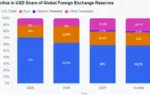
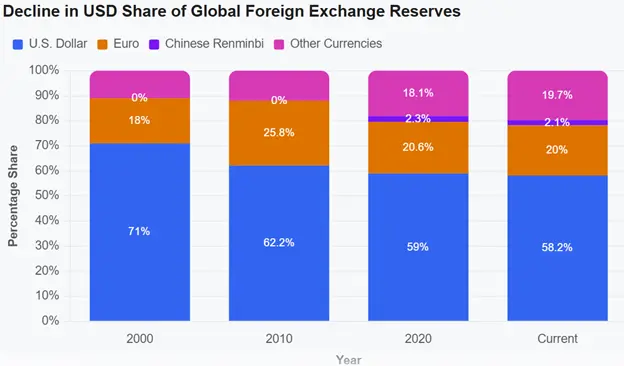
History shows that the pound did not vanish instantly from international use; rather, it steadily and gradually lost ground over many years. The U.S. dollar is currently tracking a remarkably similar pattern. Data from the International Monetary Fund’s Currency Composition of Official Foreign Exchange Reserves shows that the dollar’s share of global foreign exchange reserves now hovers at roughly 56.7%, down significantly from approximately 70% in the year 2000.
While these structural vulnerabilities align closely with historical precedents, the contemporary global financial landscape looks decidedly different in one vital way: the glaring absence of a single, scalable, and trusted alternative currency. Today’s underlying conditions match the internal fiscal decay that ultimately ruined the pound, driven primarily by unsustainable national debt trajectories and expansive geopolitical overreach. However, because the rest of the world currently has no trusted, highly liquid, single alternative to turn to, the ongoing erosion of the dollar remains a slow, fragmented drift rather than a sudden systemic displacement.