



Property taxes, a cornerstone of public finance that traces its origins back to the feudal era, continue to play a critical role in funding local government services across the globe. While early iterations of these levies were applied primarily to land and paid predominantly by agricultural workers, modern tax systems have evolved significantly. Today, property taxes are levied on a wide array of assets, most notably real estate, and are paid on a recurrent basis by individual property owners and legal entities alike. Despite their long history and widespread adoption, the structure, efficiency, and economic impact of property taxes vary dramatically from one jurisdiction to another, influencing everything from local development incentives to corporate investment decisions.
In theory, property taxes can serve as a valuable fiscal tool for local governments. By capturing the value generated by public investments—such as infrastructure, schools, and safety services—and capitalizing those values into property prices, these taxes provide municipalities with a reliable revenue stream. Furthermore, they can offer local authorities a financial incentive to permit and encourage new development. However, the design of the tax system matters immensely. When high property taxes are levied not only on the underlying land but also on physical buildings and structural improvements, they can inadvertently discourage investment. Because businesses must often pay additional taxes on these capital assets, steep property levies can distort economic behavior. Consequently, commercial enterprises frequently choose to locate away from high-property-tax jurisdictions, seeking out regions where the cost of doing business is more favorable.
International Comparisons and Economic Efficiency
An examination of property tax frameworks across 34 European countries reveals stark contrasts in how different nations approach the taxation of immovable assets. Among the countries reviewed, Liechtenstein and Malta stand out for not levying any recurrent taxes on property at all, offering a completely different fiscal landscape for property owners and businesses. Meanwhile, Estonia occupies a unique position on the European map by choosing to tax only the value of land rather than buildings and structures. By excluding physical capital improvements from its tax base, Estonia maintains a real property tax framework that is widely regarded as the most efficient among its peers, avoiding the disincentives associated with taxing productive structures.
Beyond the structure of the tax base, the treatment of business property taxes under corporate income tax regimes varies considerably and has profound implications for corporate investment. Of the 32 European nations that do levy property taxes, 28 allow businesses to deduct property or land taxes from their corporate income. This deductibility helps mitigate the overall tax burden on commercial enterprises, thereby encouraging continued capital investment. However, four countries—Austria, Iceland, Italy, and Slovenia—prohibit the deduction of property taxes from business income. This policy results in the double taxation of business properties, meaning companies in these jurisdictions are forced to pay taxes twice on the same dollar of income derived from or tied to these assets.
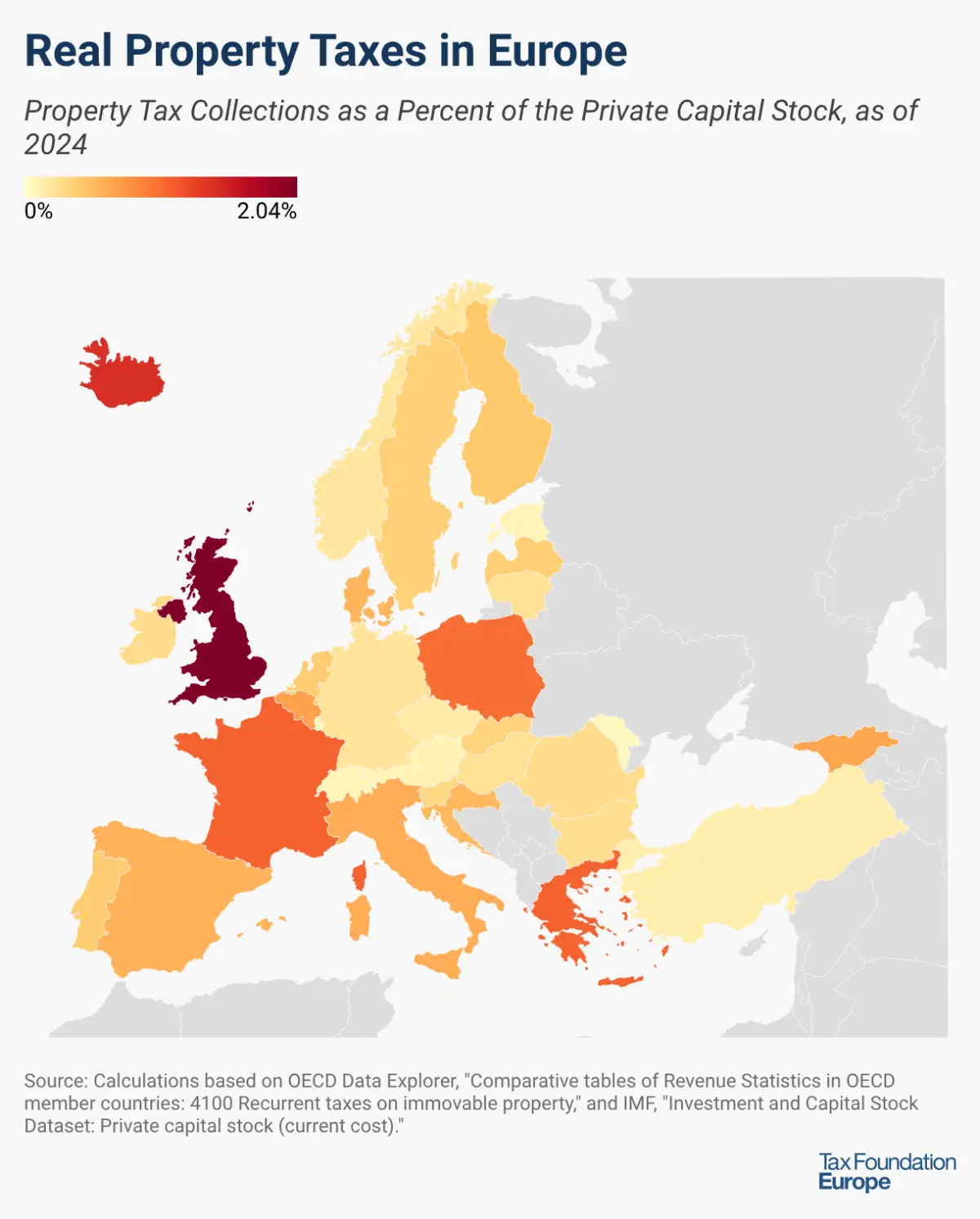
The revenue generated by recurrent property taxes also exhibits a wide dispersion when measured as a share of private capital stock. Luxembourg and Moldova record the lowest property tax revenues relative to their private capital stocks, hovering at approximately 0.05 percent. They are closely followed by Switzerland and Estonia, which collect 0.08 percent and 0.09 percent, respectively. At the opposite end of the spectrum, the highest property taxes as a share of private capital stock are found in the United Kingdom at 2.04 percent, followed by Iceland at 1.43 percent, and France at 1.08 percent.
When looking at broader regional averages, the 32 European countries that implement a recurrent property tax raise an average of 0.45 percent of their private capital stocks through these levies. This figure stands in sharp contrast to the United States, which collects a significantly higher proportion, raising 1.88 percent of its private capital stock in property taxes. In the United States, property taxes remain the single largest source of state and local revenue, serving as the financial bedrock for essential public goods such as local public schools, road maintenance, police departments, and emergency services.
When examining the distribution of the tax burden between households and businesses, data from the 16 European countries that track this breakdown reveals that households remit roughly 60 percent of total property tax revenue. However, the national experiences vary widely within this group. The share of property tax revenue paid by households ranges from a mere 7.4 percent of total receipts in the Slovak Republic to as high as 71.4 percent in France, reflecting vastly different domestic policy priorities and economic structures.
Recent Policy Changes
As economic conditions and fiscal needs evolve, several nations are actively reforming their property tax systems to improve fairness and efficiency. Germany, for instance, is devolving its property tax base to the state level. This administrative shift has already prompted individual states to rethink their approaches. Specifically, the German state of Baden-Württemberg utilized this newfound autonomy to restructure its framework, choosing to apply property taxes exclusively to the value of land, echoing the efficiency-driven model long championed by reformers.
At the same time, other European nations are expanding their tax bases to include new revenue mechanisms. Croatia introduced a brand-new recurrent property tax, designed to be levied directly on the physical dimensions of real estate, specifically targeting the square meters of land and floor area. These ongoing adjustments underscore a continuous global effort to balance the need for stable local government revenue with the economic imperatives of encouraging investment, supporting development, and maintaining a fair tax burden for both households and businesses.