



At 53 years old, a financial writer who had spent a lifetime making automotive compromises finally decided to purchase a car purely for the joy of it. What began as a routine maintenance stop evolved into a masterclass in market timing, personal finance alignment, and letting go of decades of scarcity-driven guilt.
During the peak of the COVID-19 pandemic in early July 2020, he paid $35,990 for a used 2019 Mini Countryman SE All4. Affectionately dubbing it the "Maxi Cooper," he viewed the compact SUV as a practical transportation choice. However, regret set in almost immediately. Intending originally to replace his aging 2004 Mini Cooper with a newer version of the same hatchback, he had allowed himself to be talked into a crossover vehicle instead.
For two years, he drove the Maxi Cooper and tolerated it. While acknowledging it was not a bad car by objective standards, it proved to be a poor fit for his personal driving style. Having always identified as a "small-car guy" rather than an SUV enthusiast, he found himself longing for the nimble agility of his youth.
Last month, he brought the Maxi Cooper to the dealership for a standard oil change. While waiting in the showroom, a representative unexpectedly offered to buy the vehicle back.
As observers of the automotive sector are well aware, the United States used-car market has experienced unprecedented volatility over the past several years. According to economic data from the U.S. Federal Reserve, prices for used vehicles surged 55% between July 2020 and mid-2022. While new vehicle prices also rose during that timeframe, the increase was a more modest 18%, driven by widespread manufacturing disruptions, supply chain bottlenecks, semiconductor chip shortages, and broader inflationary pressures.
Normally, used cars depreciate significantly the moment they leave the lot, following a gradual curve that historically made secondhand purchases a sensible financial strategy. However, pandemic-era economic anomalies inverted traditional depreciation curves, transforming used vehicles into surprisingly liquid and high-value assets.
As someone who writes about personal finance, he was well aware of elevated market valuations, but he had never considered liquidating his own vehicle after only 26 months. As a consumer who typically buys a car and drives it for a decade or more, the proposition initially caught him off guard. When the dealership offered $33,000 for a car he had purchased more than two years prior, his curiosity was piqued.
Seeking a professional second opinion, he consulted a trusted friend and former automotive salesman named Jeremy. When presented with the numbers, Jeremy did not hesitate. He described the offer not merely as a good deal, but as a financial miracle, equating the depreciation cost to leasing the vehicle for roughly $115 per month, and urged him to accept before the dealership reconsidered.
Unprepared to Purchase
Following the unexpected buyout offer, he immersed himself in automotive research, vowing to make a significant change: for the first time in his life, he was going to buy a model he genuinely wanted without making compromises.
Looking back at his automotive history, every vehicle purchase had involved some form of sacrifice. In his youth, the constraint was financial, limiting his choices to lower-priced options. In more recent years, compromises took the form of buying used, followed by purchasing a compact SUV instead of a dedicated sports car. This time, he wanted to bypass compromise entirely and acquire the exact vehicle he desired.
Because he had never planned to part with the Maxi Cooper, he had done zero preliminary research regarding a replacement. While most consumers determine their next vehicle before selling their current one, he found himself executing the process in reverse.
He briefly considered abandoning vehicle ownership altogether. He still owned a 1993 Toyota pickup—functional, if unsightly—and lived in Corvallis, Oregon, a small city with robust infrastructure for alternative transportation. Logging more than 20 miles of walking per week and utilizing a bicycle for longer errands, a car-free lifestyle was entirely viable. Alternatively, he could have sought out another 2004 Mini Cooper. Ultimately, however, he chose to leverage the unique economic moment to upgrade to a brand-new vehicle.
His ideal automotive profile remained anchored to a 2004 Mini Cooper, updated with modern technological conveniences. Because manufacturers no longer produced a vehicle matching that precise specification—modern Mini models having grown larger while seeing fluctuating customer satisfaction scores—he widened his parameters, though alternative favorites like the Audi A1 remained unavailable in the U.S. market.
A Very Short Search
His formal research phase lasted an intense 24 hours. Utilizing the Consumer Reports car finder tool—a preference-based selector—he generated a shortlist of recommended vehicles tailored to his driving habits and priorities.
The algorithm suggested five distinct models: the Kia Niro Electric, the Ford Mustang Mach-E, the Mazda MX-5 Miata, the Tesla Model 3, and the Hyundai Ioniq 5.
He systematically filtered the options. The Tesla was eliminated due to a high price point and mediocre reliability ratings. The Kia and Hyundai models were passed over due to lukewarm owner satisfaction scores. The electric Ford Mustang, much like his Maxi Cooper, was ultimately classified as an SUV rather than a traditional sedan or sports car, leaving the Mazda Miata as the standout candidate.
Drawn to the Miata for years due to its striking aesthetics, consistent top-tier professional reviews, and high owner satisfaction, the roadster checked the same experiential boxes as his preferred Mini Cooper. While Consumer Reports noted traditional drawbacks such as cabin noise, limited storage space, and a tight two-seat layout, these factors did not deter him. Professional reviewers praised the MX-5 for its nimble handling, direct steering response, mechanical intimacy, and high fun-per-dollar performance ratio.
Unable to find compelling reasons to reject the model, and influenced by enthusiast commentary highlighting the vehicle’s ability to deliver pure driving enjoyment, he locked in his decision.
Buying My Miata
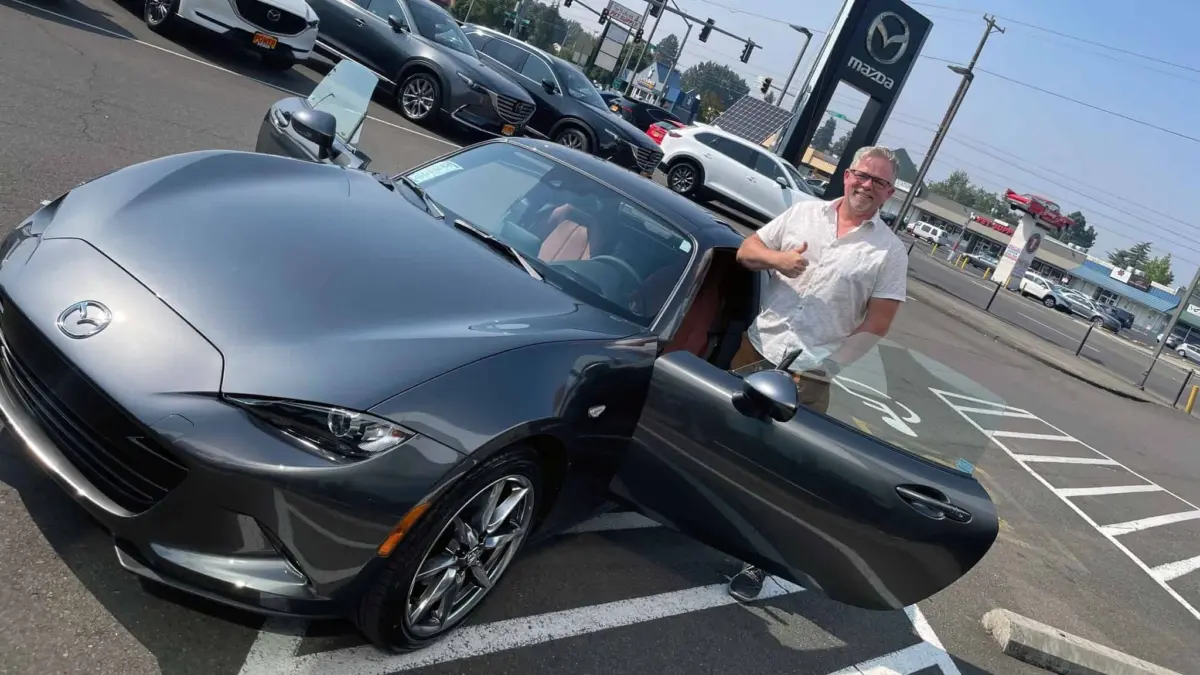
Departing from his usual cautious and deliberative decision-making style, he drove to a Mazda dealership in Salem on a Thursday afternoon in late August. Having coordinated ahead of time, a test vehicle was ready upon his arrival. Within fifty feet of leaving the dealership lot, he knew he wanted to buy the car, provided he could secure the $33,000 trade-in valuation for his Maxi Cooper.
After a brief test drive through local streets, he presented the salesperson with the written purchase offer from the Mini dealership. Management reviewed the documentation and agreed to match the $33,000 valuation.
Next came the challenge of securing the exact vehicle configuration. The lot featured several Miatas, but none matched his criteria: a gray exterior, a manual transmission, and a hardtop convertible roof. Pointing to an online listing for a vehicle currently in transit, he declined to purchase an in-stock alternative that featured red paint, an automatic transmission, or a soft top.
While the dealership maintained a mandatory market-adjustment markup bringing the sticker price to $39,245, he accepted the terms. A tentative agreement was reached without signing immediate paperwork, awaiting the arrival of the specific vehicle in transit.
Reflecting on the numbers during the drive home, he weighed the total cost against his lifelong habit of automotive compromise. Evaluating the choice simply—whether he would rather have the 2019 Maxi Cooper plus $7,000 in cash or a brand-new 2022 Mazda Miata—the decision became obvious. Seeking external validation, he consulted close friends and his partner, all of whom encouraged him to move forward with the purchase.
On the final day of August, the dealership contacted him to announce the vehicle’s arrival. With only five miles on the odometer—noted by the finance manager as the lowest delivery mileage seen in a thirty-year career—he finalized the transaction.
Taking the scenic route home from Salem to Corvallis along winding riverside roads and rolling farm hills with the top lowered, he experienced the open-air drive firsthand. Addressing long-standing feelings tied to growing up with financial scarcity, he recognized that purchasing a luxury item did not have to trigger guilt. Aligning with modern personal finance philosophies regarding intentional spending to build a rich life, the roadster became an unregretted addition to his daily routine.