




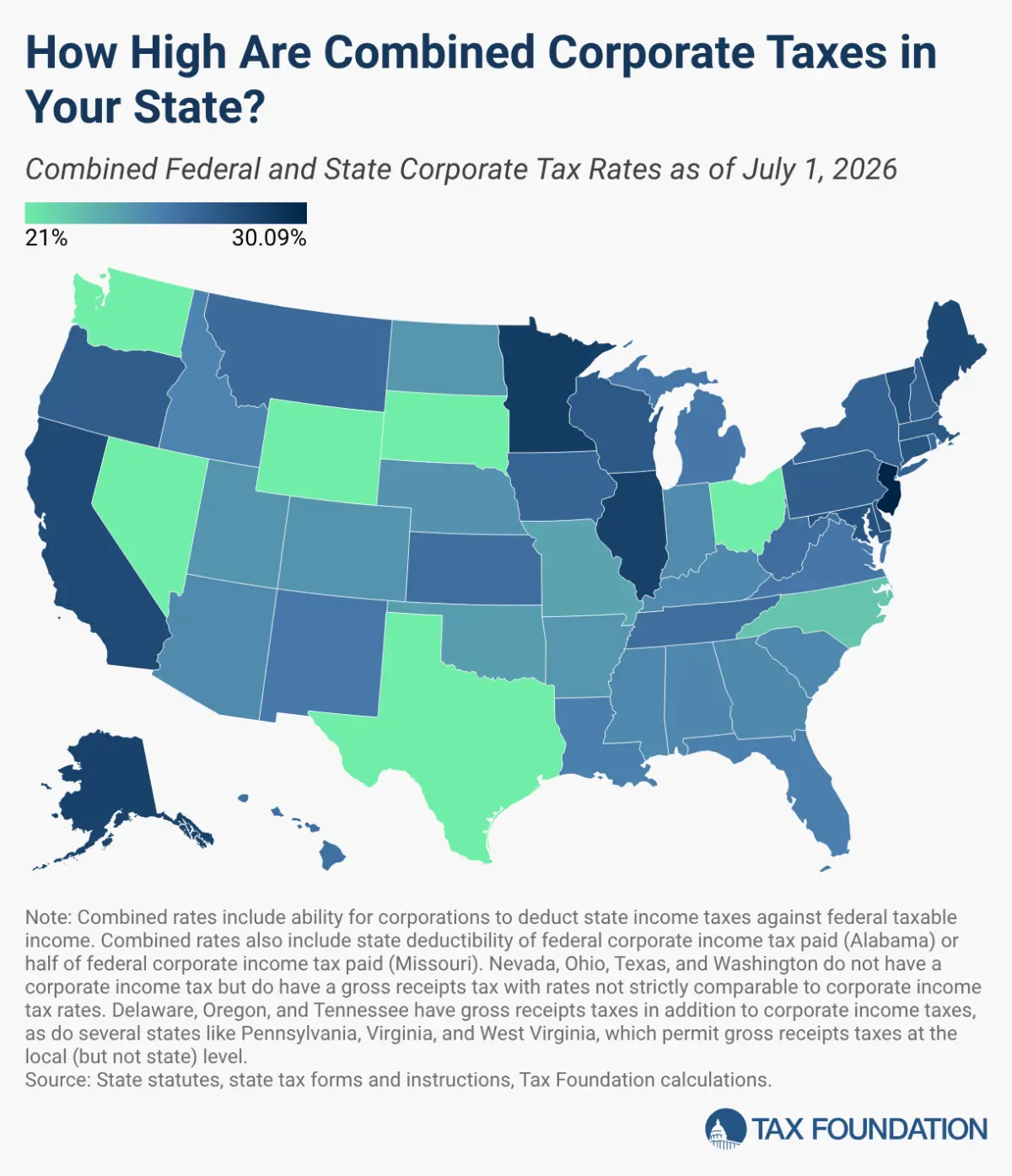
When corporations calculate their tax liabilities in the United States, they must navigate a complex, multi-layered system that combines federal mandates with a diverse array of state-level policies. At the core of this structure is the federal corporate income tax, which is levied at a flat rate of 21 percent. However, the total tax burden on businesses is rarely determined by the federal government alone. Forty-four states and the District of Columbia also impose taxes on corporate income, creating a patchwork of marginal rates, structural differences, and alternative tax mechanisms that vary significantly from one jurisdiction to the next.
The variation among state policies is substantial. Top marginal corporate income tax rates span a wide spectrum, starting as low as 2.0 percent in North Carolina and climbing as high as 11.5 percent in New Jersey. Within these jurisdictions, structural approaches also differ. Thirteen states utilize graduated corporate income tax structures, where rates increase as a company’s profits rise. Meanwhile, 31 states and the District of Columbia opt for a flat rate system, applying a single percentage to all taxable corporate income regardless of the firm’s overall earnings.
Adding to this complexity is the fact that not all states rely exclusively on traditional corporate income taxes. In Nevada, Ohio, Texas, and Washington, corporations are subject to gross receipts taxes instead of corporate income taxes. Gross receipts taxes are applied directly to a company’s total gross sales without allowing deductions for typical business expenses, such as employee compensation, the cost of goods sold, or overhead costs. Unlike a standard retail sales tax, a gross receipts tax is assessed on businesses and applies to transactions at every stage of the production process, a phenomenon economists refer to as tax pyramiding.
Other states adopt a hybrid approach. Delaware, Oregon, and Tennessee impose both a corporate income tax and a separate levy on gross receipts. Furthermore, some states introduce local-level complexity; Pennsylvania, Virginia, and West Virginia authorize gross receipts taxes at the municipal or county level, even though they do not levy them statewide. At the opposite end of the spectrum, two states—South Dakota and Wyoming—impose neither a corporate income tax nor a gross receipts tax, leaving businesses operating within their borders free from state-level taxes on corporate profits or revenue.
When federal and state policies are combined, the overall tax burden shifts dramatically depending on geography. The state with the highest combined corporate income tax rate in the nation is New Jersey, where businesses face an aggregate rate of 30.1 percent when factoring in federal obligations. Several other states push corporations toward similarly high combined burdens. In Alaska, Illinois, Maine, and Minnesota, corporations face combined corporate income tax rates at or above 28 percent.
Conversely, the six states that levy no state corporate income tax—Ohio, Nevada, South Dakota, Texas, Washington, and Wyoming—impose only the federal rate of 21 percent. It is worth noting, however, that four of these zero-income-tax states substitute other levies, such as statewide gross receipts taxes, which can still impose significant financial obligations on businesses depending on their industry and profit margins. Overall, when factoring in all states, including those that impose no corporate income taxes at all, the average combined state and federal corporate tax rate across the United States sits at 25.5 percent.
Calculating the final tax liability for a corporation also involves understanding how federal and state tax systems interact with one another. Under current rules, corporations are generally permitted to deduct state corporate income tax payments against their federal taxable income. This deduction effectively lowers the corporation’s effective federal tax rate. For example, a corporation subject to Rhode Island’s flat 7 percent corporate income tax may deduct those state tax payments against the 21 percent federal corporate income tax. This deduction reduces the effective federal rate to 19.53 percent, resulting in a combined overall tax rate of 26.53 percent.
In a few unique cases, the flow of deductions moves in the opposite direction. Two states allow corporations to deduct federal corporate income tax liabilities against a portion of their state corporate income tax obligations. Alabama stands out by allowing full deductibility of federal corporate income tax liability against state liability, while Missouri permits a 50 percent deduction of federal corporate income tax liability. These provisions serve to lower the effective corporate income tax rate faced by corporations operating within those specific states, offering a measure of tax relief that is absent in the rest of the country.
Analyzing these overlapping layers is essential for policymakers, economists, and business leaders seeking to understand the true cost of doing business in the United States. Economic research frequently points to corporate income taxes as one of the most economically damaging ways for governments to raise revenue. Because capital is mobile, high corporate tax burdens can influence where companies choose to invest, expand, or base their headquarters.
As states continually evaluate their fiscal health and economic strategies, reforming corporate tax structures remains a promising avenue for increasing regional competitiveness and fostering long-term economic growth. By streamlining tax codes, reducing top marginal rates, or eliminating cumbersome alternative levies like gross receipts taxes, lawmakers can create a more predictable and hospitable environment that ultimately benefits both companies and the workforce they employ.