



A Week of Three Tales
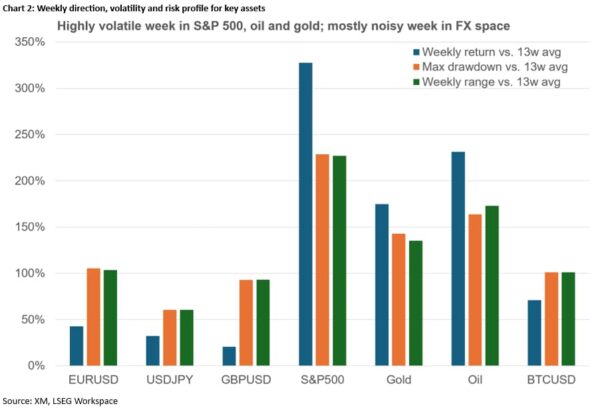
It has been a tumultuous week across global financial markets, defined by a rapid cycle of sentiment shifts. Initial market nervousness at the start of the week quickly gave way to a strong risk-on appetite on Wednesday. However, this optimism proved remarkably short-lived, as risk assets suffered a sharp reversal on Thursday. The catalyst for much of this volatility was the outcome of the United States midterm elections, where the Democratic Party performed exceptionally well, capturing control of Congress. This unexpected political shift has left investors scrambling to recalibrate their portfolios, though market participants note that it remains far too early to judge whether these emerging political and economic trends will persist over the long term.
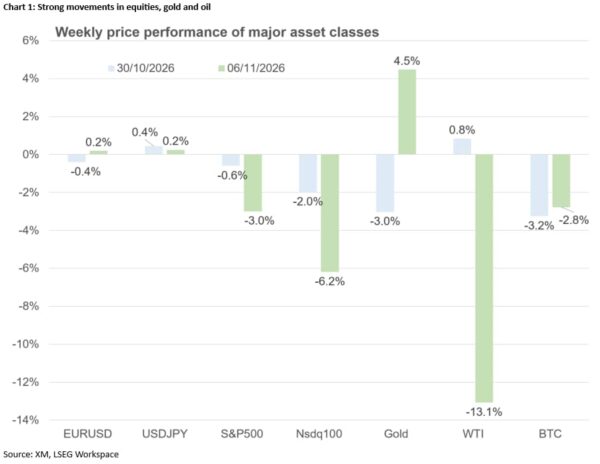
Equities, gold, and bitcoin saw some of the most pronounced reactions to the new political status quo in Washington. Initially, these assets managed to erase early-week losses and turned positive, bringing a temporary halt to three weeks of persistent declines. Soon, however, market angst took over the trading floors. The technology-dominated Nasdaq 100 index led a aggressive sell-off, severely underperforming the broader S&P 500 index. In contrast, European stock markets demonstrated notable resilience and strength, buoyed by investor expectations that a constrained political landscape might force President Trump to adopt a less aggressive domestic and international policy stance.
The post-midterm election rally in bitcoin appeared to fizzle out almost as quickly as it began. Investors are increasingly coming to terms with the Democratic Party’s historically cautious stance regarding cryptocurrency legislation and its broader skepticism toward rapid digital asset adoption. Meanwhile, despite Thursday’s downward correction, gold has managed to retain a significant portion of the rally it initiated on October 30. This price action has reconfirmed the critical psychological and technical importance of the $4,000 price level. Even so, both gold and digital assets continue to grapple with a combination of persistent legacy challenges and fresh macroeconomic headwinds.

On the commodities front, a sharp drop in oil prices found robust technical and psychological support in the $88 per barrel area. This stabilization was driven in part by a potentially misguided market belief that tariffs might be deployed less frequently by the administration going forward, and that the White House could be compelled to adopt a more conciliatory diplomatic stance regarding ongoing international conflicts.
The underlying thread connecting these disparate market movements has been the performance of the US dollar. Following an uninspiring month of October, the greenback started November on the back foot, underperforming major peers such as the British pound, the Swiss franc, and even the beleaguered euro. Nevertheless, despite declining sovereign bond yields during the week, soft overall risk appetite has historically tended to favor the safe-haven dollar. This dynamic has been further reinforced by decent market expectations for a Federal Reserve rate hike at the upcoming mid-December policy meeting.
Could the New Political Status Quo Bring About Developments in the Middle East?
The new balance of power in Washington could fundamentally alter President Trump’s foreign policy approach in the months ahead. Analysts are left questioning whether his newly limited political leeway will trigger a more appeasing, cooperative stance, or if he will remain undeterred in using aggressive foreign policy tools to advance American interests, even when it comes at the expense of traditional allies. For instance, market observers are wondering if protectionist tariffs might take a backseat as the administration decides to repair strained relationships with major trading partners such as Canada.
The most critical test of this shifting diplomatic strategy, however, will be the administration’s willingness and ability to help resolve ongoing geopolitical conflicts. While some incremental progress has been reported in Qatari-mediated talks between the US and Iran, a formal and lasting agreement remains elusive. Conversely, the situation surrounding the Russia-Ukraine conflict appears slightly more promising, with high-level trilateral talks scheduled for next week in Abu Dhabi. Despite these developments, market participants remain cautious, knowing that excessively high expectations could easily lead to disappointment, regardless of optimistic commentary from Washington.
Oil prices experienced a notable pullback following the midterm election results, but this downward momentum may prove short-lived unless concrete developments materialize on the ground to sustain the oil-negative trend. Simultaneously, central bankers around the world are monitoring energy prices closely, with December rate hike expectations for both the Federal Reserve and the European Central Bank edging lower in recent sessions. Notably, this dovish shift could accelerate if the decline in crude oil resumes, which would carry implications for the relative valuations of both the US dollar and the euro.
The Fed is Focused on Incoming Inflation Data
As policymakers digest the latest US labor market data—and with another crucial nonfarm payrolls report scheduled for publication ahead of the mid-December Federal Open Market Committee meeting—the Federal Reserve’s primary focus will squarely center on incoming inflation metrics. Specifically, markets are awaiting the release of the Consumer Price Index (CPI) and Producer Price Index (PPI) reports for October, alongside a flurry of scheduled commentary from central bank officials. Following a mandated quiet period during which most Fed members deliberately stayed on the sidelines to avoid the appearance of political interference during the elections, a heavy slate of public speeches is lined up for next week.
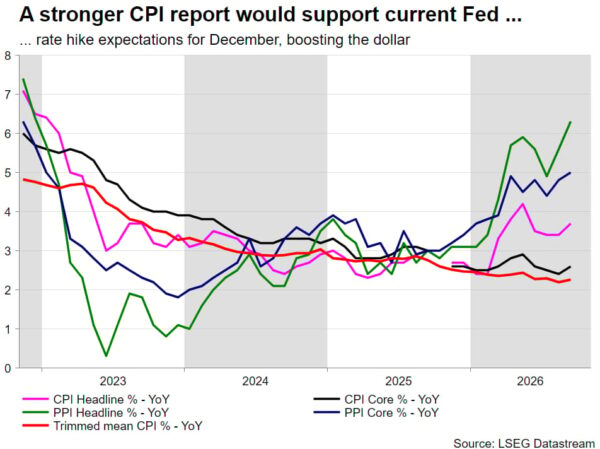
The steady deceleration in inflation rates that had been observed since the peak in May has begun to show signs of reversing, with both headline and core inflation metrics creeping upward in recent weeks. Given that oil prices rallied by roughly 15% in October—in sharp contrast to an equivalent drop recorded back in October 2025—there is a distinct possibility of an upside inflation surprise on Tuesday. A headline CPI reading registering above 4%, alongside a core indicator hovering near 3%, coupled with comparable surprises in the PPI data and hawkish rhetoric from central bankers, would significantly reinforce Federal Reserve rate hike bets and provide a substantial bullish catalyst for the US dollar.
Stock Market Weakness Could Persist
Domestically, the central question facing financial markets is whether President Trump will be willing or able to work constructively with Democrats now that opposition lawmakers hold the legislative keys to critical matters such as federal fiscal spending and healthcare policy. While the White House might ultimately choose bipartisan cooperation to support the broader domestic economy, political analysts widely anticipate that the next two years will be characterized by intense partisan friction, political attacks, and legislative vetoes that threaten to stall major policy initiatives from both sides of the aisle.
Artificial intelligence could emerge as a primary legislative battleground, given that the administration and congressional Democrats often maintain sharply conflicting priorities. The Democratic penchant for heavier regulation and strict oversight could directly impact the rapid buildup of energy-intensive data centers and potentially restrict domestic oil extraction efforts. Combined with lingering investor anxieties regarding long-term profitability, implementation timelines, funding sources, and the sheer cost of massive corporate investment plans, weakness in AI-related equities may linger. This sentiment is further underscored by the tech-heavy Nasdaq 100 index breaching key technical support below its 200-day simple moving average (SMA).
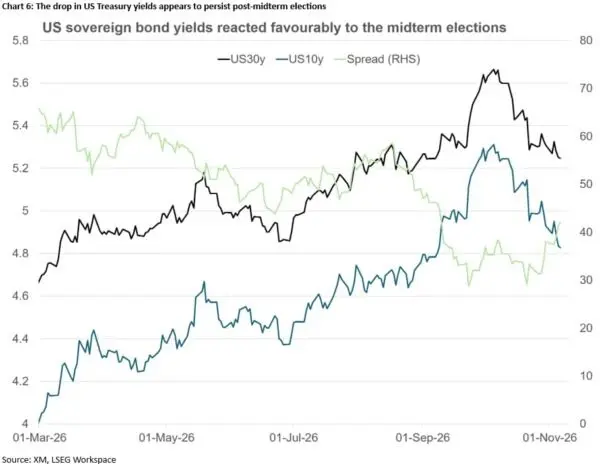
The evolving balance of power in Washington, shifting Federal Reserve rate expectations, broader market risk appetite, and prevailing trends in the oil market are all expected to heavily influence the upcoming early-month US Treasury auctions. Scheduled for the 3-, 10-, and 30-year tenors next week—and split by Wednesday’s bank holiday—these debt auctions represent a critical gauge of investor sentiment. With the 10-year Treasury yield falling sharply below the 5% threshold, demand at these auctions will act as a double-edged sword. Strong domestic demand could signal pervasive risk aversion, whereas weak demand might indicate a deeper investor reluctance to accept lower yields, thereby exposing underlying anxieties regarding the trajectory of the US fiscal situation.
Could Dollar/Yen Break Out of Its Current Range?
Since mid-September, the USD/JPY exchange rate has remained largely confined to a familiar trading range, with intermittent bouts of dollar strength and weakness ultimately failing to trigger a decisive breakout. A combination of a potentially tighter fiscal stance, lower global energy prices, softer US macroeconomic data prints, and dented Federal Reserve rate hike expectations could exert downward pressure on the greenback.
Simultaneously, expectations for a Bank of Japan rate hike may linger, supported by the tangible economic benefits that lower energy costs offer the Japanese economy through boosted consumer spending, alongside ongoing fiscal stimulus measures. A sustained break below the 156.74 technical level would open the door for a subsequent move toward the 155.00 handle, particularly if central bank doves appear to dominate the narrative during next week’s scheduled
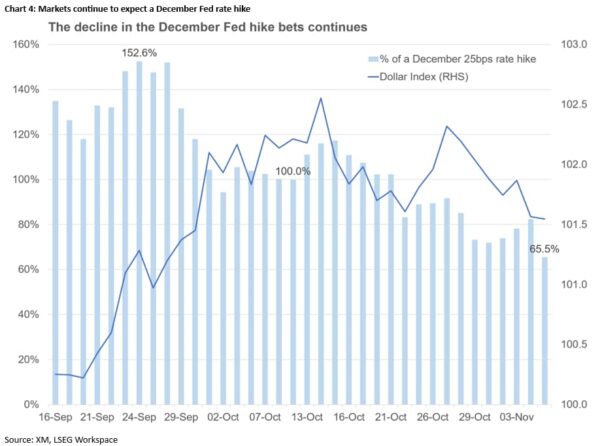
commentary from Federal Reserve officials.
Is Gold Primed for a New Bullish Trend?
Gold prices quickly capitalized on the new political status quo in the United States, climbing sharply toward the $4,150 per ounce mark on increasing market speculation that the country may be heading toward a more fiscally responsible administration. Although gold’s broader short-term trend has faced headwinds due to elevated real yields and a generally resilient dollar, a decisive move above the $4,280 level—which represents a 50% Fibonacci retracement of the August-to-October slide—would pose a significant challenge to gold bears. Should bullish momentum persist, the ultimate technical target for market buyers remains the 200-day simple moving average currently situated around $4,470.